Folding@Home; Longevity Team
Live Forever
28 Oct 2007
Professor Pande of Stanford's Folding@Home was interviewed by DL TV.
From the FAH blog:
The interview is about seven minutes in length.
To see the interview without watching the whole program:
- click the DL link
- then click to see video,
- then click the smaller window lower in the display labeled Folding@Home
A commercial of about one minute plays, then the interview.
The DL link
It is pretty good. The guys at DL.TV are contributors.
Looks like the second part of the interview has now been posted to the dl.tv site. (starts at about the 23:30 mark)
maestro949
28 Oct 2007
They used to change positions with the season.
That's funny but it makes sense. I always fire up my farm in the winter. Every fall I usually buy a new rig or CPU upgrade and donate last year's to to the cause as I know I'll be sitting at the computer more hours through the winter months.
dnamechanic
28 Oct 2007
Pretty good!Live Forever -
... the second part of the interview has now been posted to the dl.tv site. (starts at about the 23:30 mark)
Good demo of a protein as it folds.
The ending is funny
"I'm not hydrophobic, I want to fold better."
LOL
Maestro with his computers, crunching for tomorrow in a warm computer room. Not bad!maestro949 - I always fire up my farm in the winter. Every fall I usually buy a new rig or CPU upgrade and donate last year's to to the cause as I know I'll be sitting at the computer more hours through the winter months.
maestro949
28 Oct 2007
Good demo of a protein as it folds.
Yes - that was very cool. To think that entire movie is probably a very small fraction of a second and required many thousands of computing hours to generate!
Maestro with his computers, crunching for tomorrow in a warm computer room. Not bad!
Here's my basement lair from where I plot world domination. 8 machines running down there now and 3 upstairs. I just added the shiny silver one to the left after upgrading my primary machine to an Opteron CPU.
dnamechanic
28 Oct 2007
Yes, to think of the orders of magnitude differences in time between the simulated and the simulators. Somewhat indicates where we are in the scheme of things.Maestro949 - Yes - that was very cool. To think that entire movie is probably a very small fraction of a second and required many thousands of computing hours to generate!
Some small proteins fold in 10 microseconds (10 millionths of a second). That protein in the DL.TV video didn't look very large to me, so for thinking purposes lets say it took 10 microseconds. Many of Stanford's simulations take 2-3 years to complete. Looks like right now Stanford F@H is running about 250 protein projects and about 250,000 CPUs. In the past there were fewer projects and fewer contributors. So lets say it takes 1000 CPUs two years to fold a protein.
That's:
(1000 computers x 2 years x 365 days/year x 24 hours/day x 60 minutes/hour x 60 seconds/min) = 6.3 X 10^10 computer-seconds per protein project
to simulate a protein that would in vivo fold in ten microseconds (0.00001 sec) = 10^ -5 seconds/fold
or, approximately sixteen orders of magnitude between simulation and reality (10^16).
Maybe the protein takes longer to fold, maybe the computers aren't running all the time, and maybe CPUs and PS3s are now much faster... So maybe one or two of the guesstimated numbers are off by a factor of ten.
Some info directly from Stanford:
A single computer can simulate a nanosecond in a day (one nanosecond = 1 ns = 10 x 10 -9seconds or billionth of a second).
Using those numbers:So using a single computer it will take about 30 years to simulate even the fastest folding protein.
1 computer x 30 years x 365 days /year x 24 hrs/day x 60 min/hr x 60 sec /min = 9.5 x 10^8 computer-seconds/fold
to simulate protein that would in vivo fold in ten microseconds (0.00001 sec) = 10^ -5 seconds/fold
or, approximately fourteen orders of magnitude between simulation and reality (10^14).
The gap is telling.
There is much remaining to do...
Nice photo and nice setup Maestro. Its kind of like what I imaginedMaestro949 - Here's my basement lair from where I plot world domination. 8 machines running down there now and 3 upstairs. I just added the shiny silver one to the left after upgrading my primary machine to an Opteron CPU.
What was your deciding factor on the Opteron?
I appreciate AMD products; they certainly help keep Intel in an innovative mode. Hope the upcoming AMD quad "Phenom" is a lightening-fast number cruncher.
A941
29 Oct 2007
My F@H name is Administrator!
Not my idea, this was created by my Os :-)
dnamechanic
29 Oct 2007
maestro949
29 Oct 2007
There is much remaining to do...
Indeed. When you crunch the numbers it can look grim. To further the bleakness, in a recent Nature magazine article David Baker mentioned that he didn't think molecular dynamics simulations would ever replace x-ray crystallography as the best means for determining a protein's structure. [huh]
What was your deciding factor on the Opteron?
Time. Pop chip out, pop chip in. My MB could take a Socket 939 cpu and this was the best one available. When the cost of the quads are reasonable I'll consider jumping to one of those but at this point, I really don't need the horsepower as all the software tools I use are screaming fast already.
That said, it makes me wonder, what is going to drive the market for continued exponential growth in PC CPUs if the majority of gaming is moving to consoles?
Live Forever
29 Oct 2007
I am not a big gamer, but I do realize it drives the production of faster chips. Is there clear evidence that the PC gaming market is falling dramatically? (there may be, but I thought the gaming industry as a whole was on the incline)That said, it makes me wonder, what is going to drive the market for continued exponential growth in PC CPUs if the majority of gaming is moving to consoles?
I suppose the new gaming consoles will push for faster chips, which will also go into PCs. (or some version of the same chip) I am hoping lots of other stuff, like self driving cars and things start pushing for more and faster CPUs in the near future.
Live Forever
29 Oct 2007
Several thousand.How many teams are there?
Several hundred thousand. (I saw the stats page say over 500,000 registered user names, but lots of those have never been active)How many members over all F@H has?
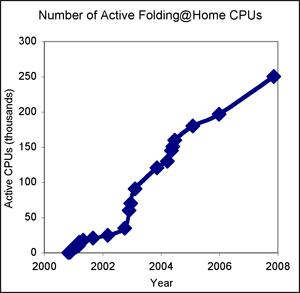
The more interesting stat is how many total CPUs have contributed to the project, and how many are currently active. ("active" meaning having produced a work unit in the last several days) http://fah-web.stanf...y?qtype=osstats
Currently sitting at slightly more than 250,000 active CPUs total, which is something that has steadily risen (active CPUs) since the start of the project (Note the total processing power has jumped tremendously faster than this, this graph is just active CPUs):
dnamechanic
29 Oct 2007
I don't know.A941 - How many teams are there?
Looks like Kakaostats tracks 13,730 teams.
Extreme Overclocking tracks the top 2,000 teams.
Don't know that number either. Stanford tries to track the number of contributing CPUs using various means. But one individual can contribute with many CPUs, so the number of individuals contributing is likely less than the number of CPUs.How many members over all F@H has?
According to this Stanford, here:
Over the last seven years or so, approximately 2,520,061 CPUs have contributed.
The current number of active* contributors is: 254,423
*Active CPUS are defined as those which have returned WUs within 50 days
Live Forever
29 Oct 2007
Unless they are GPUs (10 days) or PS3s (5 days).*Active CPUS are defined as those which have returned WUs within 50 days
Side note: GPUs + PS3s only account for about 15% of the active CPUs, but more than 80% of the work load currently being completed.
maestro949
29 Oct 2007
I am not a big gamer, but I do realize it drives the production of faster chips. Is there clear evidence that the PC gaming market is falling dramatically? (there may be, but I thought the gaming industry as a whole was on the incline)
There has been some decline and it's demise has been predicted for quite a while but it seems to be hanging on at the moment. The one telltale sign that I see is the fact that gaming stores carry less and less PC titles compared to console titles. The two nearby stores have both whittled the PC section down to a single shelf of PC games.
A941
29 Oct 2007
Live Forever
29 Oct 2007
You are probably right. It seems like PC games are trending more to the MMOG types of games. (World of Warcraft, etc.)I am not a big gamer, but I do realize it drives the production of faster chips. Is there clear evidence that the PC gaming market is falling dramatically? (there may be, but I thought the gaming industry as a whole was on the incline)
There has been some decline and it's demise has been predicted for quite a while but it seems to be hanging on at the moment. The one telltale sign that I see is the fact that gaming stores carry less and less PC titles compared to console titles. The two nearby stores have both whittled the PC section down to a single shelf of PC games.
Live Forever
29 Oct 2007
There have been fifty research papers published, which is more than all the other distributed computing projects combined. (by a large margin in fact) I would say most of the promise lies in the future, though, and the breakthroughs that are to come.What have they achieved till today, is there anything what could be of use or are they still waiting for the big thing to appear?
dnamechanic
29 Oct 2007
Haven't read the article, but naysayers are frequently wrong.Maestro949 - ... in a recent Nature magazine article David Baker mentioned that he didn't think molecular dynamics simulations would ever replace x-ray crystallography as the best means for determining a protein's structure. [huh]
For example, aeronautics engineers used to say nothing could replace wind tunnel testing for airframes (a hugely expensive undertaking). In a sense they were wrong.
The wind tunnel still has a place but now computer simulations can carry much of the load.
It is important to understand when the *best* is the enemy of the *good*.
Yes, timeTime. Pop chip out, pop chip in.
Interesting question. I tend to agree that computer performance has been driven by the needs/wants of gamers.... what is going to drive the market for continued exponential growth in PC CPUs if the majority of gaming is moving to consoles?
Didn't realize that gamers were wholesale moving to consoles. But, it is understandable. For example the PS3 that has been discussed here. Current games are not yet fully utilizing its power. And its processing power is increasing, already the 65 nm version of the PS3 cell processor is showing up in the marketplace. This 65nm version is reportedly capable of more than 5 GHz clock rate. Although it will probably run for some time at current rate which I believe is 3.2 GHz.

On the other hand, AMD is pushing for 'Fusion', a combination of GPU and CPU on same chip die. Some indications are that this was the primary motivation for AMD to acquire ATI. Reportedly Intel will so something similar.
Maybe there will develop a stiff competition in the marketplace between computers and game consoles.

If AMD were to stumble, this could turn out be the only major competition that Intel would have.
niner
30 Oct 2007
Crystallography has some problems. You need a significant quantity of the protein, it has to be clean, and you have to coax it into growing a crystal. None of that is easy, especially the last one. Then you need some very specialized equipment to collect diffraction data, and finally, the computation and modelbuilding involved in solving the phase problem is not at all trivial. Also, proteins do not function in the cell while in the crystal phase. Crystal packing forces can be huge, and may distort the true picture of structure and dynamics. Getting the structure of a protein in a tricky environment, like embedded in a membrane, is a major challenge. I'll hazard a guess that David Baker is a crystallographer.... in a recent Nature magazine article David Baker mentioned that he didn't think molecular dynamics simulations would ever replace x-ray crystallography as the best means for determining a protein's structure.
Haven't read the article, but naysayers are frequently wrong.
For example, aeronautics engineers used to say nothing could replace wind tunnel testing for airframes (a hugely expensive undertaking). In a sense they were wrong.
The wind tunnel still has a place but now computer simulations can carry much of the load.
It is important to understand when the *best* is the enemy of the *good*.
That said, he is almost right. Instead of "ever", I'd say "in a really long time". I can't begin to speculate exactly how long, but I doubt that any crystallographers practicing today need to worry about early retirement. Essentially we need to have really superb force fields (the equations that describe molecular energies as a function of atomic coordinates) and we need to be able to simulate systems with sufficient water and counterions to be realistic. The simulations need to be long enough to cover the amount of time it actually takes to fold the protein, and long range electrostatics need to be handled properly. Various heuristics and hacks may help a lot.
Computational Fluid Dynamics as a wind tunnel replacement is orders of magnitude simpler than MD computation of protein structure. That doesn't mean that protein structure computation is impossible; we have a way forward, but it will take many years.
dnamechanic
31 Oct 2007
Welcome Administrator.Done! My F@H name is Administrator!
You are the 191st contributor to join The Longevity Meme F@H team.
Thank you.
------------------------------------------------------------------------------
Selected Stats at the Extreme OC site:
Current active contributors - 32
Total work Units completed - 21,944
Total Points (accumulated) - 5,456,979
Points per Day (Avg. ppd) - 15,323
Team Rank - 212
Live Forever
07 Nov 2007
Here is the page for it (you have to click where it says "here" to start, and then continue on with the arrows on through the presentations):
http://fah-web.stanf...lets/index.html
via: http://folding.typep...n-youtube-.html
dnamechanic
07 Nov 2007
You are the 192nd contributor to join The Longevity Meme F@H team.
Thank you.
------------------------------------------------------------------------------
Selected Stats at the Extreme OC site:
Current active contributors - 38
Total work Units completed - 22,211
Total Points (accumulated) - 5,572,794
Points per Day (Avg. ppd) - 16,745
Team Rank - 214
Icie Jennifer
12 Nov 2007
It says:
Name PS3
Team 0
Live Forever
12 Nov 2007
"Press triangle while in the visual client to change your username and team number."I just set up the PS3, but it didn't let me chose a team. Is that normal?
It says:
Name PS3
Team 0
according to the PS3 FAQ.
Icie Jennifer
12 Nov 2007
Thanks!
Donor
Name Jimmy Adams
Team 32461
Completed 1 Work Units
s123
12 Nov 2007
Welcome Sven.
You are the 192nd contributor to join The Longevity Meme F@H team.
Thank you.
------------------------------------------------------------------------------
Selected Stats at the Extreme OC site:
Current active contributors - 38
Total work Units completed - 22,211
Total Points (accumulated) - 5,572,794
Points per Day (Avg. ppd) - 16,745
Team Rank - 214
Thanks
I have already completed 2 WUs.
dnamechanic
12 Nov 2007
Indeed!I have already completed 2 WUs.
Sven, you have moved up 30 places in The Longevity Meme team rank.
Much appreciated.
dnamechanic
13 Nov 2007
Yes, you did!I found it. Thanks!
Welcome Jimmy Adams.Donor Name: Jimmy Adams
Team 32461
Completed 1 Work Units
You are the 193rd contributor to join The Longevity Meme F@H team.
Thank you.
------------------------------------------------------------------------------
Selected Stats at the Extreme OC site:
Current active contributors - 40
Total work units completed - 22,406
Total Points (accumulated) - 5,659,871
Points per Day (Avg. ppd) - 16,949
Team Rank - 210
dnamechanic
12 Dec 2007
You are the 194th contributor to join The Longevity Meme F@H team.
Thank you.
------------------------------------------------------------------------------
Selected Stats at the Extreme OC site:
Current active contributors - 38
Total work units completed - 23,501
Total Points (accumulated) - 6,140,422
Points per Day (Avg. ppd) - 17,437
Team Rank - 209
dnamechanic
13 Dec 2007
You are the 195th contributor to join The Longevity Meme F@H team.
Thank you.
------------------------------------------------------------------------------
Selected Stats at the Extreme OC site:
Current active contributors - 38
Total work units completed - 23,550
Total Points (accumulated) - 6,162,817
Points per Day (Avg. ppd) - 16,831
Team Rank - 208