←  Supplements

LONGECITY


The above is an ad! Advertisements help to support the work of this non-profit organisation. To go ad-free join as a Member.
»

ALT-711 (Alagebrium) and Atherosclerosis

Daniel Cooper's Photo Daniel Cooper 17 Mar 2016

There are studies that show that an AGE breaker like ALT-711 (Alagebrium) might be useful in treating atherosclerosis, most particularly in diabetics. 


Advanced glycation end product interventions reduce diabetes-accelerated atherosclerosis.

http://www.ncbi.nlm....pubmed/15220206


The advanced glycation end product-lowering agent ALT-711 is a low-affinity inhibitor of thiamine diphosphokinase.


The Effect of Alagebrium Chloride (ALT-711), a Novel Glucose Cross-Link Breaker, in the Treatment of Elderly Patients With Diastolic Heart Failure.

https://www.research...c_Heart_Failure


The effect noticed seems to be a reduction in arterial stiffness, which makes lots of sense given the proposed effect of breaking AGE crosslinks.  However, this seems to me to be a separate thing to reversing arterial plaques.


Does anyone believe that AGE breakers like ALT-711 have a role in reversing arterial plaques and if so is there evidence to back that up?  


Equally importantly, does anyone have any concern that a patient using ALT-711 with existing established arterial plaques might destabilize them, leading to plaque rupture?


Edited by Daniel Cooper, 17 March 2016 - 07:39 PM.
Quote

niner's Photo niner 18 Mar 2016

The first paper was in diabetic mice with an ApoE deletion that are particularly susceptible to atherosclerosis.  This is so different from a normal human that it's probably not going to be relevant to you, but perhaps more importantly, the effect was seen in animals that were being treated as their atherosclerosis developed, so it doesn't show that ALT-711 would work in the reverse direction on pre-existing atheromas.  Yet another monkey wrench in the works is the notion that mice have a lot more pentosidine, the crosslink that ALT-711 is said to break, than humans.  The more important crosslink in humans is glucosepane.


The third paper, on the other hand, shows a useful effect in humans.  Not specifically on atherosclerosis, but it suggests that maybe it's wrong for everyone to give up on ALT-711.  Maybe pentosidine is a bigger player in human aging (or pathology) than we thought, and we just weren't looking in the right place.  There are some papers showing that it has value in diabetic nephropathy, for example.


I doubt that it would cause a rupture, but I think that the likelihood of it helping much isn't high.

Quote

maxwatt's Photo maxwatt 18 Mar 2016

Vitamin K2 (as MK-7) reverses calcification of arteries and heart ventricles, and hence stiffness.  Not quite the same thing, but may be effective for your purposes. 


ALT-711 was at one time sold by an individual who had it synthesized in Italy, to a select group gathered on the internet.  But beyond a strong placebo effect, I cannot say any consistent effects were reported by those who bought it.    I don't know that the identity of the substances purporting to be ALT-711 was ever confirmed. And the substance was abandoned by Alteon when it disbanded.  It only worked on a limited class of AGE's.  Fine to maintain flexibility of rats' tails.  Humans' heart valves, not so much.

Quote

niner's Photo niner 18 Mar 2016

I think Alteon's problem with ALT-711 is that it didn't work for the blood pressure indication they were shooting for, and they either didn't have another indication ready or didn't have the cash to pursue it.   If they don't have a sufficiently lucrative indication, then the venture guys aren't interested.  It looks like the compound might still be worthwhile, given the right indication (like diabetic nephropathy or heart failure as described above).

Quote

Heisenburger's Photo Heisenburger 18 Mar 2016

I used to own 100 shares of Alteon. Last I checked (about 10 years ago) they were worth $.01/share. :blush:

Quote

Steve H's Photo Steve H 20 Mar 2016

It does not break existing glucosepane cross links that is the problem. It may slow rate of glycation acting as a sacrificial agent but we need something better.

I have access to synthesized glucosepane and we are looking at breakers currently.
Quote

Steve H's Photo Steve H 21 Mar 2016

I have access to glucosepane from Yale and we are looking for chemists to help find breakers. If you have a lab get in touch
Quote

Heisenburger's Photo Heisenburger 21 Mar 2016

I have access to glucosepane from Yale and we are looking for chemists to help find breakers. If you have a lab get in touch


Serious question—realistically, how much progress do you personally feel will be made in this area in the next twenty years? An intuitive guess would be sufficient.


Quote

Steve H's Photo Steve H 20 Apr 2016

Recently speaking with David Spiegel at Yale I would say not too long. He has informed me the lab at Yale has made some progress with antibodies so I am hoping we will have something to parallel test in the near future. 

Quote

Daniel Cooper's Photo Daniel Cooper 27 Apr 2016

Recently speaking with David Spiegel at Yale I would say not too long. He has informed me the lab at Yale has made some progress with antibodies so I am hoping we will have something to parallel test in the near future. 


This work on antibodies, I assume it is in regards to atherosclerosis?

Quote

Heisenburger's Photo Heisenburger 27 Apr 2016

This work on antibodies, I assume it is in regards to atherosclerosis?


That would be my own amateur guess as well. I think we’ll figure out how to reverse arterial stiffening before we figure out how to de-wrinkle skin. Which is fine by me. Having the former may be all we need to allow us to live long enough to eventually see the latter. My bucket-list goals are to live long enough to see humans land on Mars (and come home) and an atheist in the Oval Office.

Quote

Daniel Cooper's Photo Daniel Cooper 27 Apr 2016


This work on antibodies, I assume it is in regards to atherosclerosis?


That would be my own amateur guess as well. I think we’ll figure out how to reverse arterial stiffening before we figure out how to de-wrinkle skin. Which is fine by me. Having the former may be all we need to allow us to live long enough to eventually see the latter. My bucket-list goals are to live long enough to see humans land on Mars (and come home) and an atheist in the Oval Office.


By my understanding there are really two issues here with varying degrees of relatedness depending on who you ask:


1.) Loss of arterial elasticity, mainly caused by the formation of AGEs.  The solution here would seem to be AGE breakers, particularly breakers of glucosopane.


2.) Build up of of arterial plaques which led to ruptures and stenosis.  Using the body's immune system to "eat the plaque" would seem to be one potential approach to a solution.


There's probably some degree of overlap since AGEs may be a component of plaques as well.  But ideally you want to fix both problems.  I haven't heard of anyone looking at using an immune based approach to eliminating AGEs, so I was curious if that is what Steve was implying.

Quote

Logjam's Photo Logjam 16 Jul 2016

Something popped into my head the other day and I'm just curious what others think.  Is the reason ALT-711 never panned out as well in humans as it did in mice and primates (monkeys I think) simply a matter of time and as a function of that, the AGEs that form over that time period?  


1. Mice live only a few years, not 70.

2. Monkeys live maybe 15-30, not 70


In other words, it's not the fact that mice aren't humans and something metabolic or different about them.  It's that they don't live 70 years.


If glucosepane takes a longer time to form, then it isn't in the mice and monkeys in 5 years, but that means that taking ALT-711 chronically at a younger age may block the formation of various intermediates on the way to glucosepane.


Maybe it's that simple.  So then the reason to take it is ... why wait?


And may ALT-711 actually work if you take it chronically when you're younger?


Edited by Logjam, 16 July 2016 - 07:24 PM.
Quote

stefan_001's Photo stefan_001 24 Jul 2016

http://www.ncbi.nlm....pubmed/27402556


Alagebrium plus exercise had no synergistic effect on exercise LV function and failed to achieve levels associated with lifelong exercise despite a similar exercise frequency.


http://www.ncbi.nlm....pubmed/24400341

The use of the AGE-crosslink breaker Alagebrium had no independent effect on vascular function, nor did it potentiate the effect of exercise training. 


Edited by stefan_001, 24 July 2016 - 08:28 PM.
Quote

Logjam's Photo Logjam 25 Jul 2016

The story again is that ALT-711 doesn't do very much on older adults.  This is not a surprise.  It works well on mice and monkeys that live less long.  These mice and monkeys have many more non-crosslink AGEs like:


1. CML

2. Methylglyoxal,

etc.


Methylglyoxal in turn will eventually turn into stuff like glucosepane.  It's one of the building blocks.  It also causes neuropathic pain.


Alagebrium is better for someone who is young and diabetic, not diabetic for 40 years and then trying to fix crosslinks that formed over a long time.


See the papers on ALT-711 blunting methylglyoxal and CML.  It's all out there.

Quote

Logjam's Photo Logjam 27 Jul 2016

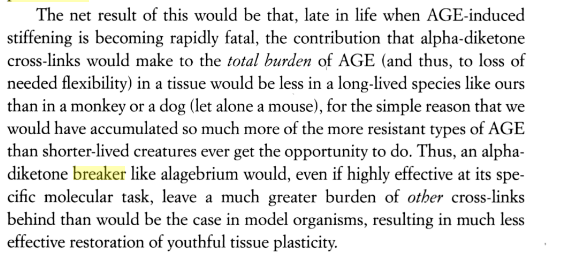
Attached File  Screen Shot 2016-07-27 at 8.35.33.png   89.99KB   1 downloadsAubrey actually says this in his book.


Edited by Logjam, 27 July 2016 - 12:37 PM.
Quote

Logjam's Photo Logjam 11 Aug 2016

Is it possible, Steve, that the reason ALT-711 never worked is that mice and rats never get old enough to form appreciable amounts of glucosepane?


If so, the idea of taking ALT-711 isn't silly, but it should be taken preemptively.  ALT-711 has been verified to blunt CML and MGH in various studies.  I believe MGH adducts are a necessary part to form glucosepane.


MGH: http://www.ncbi.nlm....pubmed/26772824

MGH: http://www.ncbi.nlm....les/PMC2823362/

CML: http://www.ncbi.nlm....pubmed/16974073


If rats made it to 70, maybe they'd also have lots more glucosepane.  But they all die before that.


I'm not sure that as a younger human, that we don't also want to blunt CML and an MGH.  MGH and CML aren't doing us any favors, and our body actually has a mechanism to remove MGH itself.


I think Aubrey said something like this actually: http://www.longecity...-1469623038.png


Recently speaking with David Spiegel at Yale I would say not too long. He has informed me the lab at Yale has made some progress with antibodies so I am hoping we will have something to parallel test in the near future. 


Quote