Jump to content

  • Log in with Facebook Log in with Twitter Log In with Google      Sign In   
  • Create Account


To go ad-free join as a Member.


- - - - -

yoga pranayama

intermittent hypoxic training

  • Please log in to reply
4 replies to this topic

#1 OFFLINE   clairvoyant

  • Registered User
  • 37 posts
  • 21
  • Location:bulgaria

Posted 26 April 2012 - 12:49 AM


Please, first read intermittent hypoxic training, high mounting training, hypoxia and PULMONARY OBSTRUCTIVE DISEASE in wikipedia.


I claim that pranayama is intermittent hypoxic training that leads to mitochondrial hormensis. It includes inhalation, RETAINING of breath, exhalation with GRADUAL increasing of the RETAINING of breath that is self-induced suffocation (hypoxia) leading to increasing of mitochondrial matrix.


It improves longevity and endurance. On one hand, it decreases metabolic rate at REST (longevity) but on the other increase VO2 MAX while exercising. Thus, it reduces ROS at rest. I do not recommend you exert yourself aerobically to VO2 MAX.


My personal experience with pranayama is:


1.At rest, if I am not hungry I do not feel my breath, so need less oxygen (low metabolism at rest).


2.While exercising, I feel boost of energy and easily burn fat tissue.


All this with a couple of weeks practice.


Later on, I will provide information about physiological changes in the NERVE tissues, which are the most susceptible to suffocation (hypoxia).


At the end I will show easy (not time consuming exercise) that can be done in front of you computer or while watching TV.


Please comment.


#2 OFFLINE   xEva Re: yoga pranayama

  • Registered User
  • 677 posts
  • 331
  • Location:USA

Posted 28 April 2012 - 04:38 AM

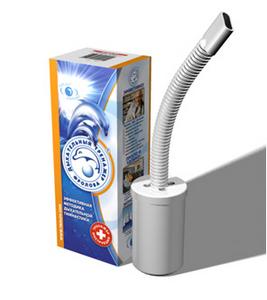
There is a similar method popular in Russia, called Buteyko method http://www.buteyko.i...ing_method.html And they even came up with a gadget that helps you learn the technique:


Posted Image


But I am not convinced that is causes hypoxia. It makes no sense to me. If respiration in mitochondria requires oxygen, how would hypoxia lead to "increasing of mitochondria matrix"?

I think what actually happens is that these sort of exercises improve breathing efficiency: even though you consume less air (per given time period) you actually extract more O2 from it, compared to your "normal" breathing; and then utilization of the extracted O2 goes up too. So instead of hypoxia you actually get more O2. And that would support respiration in mitochondria.

But I'm certainly not an expert. I used to do "slow breathing" as part of qigong meditation, doing 1 breath per minute during meditation and 4 breath per minute normally. I stopped doing it and my normal breathing is much faster now.

#3 OFFLINE   clairvoyant Re: yoga pranayama

  • Topic Starter
  • Registered User
  • 37 posts
  • 21
  • Location:bulgaria

Posted 29 April 2012 - 07:01 PM

I am sorry if have not explained precisely. The breathing exercises are:
  • Sit with crossed legs, spine erect, inhale slowly full lungs
  • Retain the breath as much as possible
  • Exhale slowly.

This is one cycle. Do several cycles (10-40). Do twice a day. Precautions: do not do it on full stomach and high temperature (room’s and your body’s). Do not retain too much in the first 2-3cycles. This exercise can be done at your working place while sitting on a chair.


Second (classic exercise):

1. Inhale for 7 seconds (or your own counts)

2. Retain for 7x4=28 seconds

3. Exhale for 7x2=14 seconds

The ratio is 1:4:2. Do several cycles. With time, increase periods:

8:32:16, 9:36:18, 10:40:20. Increase cycles 10-40, twice a day.

You will see that you will definitely suffocate within a few cycles. For example, you will not be able to walk in this condition.

Both exercises will consume about 20 minutes.


What made me think that it is mitochondrial hormensis, is that I read in wikipedia that http://en.wikipedia....ypoxic_training

If you do not believe me, see this

http://www.ncbi.nlm....pubmed/12613400

The fact that ROS are decreased but SOD is slightly increased has two options:

    The first is slowed metabolism or the second enhancement (better oxidation) of the cellular respiration.

Animal such as naked mole rat (suffocates itself by breathing its own exhausted carbon dioxide in the hole) and hunch back whale (does not breathe when submerged) live indecently longer than they should.


#4 OFFLINE   clairvoyant Re: yoga pranayama

  • Topic Starter
  • Registered User
  • 37 posts
  • 21
  • Location:bulgaria

Posted 29 April 2012 - 07:52 PM

The increasing of mitochondrial density is an organism's compensation to the lack of oxygen.
Here I show you that people have been smoking a lot and have damaged their lungs. Thus as a result their organisms produced more mitochondria to supply the adequate amount of oxygen.

http://ajrccm.atsjou.../167/6/873.full

Of course, they smoked to seek pleasure not to increase their mitochondrial density.

#5 OFFLINE   reshmita Re: yoga pranayama

  • Registered User
  • 1 posts
  • 0
  • Location:India

Posted 07 May 2012 - 04:49 PM

Yoga therapy and its various forms have helped all of us to get rid of our diseases from time immemorial. Kriyas, Asanas and Pranayama have helped me a lot. I practice yoga regularly, obviously with an expert's advice.


0 user(s) are reading this topic

0 members, 0 guests, 0 anonymous users