






In Nature Aging, researchers have published their finding that targeting urokinase plasminogen activator receptor (uPAR), a senescence-associated protein, restores gut function in mice.
One way the gut lining ages
Of all the tissues in the human body, the intestinal epithelium, which lines the gut, replaces its cells most quickly [1]. This self-renewal diminishes with aging [2], leading to leaky gut and an overall decline in function [3]. While there has been substantial previous research in this area, leading to multiple potential treatments, these researchers note that the safety and efficacy of such approaches remain unproven in human beings.
They point out two main hallmarks of aging that are of interest in this context: the chronic, age-related inflammation known as inflammaging and the increasing numbers of senescent cells. Their previous work has revealed that senescent cells that express uPAR are harmful in excess and that CAR T cells programmed to attack this receptor may be useful in dealing with them [4]. Other researchers have concurred, finding that using CAR T cells against uPAR-expressing cells fights liver fibrosis in a mouse model [5].
That previous work was on other tissues, and this is the first study that specifically uses CAR T cells to target uPAR cells in the intestinal epithelium.
Removing uPAR cells restores gut function
To begin their study, the researchers analyzed cells from the small intestines of 3-month-old and 20-month-old mice. Unsurprisingly, the older mice had more uPAR-expressing cells, and these cells were also very likely to express the senescence biomarker SA-β-gal and have other presentations of senescence, such as a lack of proliferation. A gene expression analysis found that these uPAR cells had upregulated DNA repair and immune response. Of all the cells identified as senescent by SenMayo analysis [6], roughly three-fifths expressed uPAR.
Similar results were found in cells derived from human beings; using samples taken from 25- to 30-year-olds and 65- to 70-year-olds, the researchers found that, like mice, older people have more uPAR-expressing cells and that these cells have similar gene expression profiles and a similar relationship to senescence.
The researchers then introduced their CAR T cells into the bloodstreams of 3-month-old and 18- to 20-month-old mice. In the small intestines of the older animals, this cell population rapidly expanded, dramatically reducing the numbers of cells that expressed uPAR and SA-β-gal, while restoring intestinal integrity as measured by FITC-Dextran.
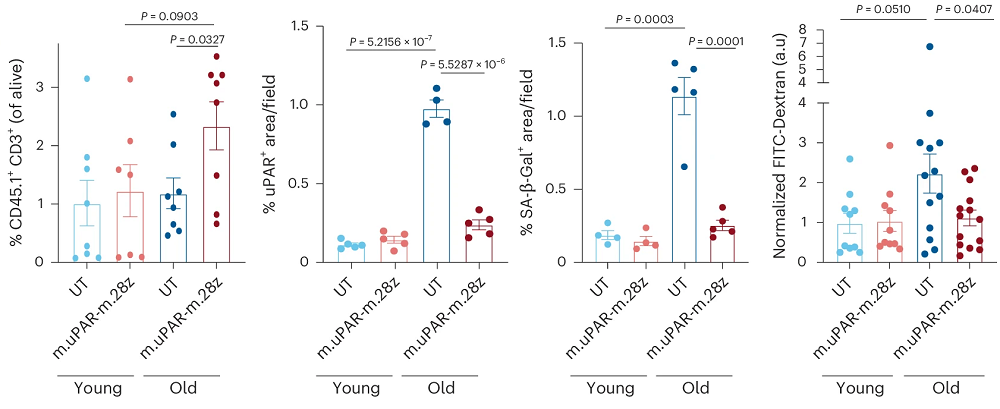
The numbers of stem cells and proliferating cells were also restored, with the stem cells of treated mice more readily able to form organoids. There was also a decrease in inflammation and dysbiosis, with the treated animals having gut flora that more strongly resembled that of younger animals. Further work found that these results were due to the CAR T cells’ effects on intestinal tissues rather than on immune cells.
The study also took a look at the well-known senolytic combination of dasitnib and quercetin. The results were similar to CAR T cells, with this combination also reducing senescent cell levels and restoring stem cells in the small intestine.
Long-term benefits
Amazingly, one treatment with anti-uPAR CAR T cells in 3-month-old mice persisted throughout the lifespans of these animals, despite having negligible effects during youth. The mice so treated had detectable uPAR-fighting cells 15 months later, with a signfiicant decline in cellular senescence along with improvements in stem cell numbers, intestinal integrity, and gut health.
In total, the researchers hold that “uPAR+ epithelial cells are key drivers of intestinal aging and associated inflammation and dysfunction.” While regeneration-promoting approaches have been previously linked to cancer, the researchers note that none of the mice that received CAR T cells developed intestinal cancer as a result. Clinical trials are needed to determine if this approach is safe and effective in humans.
Literature
[1] Barker, N. (2014). Adult intestinal stem cells: critical drivers of epithelial homeostasis and regeneration. Nature reviews Molecular cell biology, 15(1), 19-33.
[2] Brunet, A., Goodell, M. A., & Rando, T. A. (2023). Ageing and rejuvenation of tissue stem cells and their niches. Nature Reviews Molecular Cell Biology, 24(1), 45-62.
[3] Dumic, I., Nordin, T., Jecmenica, M., Stojkovic Lalosevic, M., Milosavljevic, T., & Milovanovic, T. (2019). Gastrointestinal tract disorders in older age. Canadian Journal of Gastroenterology and Hepatology, 2019(1), 6757524.
[4] Amor, C., Feucht, J., Leibold, J., Ho, Y. J., Zhu, C., Alonso-Curbelo, D., … & Lowe, S. W. (2020). Senolytic CAR T cells reverse senescence-associated pathologies. Nature, 583(7814), 127-132.
[5] Dai, H., Zhu, C., Huai, Q., Xu, W., Zhu, J., Zhang, X., … & Wang, H. (2024). Chimeric antigen receptor-modified macrophages ameliorate liver fibrosis in preclinical models. Journal of hepatology, 80(6), 913-927.
[6] Saul, D., Kosinsky, R. L., Atkinson, E. J., Doolittle, M. L., Zhang, X., LeBrasseur, N. K., … & Khosla, S. (2022). A new gene set identifies senescent cells and predicts senescence-associated pathways across tissues. Nature communications, 13(1), 4827.
View the article at lifespan.io


