






A new review highlights the promise of microglia replacement, a strategy that made the leap from mouse studies to the first successful human trial in just five years [1].
Repair or replace
Microglia, the resident immune cells of the brain, have been implicated in various diseases, including Alzheimer’s [2]. However, treatments modulating microglial behavior are scarce, partly because they hide behind the blood-brain barrier (BBB), which blocks many potential drugs and makes it hard to target them precisely [3].
Replacing defective microglia is an interesting solution, but until several years ago, it sounded like something out of this world. Surprisingly, the required technology has matured fast, making its way from mouse studies to a successful human trial in five years. Now, the team behind these breakthroughs, from Fudan University in China, has published an enlightening review of the field in the journal Cell Stem Cell.
“Microglial gene mutations can either cause or accelerate the course of CNS disorders. Conceptually, replacing pathogenic microglia with gene-corrected or wild-type counterparts offers a promising therapeutic avenue to restore homeostatic function and mitigate disease progression,” said corresponding author and team leader Bo Peng, professor at Fudan University.
Success at a cost
As is the case with many promising but ambitious directions, the team chose a rare and severe disease, adult-onset leukoencephalopathy with axonal spheroids and pigmented glia (ALSP), as their first target. Like some other primary microgliopathies, ALSP is caused by mutations in microglial genes such as CSF1R. In July of this year, the researchers reported highly encouraging results of microglia replacement in human patients, with a two-year follow-up suggesting that disease progression had slowed or halted.
While done in a small, highly selected cohort, the trial showed that large-scale microglia replacement is possible in humans and can change the trajectory of a devastating microgliopathy. However, it came at a cost.
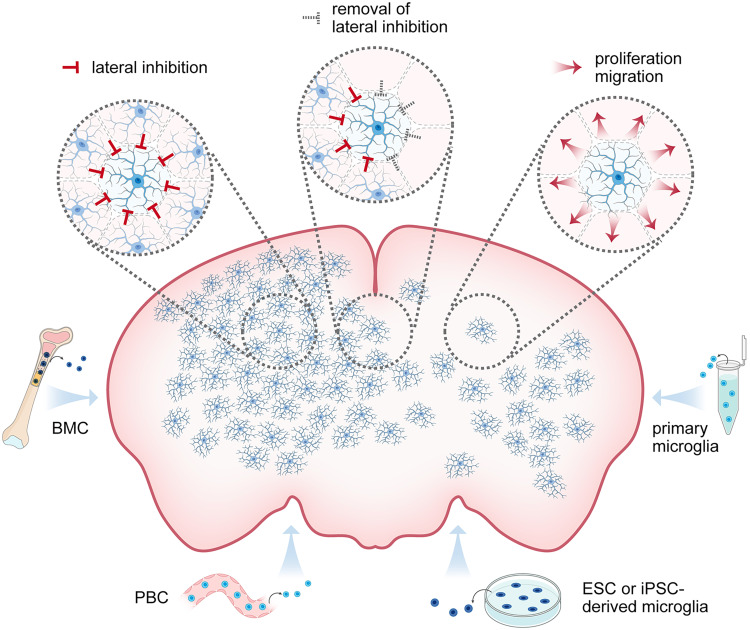
Microglia replacement is easier said than done. In a healthy brain, microglia form a dense, self-renewing grid. They occupy territories and suppress each other’s proliferation, so newcomers cannot easily move in. Early attempts mostly involved local injections or incomplete depletion and ended up with small patches of donor cells or rapid rebound of the original microglia.
“Even though microglia replacement is recognized for its potential for disease treatment, early approaches in the pre-replacement era lacked an efficient and robust strategy for microglia replacement, which is key for a meaningful and effective therapy,” co-author Junhao Rao said.
Hey, MISTER!
A successful therapy must combine effective clearance of the resident microglia with a strong influx of donor cells. In practice, that means depleting resident microglia simultaneously with myeloablative conditioning similar to what is used before bone marrow transplantation. Conditioning wipes out much of the host’s hematopoietic system and triggers strong chemokine signals in the brain, which invites donor-derived myeloid cells from bone marrow or peripheral blood to enter the CNS and differentiate into microglia-like cells.
This led the researchers to develop Microglia Intervention Strategy for Therapy and Enhancement by Replacement (MISTER), which includes several protocols. In Mr BMT, microglia are replaced using classical bone marrow transplantation. In Mr PB, the donor source is peripheral blood, which is easier on donors and still achieves high levels of replacement (80% compared to 90% for Mr BMT in mice).
Looking into the future
Can this therapy, today or in the future, treat more common diseases? Some genetic mutations have been linked to dementia. Even if they do not cause disease on their own, they can heavily tilt the odds. “TREM2 mutations may not be sufficient to cause Alzheimer’s disease independently, but they can act as pathogenic amplifiers that synergistically drive disease risk,” Peng said, noting that this is just one example; another one would be mutations in APOE, an Alzheimer’s-related gene strongly expressed in glia, including microglia.
However, the authors are careful about the limitations of their approach. Myeloablative conditioning is still a harsh, cancer-level intervention, which currently confines microglia replacement to rare, life-threatening indications. For common neurodegenerative diseases or risk reduction, the risk-benefit balance must be better, especially in frail older patients. The review explicitly points to safer, more targeted conditioning and better control over engineered microglia as key design goals.
If more tolerable protocols are developed, the authors envisage an even broader use for microglia replacement: genetically engineered microglia that essentially work as drug factories, secreting missing lysosomal enzymes, anti-amyloid antibodies, or neurotrophic factors from within the brain. This would turn microglia replacement into a long-lived delivery system behind the blood-brain barrier.
“Overall, microglia replacement is a newly emerging but rapidly progressing field,” Peng said. “Challenges in safety, compatibility, and long-term function remain, yet they represent solvable design targets. With continued mechanistic insight, clinical innovation, and broad collaboration, microglia replacement can mature from early breakthroughs into a generalizable platform across neurological diseases.”
Literature
[1] Peng, B., Rao, Y., & Wu, J. (2025). The evolution of microglia replacement: A new paradigm for CNS disease therapy. Cell Stem Cell, 32(12), 1487–1503.
[2] Hansen, D. V., Hanson, J. E., & Sheng, M. (2018). Microglia in Alzheimer’s disease. Journal of Cell Biology, 217(2), 459-472.
[3] Pardridge, W. M. (2005). The blood-brain barrier: bottleneck in brain drug development. NeuroRx, 2(1), 3-14.
View the article at lifespan.io


