






For those of us in the Northern Hemisphere, spring is here. This is a time of renewal and hope for better times ahead, echoing what our field is trying to achieve: the rejuvenation of aging cells and tissues to keep older people free from age-related diseases.
On that note, let’s take a look at what has been going on at Lifespan News and the wider Lifespan Research Institute.
Top longevity news stories
Kicking off the new year, we published a trio of articles covering the state of the rejuvenation research field. We engaged leading experts in business, research, and advocacy to give you an overview of how things are progressing.
Geroscience in 2025: The Expert Roundup
 How far has science advanced towards longer healthier lives?
We spoke with researchers Steve Horvath, George Church, Andrea Maier, Matt Kaeberlein, and Oliver Medvedik. They shared their expert views on the current state of aging research.
Longevity Biotech in 2025: The Expert Roundup
 Good science also needs good business leadership to turn discoveries into working therapies. Getting therapies through clinical trials is the final barrier to making rejuvenation biotech an accessible reality.
Kristen Fortney, Mehmood Khan, Jamie Justice, Nathan Cheng, Karl Pfleger weighed in on the business side of the field. Join us as we explore how the business of rejuvenation is progressing.
Longevity Advocacy in 2025: The Expert Roundup
 Developing the technology is one thing, but that needs to be accompanied with effective advocacy. There are many misconceptions and objections to treating aging as a medical issue. We need strong advocacy to educate people and build social acceptance.
Andrew Steele, Melissa King, Bernard Siegel, Dylan Livingston, Adam Gries, and Anastasia Egorova shared their thoughts. Check out how longevity advocacy performed in 2025.
LRI was at the Longevity Biomarkers Competition
LRI President Keith Comito recently spoke at the Longevity Biomarkers Competition in Infinita City in Roatán, Honduras. The “living laboratory” event saw researchers, innovators, entrepreneurs, artists, and biohackers exploring the future of longevity science.
Keith is a technology inventor who has developed digital biomarker tools using face, body, and voice data. In his presentation, he suggested that these non-invasive “functional biomarkers” may solve a key challenge in aging research. They could provide reliable, treatment-sensitive signs of biological age for clinical trials.
Prioritizing audio/video-based biomarkers could deliver quick wins and drive broader adoption. For example, most dementia cases go undiagnosed because doctors rarely screen for it. However, voice-based technology has the potential to detect dementia early. Paired with new drugs, it may reduce progression and yield major economic benefits.
In addition to chronic conditions, this diagnostic potential also applies to infectious diseases. During the COVID-19 pandemic, Keith worked on projects surrounding vocal diagnostics of the disease using Convolutional Neural Networks (CNNs).
CNN-based vocal diagnostics can detect infectious diseases like COVID-19 by analyzing vocal cord and respiratory features. These models reportedly outperformed antigen tests versus PCR, detecting even asymptomatic cases with high specificity. They work because COVID affects the nervous system, so models can detect subtly altered vocal cord vibrations rather than relying on phlegm.
This may be useful for other conditions that affect the neurological system, such as Alzheimer’s disease. In fact, it may have broad applications for a variety of diseases that have a subtle influence on the voice.
Non-invasive functional biomarkers, if developed properly, could become a useful accompaniment to traditional medical screening. In the future, it isn’t hard to imagine something akin to the Star Trek medical tricorder using these technologies.
Rapamycin and exercise clinical trial results
We are delighted to see that Dr. Brad Stanfield has had his manuscript accepted. LRI (at the time Lifespan.io) supported Brad’s fundraising efforts to get this clinical trial launched.
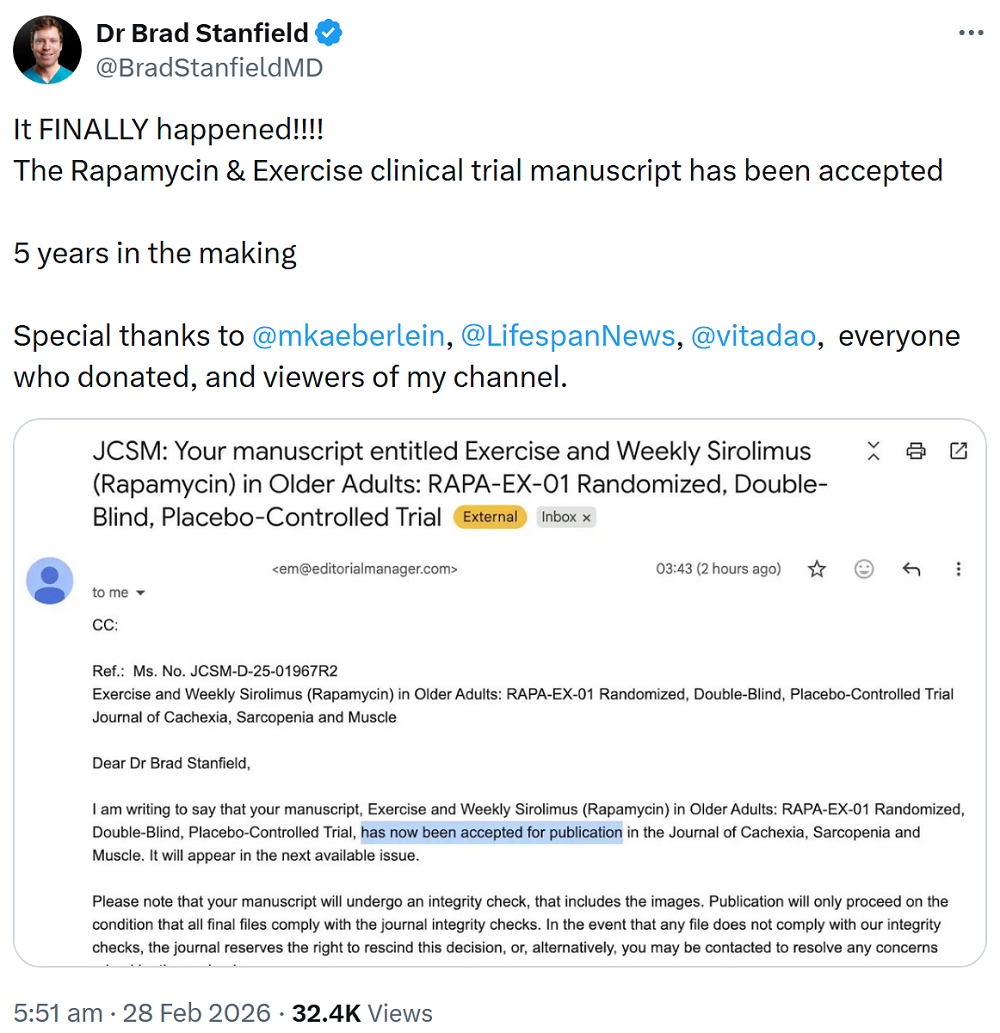
Congratulations to Brad, and we are glad we were able to help. We look forward to seeing the published results of his rapamycin clinical trial.
Radical No More: Societal Perceptions of Life Extension – Past, Present, and Future Directions
Keith Comito has also recently contributed to a publication focusing on how society suffers from mixed messaging. He argued that the public does, in fact, support longer lifespans. He also proposes that our field should be less inclined to downplay the potential rewards of its success.
There should be nothing radical about the idea of living longer thanks to medical technology that targets aging. It does seem somewhat strange that the concept of more and healthier years should be somehow taboo. It makes us wonder if people in the past pushed back on other technologies that allowed people to live longer in good health. Somehow, we doubt that happened in any significant capacity.
A good example of that support would be a 2022 AARP and National Geographic collaborative survey, which included 2,580 US adults. In one part, they asked them a simple question: “Assume for a moment that there was a pill that could extend your life by 10 years. How likely would you be to take that pill?”
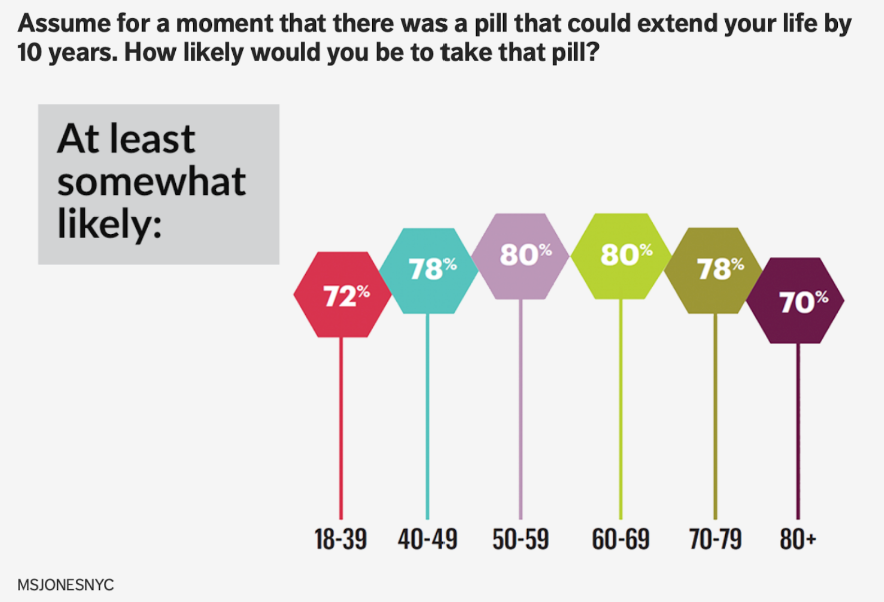
The response to that question was largely in favor of taking that pill and enjoying additional years of life. This seems to go against the persistent narrative that these ideas are somehow radical and unpopular.
The same survey went on to couch those additional years with continued good health. The results are even more in favor of using rejuvenation technologies to increase healthy lifespans. With the understanding that those additional years will be spent in good health, there is a significant increase in support.
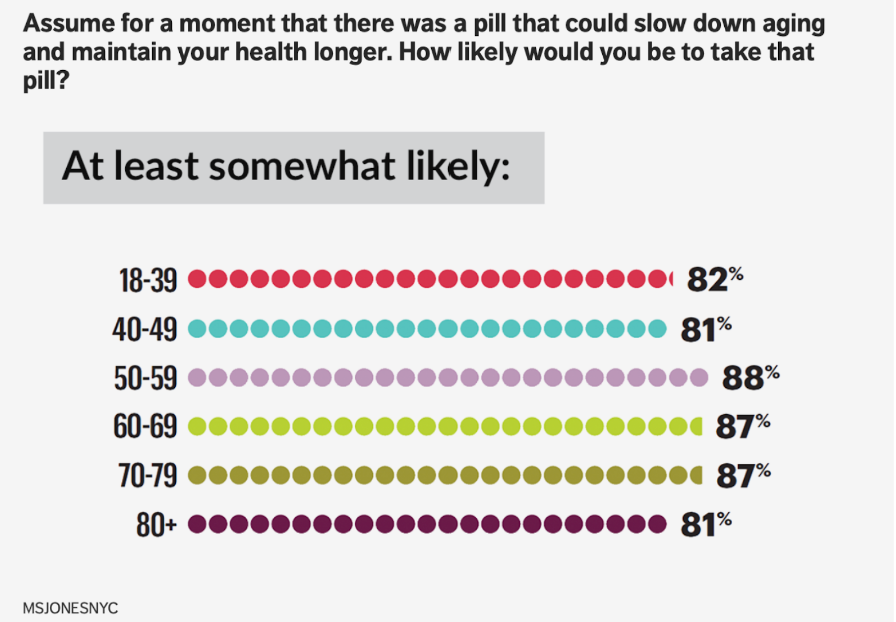
Keith went on to discuss other examples of support and enthusiasm for increasing human lifespans.
Abstract
Humanity’s relationship with mortality has long defined its values, myths, and ambitions. Across cultures, the quest to transcend aging has been reflected in stories that both explore the desire for life extension and warn against its pursuit.
However, as the science of longevity advances, these inherited narratives, once serving to reconcile people with inevitable death, now distort public understanding and policy by linking life extension with moral corruption, inequality, or futility.
This tension reflects a psychological coping pattern that evolved in response to perceived impossibility, not genuine opposition to longer life itself. Analysis of mythological motifs, cultural history, social media data, and contemporary polling reveals that broad public support exists for increased healthspan and even radical lifespan gains, provided they are equitable and grounded in credible science.
These findings challenge the assumption that advocacy must downplay longevity goals for wider acceptance. Recognizing and updating these cultural scripts opens new pathways for public engagement, research funding, and ethical frameworks that align emerging biotechnologies with our enduring human aspiration, to live longer, healthier, and more meaningful lives.
Keith provided some real food for thought ,and perhaps our field needs to change how it thinks about public engagement. Check out the full Radical No More article.
View the article at lifespan.io


