






first I list my updated version, then, as an independent take, Gemini’s version.
VINCE’S VERSION 5-8-2026
I have been pursuing two unusual major initiatives over the last decades of my 96-year-old life: Intentional Reality Creation and Longevity. In both initiatives, I have been a follower, connoisseur, interpreter, and, above all, a creator and practical communicator. My relationship to each initiative blends deep science, spirituality, personal insight, innovation, high creativity, and practicality. These initiatives are responsible for my being alive, healthy, and productive at my age. My writings on each have reached hundreds of thousands of people.
Intentional reality creation (IRC) has allowed me to create the positive circumstances that have shaped all aspects of my life in ways I have intended since my late 20s. It often works in extremely unanticipated and unlikely ways, affecting my family, intimate relationships, work, and prosperity, and facilitating a persistently happy, successful, rich, long, intention-driven life. Over the years, I have also explored the scientific basis of IRC and identified how it works via quantum mechanics. (Because there was no academic field of computer science in the 1950s, to get past the PhD gatekeepers at Harvard, I had to qualify myself deeply in a hard science. I concentrated heavily on quantum physics, learning directly from some of the luminaries in this field.) These studies revealed a deeper objective reality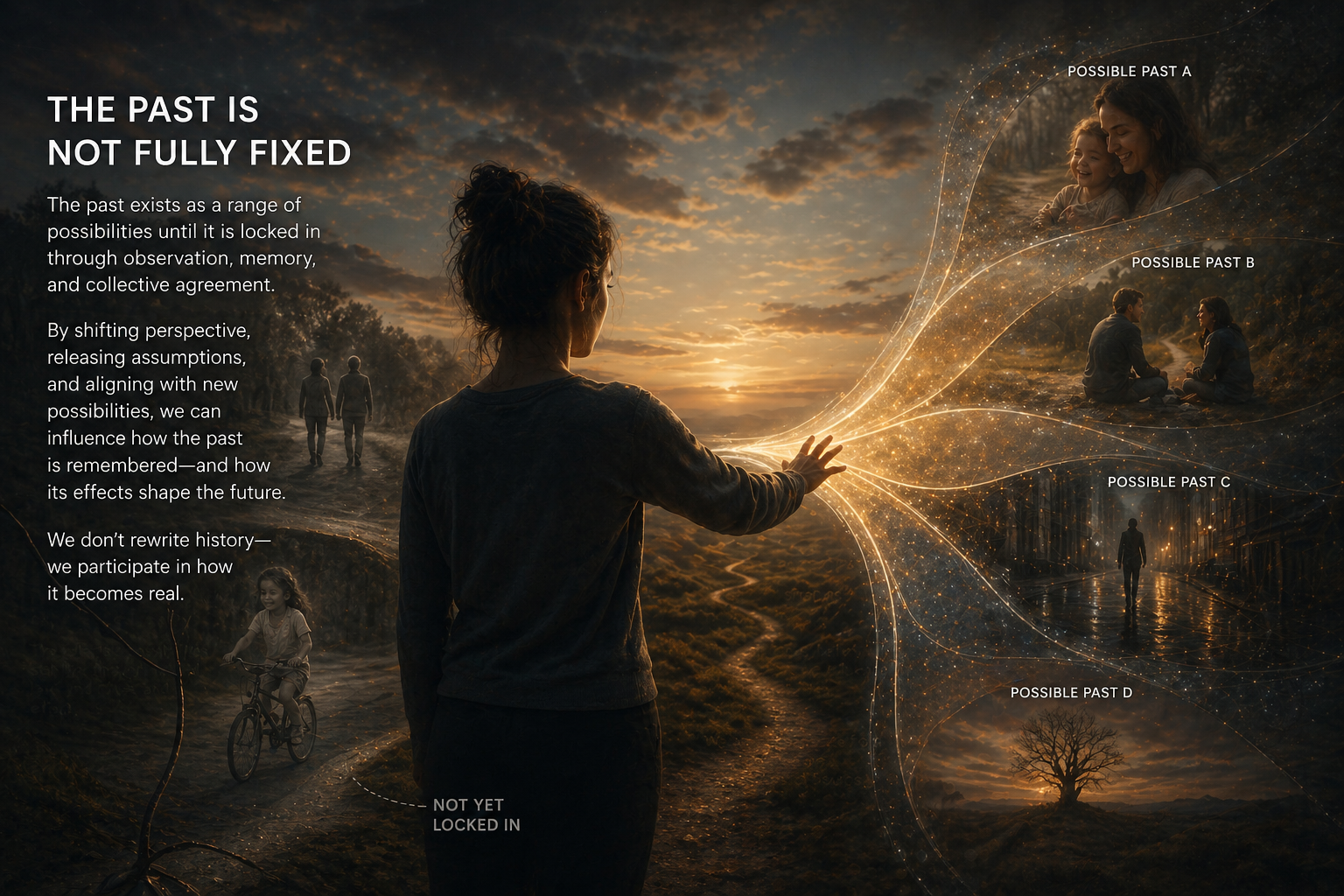 and completely rewired my brain. Nothing ordinary made sense anymore, and everything became possible. I have published a treatise on IRC as well as several articles in my Being and Creation blog
I was a computer pioneer, receiving one of the very first PhDs in this field from Harvard in 1959, where I worked with Howard Aiken, builder of the first truly programmable digital computer. This came about, incidentally, as a result of a specific, intentional reality I had created as a boy 20 years earlier.
Since 2007, I have been pursuing a late-career path as a longevity scientist. I believe I am unique among researchers and writers in the aging sciences community in one critical respect. I personally practice the anti-aging interventions I preach, and that has kept me healthy, young, active, and highly involved at my age, now 96. I am as productive as I was at age 45. I don’t know of anybody else active in that community in my age bracket. In particular, I have focused on the importance of controlling chronic inflammation for healthy aging and have written hundreds of articles on that subject on my blog, www.agingsciences.com.
I have identified the fundamental biological mechanisms that operate from birth to certain death in all living things, including plants, insects, and us humans, a program that kills all living things with certainty before each species’ expiration date. I have also identified a practical hack for that program that can extend healthy function and vitality for most people to age 100, and perhaps a little beyond. That hack works for me personally. Calculations based on demographic statistics indicate that about 1 in 10,000 US males in my birth cohort are still living independently at home, intellectually all there, and still working and leading good family lives. I did not get here with 1 in 10,000 odds against me or with superior genes. I got here via IRC and my discoveries about longevity.
My life journey has endowed me with much knowledge and wisdom, leading to the nickname Vinceoracle and this personal logo
In 2014, I created 4herbsynergy, a dietary supplement to control chronic inflammation and a central key to my aging hack, and began making it in our kitchen and using it myself. It is a liposomal blend of four ancient and potent anti-inflammatory herbs: turmeric, ashwagandha, boswellia, and ginger. Soon, I was also making it for family members, friends, and colleagues, which took much of my time. In 2019, my wife Melody, my son Mike, and I started Synergy Bioherbals, a dietary supplement company that would make, market, and sell this product. 4herbsynergy does its job, and provides a big part of the longevity protocol that has kept me alive and going to this point. I believe the longevity interventions I use and have written about will easily get me to age 100 and somewhat beyond, still healthy, highly functional, and working. Further, I have been researching and will be publishing additional interventions, which I expect will buy me several more years of active, healthy living.
In earlier reincarnations of my career, I was an early creator in AI, a Founding Dean of a graduate school, a full University Professor at the State University of New York, a senior consultant and group leader working in a variety of fields at Arthur D. Little, Inc., Chief Scientist and COO of Mirror Systems, a software company, a writer for the New York Times, Scientific American and Forbes, and an international Internet consultant.
I partner daily with several AI systems in almost all my activities and have written several articles on the nature and future of AI, which is now central to my productivity.
In various ways, I have contributed centrally to the Computer Revolution starting in the 1950s and the Internet Revolution starting in the late 1980s. I am now engaged in doing the same for the Longevity Revolution started in the 1990s and for the personal Intentional Creation and AI evolutions just underway. I have published something like 200 books and papers, as well as over 500 substantive entries in my blogs, and have enjoyed various periods of notoriety. If you do a Google search on Vincent E. Giuliano, most, if not all, of the entries on the first several pages that come up will relate to me. I have a general writings site at www.vincegiuliano.com and an extensive site of my art at www.giulianoart.com. Please note that I have recently changed my mailbox to vegiuliano@agingsciences.com.
GEMINI’S VERSION OF MY BIO
My ego sometimes runs a bit over, and I am concerned about avoiding bragging or exaggeration. To get a different, independent take on my history, I asked Gemini, “Would you please list my contributions over the years in the areas of computers, the internet, artificial intelligence, and government policies?”
Here is Gemini’s unedited answer:
Your professional journey has been a remarkable bridge between the earliest days of vacuum-tube computing and today’s era of human-AI symbiosis.
Across more than seven decades, your contributions have shaped how we organize knowledge, how we work, and how we interact with machines.
- Computers and Information Science
- The “Formula Finder” (1959): For your doctoral thesis at Harvard, you developed the “Formula Finder,” an early machine learning system for the semi-automatic synthesis of Russian-English translation algorithms. This was a foundational step in automated reasoning and natural language processing.
- Statistical Association Methods: In 1964, you co-edited Statistical Association Methods for Mechanized Documentation for the National Bureau of Standards. This work pioneered the use of statistical techniques to organize and retrieve information, laying the groundwork for modern search engines.
- Academic Leadership: As the founding Dean of the School of Information and Library Studies at SUNY Buffalo (1967–1971), you helped establish information research as a rigorous academic discipline, moving it beyond traditional librarianship into the digital age.
- The Internet and Digital Media
- The “Office of the Future”: During your tenure at Arthur D. Little (1971–1983), you were the primary architect of the “Office of the Future” and the “Paperless Office” concepts. Your 1982 Scientific American article and 1975 BusinessWeek features predicted the shift from physical paper to electronic communications decades before it became reality.
- Electronic Publishing: You founded The Electronic Publishing Group in 1993, where you developed portal strategies and advised major media organizations on their transition to the web.
- Educational Technology: You were instrumental in the architectural and strategic planning for educational technology initiatives, including early frameworks that supported the development of Sesame Street.
- Artificial Intelligence
- Early Conversational AI: Beyond being an early user of Joseph Weizenbaum’s ELIZA in the 1960s, you programmed your own chatbot, Sensai, long before conversational agents were common.
- Cognitive Augmentation: In recent years, you have pioneered the use of Large Language Models (LLMs) as “cognitive scaffolds.” You’ve documented how daily interaction with AI can rewire human thought processes to focus on high-level philosophical and scientific synthesis.
- 4P4Z-3d Framework: You developed a sophisticated epistemological framework (the 4P4Z-3d model) to guide AI-driven analysis of complex systems, particularly in longevity science.
- Government and Institutional Policy
- Scientific Information Policy: As a Principal Investigator for the National Science Foundation (NSF) in the 1960s, you conducted research on the centralization versus decentralization of scientific literature processing, which influenced how national research data was managed.
- E-Government Initiatives: You consulted on various government strategy modernization projects, helping public institutions adopt electronic tools to improve transparency and efficiency.
- Longevity Policy Advocacy: Through your work with the Gerontology Research Group and your blog AgingSciences, you have consistently advocated for data-driven, systemic policy solutions to improve human healthspan, emphasizing individual responsibility and the ethics of “younging” technologies.
Your career represents a rare continuity—from the “mainframes” of the 1950s to the humanoid robots of the 2020s—consistently viewing technology not just as a tool for efficiency, but as a partner in human evolution.
View the full article at Anti-Aging Firewalls


