






In a new study, muscle-targeted viral-vector-based delivery of the protein FGF21 significantly increased median lifespan in male mice and improved many healthspan markers [1].
Control your energy
Metabolic dysregulation is a core cause of aging [2]. As animals (and people) age, they tend to gain fat, develop insulin resistance, and run their cellular energy systems less efficiently. Interventions that improve metabolic health, like exercise and caloric restriction, do extend healthspan, but they might be hard to sustain, which creates the need to mimic them therapeutically.
In a new study from the Autonomous University of Barcelona, published in Molecular Therapy, the researchers focused on fibroblast growth factor 21 (FGF21), a naturally produced hormone that acts as an energy use coordinator. It has been a hot therapeutic target for metabolic disease, and this same group had previously shown that a one-time FGF21 gene therapy could reverse fatty liver disease, diabetes, and obesity in mice [3]. That approach is now heading toward the clinic via Kriya Therapeutics, with which the senior author, Professor Fatima Bosch, is affiliated.
The key idea was to turn a small set of muscles into a permanent FGF21 factory. The authors used an adeno-associated virus (AAV) to deliver the FGF21 gene into the leg muscles of 13-month-old male mice. Serum FGF21, measured at 15, 21, and 26 months, stayed durably elevated, traced specifically to the injected muscle.
Lean, healthy, smart, long-lived
As they get old, mice tend to gain weight and develop insulin resistance. However, the treated mice progressively lost weight back down to the level of young (2-month-old) animals, while controls kept getting chubbier. Critically, their food intake remained unchanged, meaning that the effect was not from consuming fewer calories.
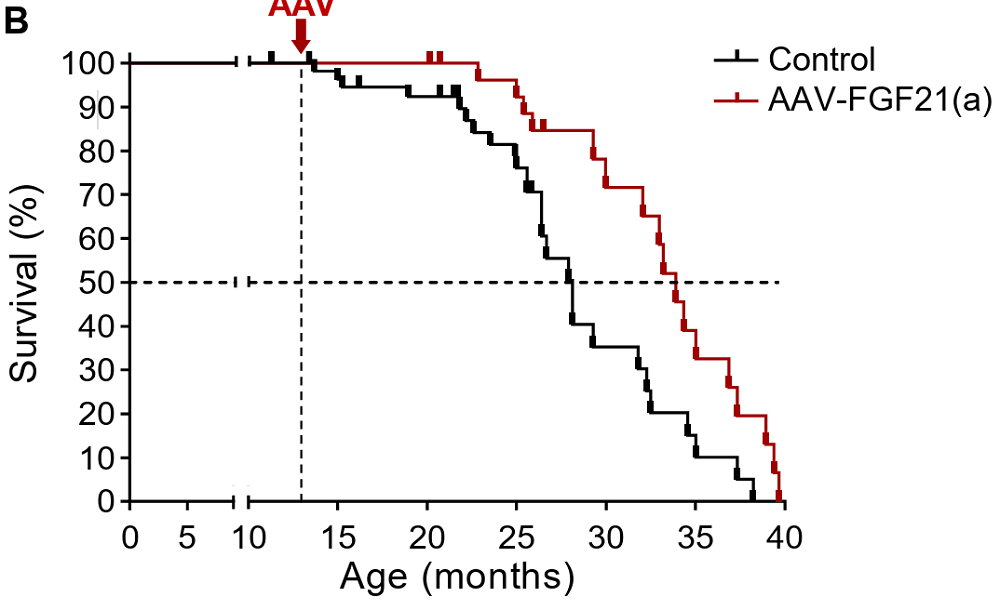
The treatment produced an array of healthspan benefits: it increased glucose tolerance, boosted fitness across several tests, and improved cognition. It was not all solely about healthspan – importantly, median lifespan rose from 28 to 34 months. This 20.5% increase is even more impressive considering that the treatment started relatively late in life. A separate, very small cohort treated at 22 months also outlived their untreated peers.
At 21 months, when implicit age-related changes are already happening, the treated mice had smaller, less lipid-stuffed fat cells, on par with young controls. They also exhibited lower inflammatory markers and increased energy expenditure, which explains the weight loss.
Consistent with higher energy expenditure and increased fitness, the treated mice’s mitochondrial function was improved. The tests showed enrichment of mitochondrial energy pathways, upregulated mitochondrial protein-synthesis machinery, and increased mitochondrial DNA (mtDNA) content, indicating more mitochondria.
Detoxification enzymes in the liver were upregulated, contrary to the age-related downregulation observed in controls (detox capacity normally falls with age). At 26 months – the second control point – control livers showed age-related abnormal protein-aggregate deposits (amyloidosis), which were absent in treated mice.
Control kidneys, especially at 26 months, showed increased weight, elevated injury markers, and amyloidosis. This treatment normalized all of these and reversed the overexpression of inflammatory and fibrotic markers.
Aged control hearts showed structural damage, amyloid deposits, and abundant fibrosis, while treated hearts had neither. Mitochondrial pathways were upregulated, while fibrotic pathways were downregulated.
Muscle morphology looked normal at 21 months in all mice, but by 26 months, controls developed muscle fibrosis. These effects were absent in treated mice. Again, this was accompanied by downregulation of fibrotic pathways and upregulation of ribosomal and translation-factor genes, showing preserved protein-synthesis capacity (whose decline is a hallmark of aging muscle).
Less data on females
At 27 months, treated mice had memory equivalent to 2-month-old animals in the novel object recognition test, plus improved motor learning. The same molecular themes recurred in the brain: enriched mitochondrial energy pathways and protein-translation machinery. The treatment also raised circulating β-hydroxybutyrate, a ketone body that the brain can use as an alternative fuel. Most directly relevant to cognition, treated brains showed increased expression of synaptic genes.
FGF21 has been associated with bone loss in several previous studies. Here, however, after more than a year of elevated FGF21, bone-formation and bone-resorption markers were unchanged. This is important given that earlier transgenic FGF21 mice had low bone mass. The authors attribute this difference to lifelong vs. adult-onset, muscle-restricted expression.
According to Bosch, “these results position gene therapy based on FGF21 as a potentially translational strategy to promote healthy aging.” One important caveat, however, is that in most experiments, including lifespan, only male mice were used, although females showed improvements in several departments, including cognitive function.
Literature
[1] Jimenez, V., Sacristan, V., Garcia, M., Jambrina, C., Casana, E., Muñoz, S., Vilà, L., Grass, I., Jaén, M. L., Roca, C., León, X., Marcó, S., Molas, M., Ribera, A., Elias, I., Rodó, J., Ferré, T., & Bosch, F. (2026). AAV-mediated FGF21 gene therapy promotes healthspan extension by whole-body tissue-specific adaptations. Molecular Therapy. Advance online publication.
[2] Zhang, F., Kerbl-Knapp, J., Akhmetshina, A., Korbelius, M., Kuentzel, K. B., Vujić, N., … & Madl, T. (2021). Tissue-specific landscape of metabolic dysregulation during ageing. Biomolecules, 11(2), 235.
[3] Jimenez, V., Sacristan, V., Jambrina, C., Jaen, M. L., Casana, E., Muñoz, S., … & Bosch, F. (2024). Reversion of metabolic dysfunction-associated steatohepatitis by skeletal muscle-directed FGF21 gene therapy. Molecular Therapy, 32(12), 4285-4302.
View the article at lifespan.io


