






This AI startup, which lists Nobel laureate David Baker among its co-founders, has announced a “world model” of a cell that can simulate both its natural state and responses to successive perturbations, potentially transforming biological research.
Living in a simulation
Simulating a living organism on a computer (in silico) has been a dream of both computer scientists and biologists for decades. However, previous attempts have been hampered by the immense complexity of biology, which existing computational tools could not adequately recreate.
Recent advances in AI may have changed the equation considerably, giving scientists a much better shot at the target. Multiple teams are now developing foundation and other large AI models in biology, including Nucleotide Transformer, Evo, ESM, AlphaFold, GeneFormer, and many others. A foundation model is a large model trained on a very broad dataset so that it learns general-purpose representations that can later be reused for many different tasks.
However, even these huge models remain limited in their scope and modalities. Take AlphaFold, an AI model that predicts protein structures from amino acid sequences. Impressive as it is, it covers only a tiny sliver of what we call life. One proposed route toward actually simulating life is therefore to make multiple specialized models work together within a larger system.
The challenge of building a world
GenBio AI, a startup based in Palo Alto, CA, has just announced what may be an early step toward that goal. The company’s list of co-founders includes Nobel laureate David Baker, AI scientist Eric Xing, and other prominent life science and AI researchers. The press release, published today, describes AIDO Cell as a virtual cell “world model” and “the first system capable of simulating a human cell, both in its natural state and in response to drugs and other interventions, across its full biological hierarchy, from DNA and RNA through protein to the whole-cell level.”
“What’s exciting here isn’t that we’ve solved cellular biology – we haven’t, at least not yet,” said Baker, who received the 2024 Nobel Prize in Chemistry for his work in computational protein design. “It’s that, for the first time, we have a system capable of simulating a cell across the full hierarchy of biological scales, from DNA to whole-cell behavior, in one place, which lets you interrogate it computationally.”
An accompanying Perspective in Nature Medicine, published several days ago by three of the co-founders – Eric Xing, Eran Segal, and Le Song – describes how such a system could be built in three stages. Stage 1 involves building strong foundation models for individual biological modalities. At Stage 2, mechanisms are developed to link those models across modalities and biological scales. Finally, at Stage 3, the entire network is jointly aligned and optimized so that it behaves coherently as one system.
Ultimately, the researchers envision AIDO drawing on many forms of information – sequences, structures, pathways, transcriptomics, metabolomics, imaging, and spatial and longitudinal data – and integrating them across biological levels. A crucial feature is the ability to feed information back from higher biological levels to lower ones. AIDO Cell is also stateful, meaning that a sequence of perturbations can build on one another rather than being treated as a series of isolated predictions. A more detailed explanation can be found in the technical paper.
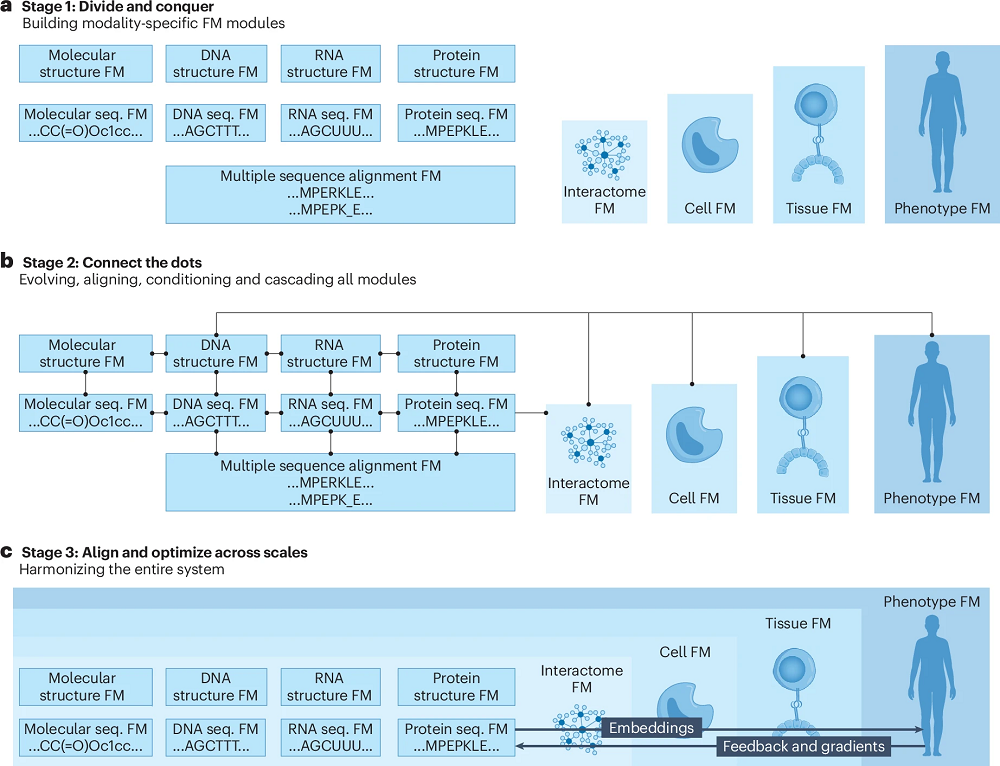
In addition to developing a reliable enough “common language” for models operating at very different biological scales without losing important information in translation, another major challenge is preventing small inaccuracies from accumulating as predictions propagate across those scales.
“A key part of AIDO’s design is to avoid treating biology as a one-way chain of predictions, where a small error at the molecular level could become a much larger error by the time you reach the cell or patient level,” said Le Song, co-founder and CTO. “Instead, AIDO uses feedback across biological scales: predictions made at the molecular, cellular, and higher levels can be checked against real measurements and biological outcomes, and that feedback can be used to improve the system as a whole. You can think of it somewhat like the feedback and alignment process used to improve large language models.”
Experimental and accessible
What can AIDO Cell actually do? In one early demonstration, GenBio used the system to model the effects of imatinib on leukemia cells and found that it could reproduce the drug’s known mechanism of action across several levels of cellular biology.
AIDO Cell currently supports K562 and HepG2, two of the most widely used immortalized human cell lines in biomedical research, derived, respectively, from a patient with chronic myeloid leukemia and from a liver tumor. They are commonly used as laboratory models of blood cancer and liver biology. While additional cell types are in development, the current version remains an early-stage system. GenBio itself describes it as a preview and an early functional demonstration.
GenBio is also preparing to launch an early-access academic collaborator program for scientists across academia, biotech, and pharma, and it plans to release more advanced versions of the system later this year and over the next year.
“Unlike our competitors, we do not believe that virtual cell models belong behind closed doors,” said another co-founder, Emma Lundberg, professor at Stanford University and Co-Director of the Human Protein Atlas. “We’ve not only built a virtual cell model, we’ve also built an AI that can rapidly build a tailored virtual cell for your question, on your data. Bring your data, and we’ll build it for you.”
In the near term, AIDO Cell could serve as a virtual testing ground for drugs, allowing researchers to explore cellular effects in silico before committing to physical experiments. If sufficiently accurate, that could help eliminate weaker candidates earlier and focus resources on the most promising ones.
“Having led AI for R&D at a major pharmaceutical company, the major challenge we were facing was the inability to accurately determine how a drug behaves in a real cellular environment,” said Ziv Bar-Joseph, co-founder and CSO. “This often led to many clinical trial failures. A system like AIDO Cell enables companies to quickly and accurately evaluate several drug candidates leading to better, safer and more efficient treatments years earlier than is possible today.”
There is a broader scientific promise as well. AIDO Cell and similar systems could eventually become powerful tools for basic biological research, allowing scientists to perturb genes, proteins, or pathways, follow the predicted consequences across biological levels, generate hypotheses, and identify relationships that might take much longer to uncover in the lab.
View the article at lifespan.io


