






A new study compared high-intensity sprint-interval exercise with moderate-intensity exercise. The former produced larger changes in circulating protein and metabolite levels than the latter and stimulated proteins associated with cardiometabolic health benefits [1].
Short and intense vs. long and moderate
Exercise is a well-known lifestyle factor that can positively impact health. Exercise benefits multiple cells, tissues, and organs through factors that are secreted by various cells and circulate in the body [2]. However, the particular type of exercise that offers the greatest return on investment remains debated. Similarly, the circulating factors that mediate exercise benefits are still not fully defined.
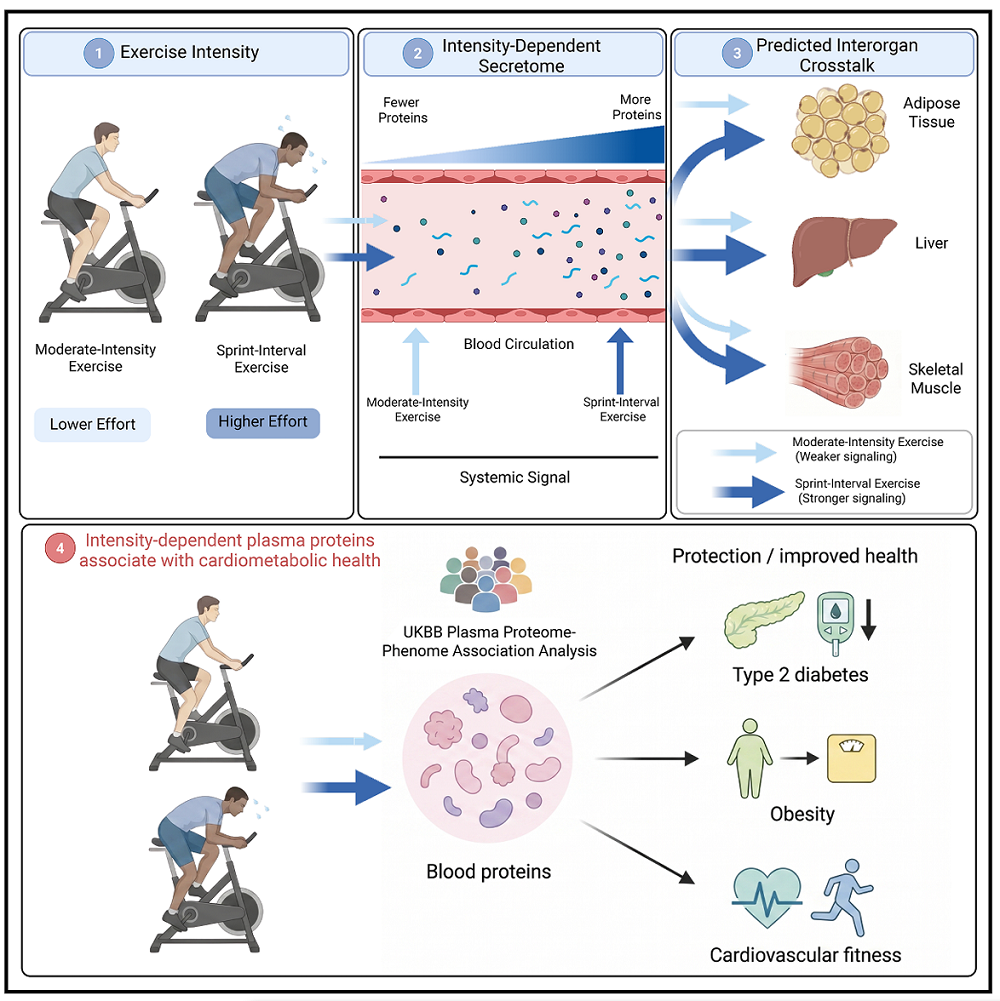
Since intensity affects the composition of secreted molecules, the researchers employed “young, active, metabolically healthy males” in order to understand how exercise intensity affects these molcules and their crosstalk between organs. One group performed sprint-interval exercise (SIE), a routine that consists of short bursts of physical activity: here, it was 6 sets of 30-second all-out cycling with 4-minute rests between sets. The other group did 90 minutes of continuous cycling as moderate-intensity exercise (MIE), with individually adjusted intensity.
Intensity-dependent changes
Initial analysis of all proteins (the proteome) in plasma showed intensity-dependent changes, encompassing almost a quarter of the total detected proteins, including factors involved in the formation of new blood vessels (angiogenesis), extracellular matrix remodeling, gut signaling, and potential neuroregulation, immediately after SIE. Most of these proteins returned to resting levels three hours after exercise, showing that SIE drives rapid changes in the plasma proteome. MIE shows only modest time-dependent changes.
The researchers also noted intensity-dependent and time-dependent changes in secreted metabolites following both SIE and MIE. For SIE, significant changes were observed immediately after exercise and again three hours later, while MIE showed a delayed response: only a few molecules changed immediately after exercise, but that number increased three hours later. The metabolites that changed following SIE are associated with high energetic demands, while those that changed following MIE reflect the sustained energetic demands that are characteristic of continuous exercise.
The researchers repeated the experiment on a subset of participants who underwent 8 weeks of training; similar results emerged. Similar observations also emerged when the researchers tested runners, suggesting these changes are specific to exercise intensity rather than training level or exercise modality.
“What’s exciting here is that just a few minutes of intense exercise can trigger a significant molecular response,” says Paul Cohen, Associate Professor at The Rockefeller University and the corresponding author of the study. “And we still see it after eight weeks of training, which tells us this response isn’t simply a product of the body struggling to keep up with unfamiliar stress. It may be that the responses we observed are intrinsic to intense exercise.”
Multi-organ crosstalk
Because those exercise-responsive proteins and metabolites were in plasma, the question is which organs released them and which organs they affect. Investigating this question suggested crosstalk among many organs and the systemic effects of the studied metabolites.
First, experiments suggested that multiple organs can be a potential source for plasma proteins released following both SIE and MIE, with immune-system proteins most represented. However, later experiments focused on skeletal muscle, a tissue known to be affected by physical exercise. Experiments using human and mouse skeletal muscle cell cultures and skeletal muscle samples collected from study participants before and three hours after SIE and MIE suggested a role for skeletal muscle in intensity-dependent release of organ-specific proteins, specifically muscle fiber-derived proteins, which was greater following SIE.
Next, the researchers focused on the tissues affected by those circulating proteins, since secreted proteins can affect organs if they bind to receptors on their surfaces. There were multiple ligand-receptor pairs that were differentially regulated following SIE but not MIE.
Using primary human adipocyte cell cultures as an example, the authors showed that exercise intensity can impact gene expression in these tissues, with significant changes following SIE and modest changes following MIE. While only adipose tissue was investigated, it is likely not the only tissue affected by exercise-intensity-dependent protein release, but further research needs to assess the extent of cross-talk between organs following exercise.
Cardiometabolic health benefits
The experimental data suggested that exercise intensity affects protein release, which impacts interorgan communication. Those processes, in turn, affect systemic metabolism. The observed changes in protein levels, while transient, might have long-term effects if repeated in regular bouts of physical activity. Previous studies proposed a link between repeated exposure to such “transient increases in beneficial circulating proteins” and cardiometabolic health [3]. This study’s authors asked whether the proteins identified as being regulated by SIE and MIE are associated with health outcomes.
Using UK Biobank data and their own data, they identified protein-disease associations. Among the identified associations, they focused on plausible links to cardiometabolic benefits. This allowed them to identify 143 proteins associated with multiple disease groups, most of which were regulated solely following SIE. Narrowing their search to proteins associated with a lower risk of metabolic disorders, obesity, and type 2 diabetes identified 33 proteins. All but one of those proteins were differentially regulated following SIE, which is a stark contrast to only 3 proteins that were regulated by MIE.
The intensity-dependent systemic benefits of exercise also appear to have long-term effects, as more than a quarter of the 33 identified proteins had previously been inversely associated with age.
Mediators of health-promoting effects
Overall, this study shows exercise intensity-dependent changes in the plasma proteome and their systemic impact, and it provides understanding as to how short bursts of intense exercise can elicit whole-body health benefits.
As Luke Olsen, the postdoctoral fellow who conducted the studies, summarizes, “It’s well appreciated that different intensities of exercise stimulate distinct body-wide adaptations.” “However, the molecular mechanisms linking these intensity-dependent adaptations have remained largely elusive. Our work suggests that exerkines—proteins and metabolites released into the bloodstream following exercise—are highly sensitive to exercise intensity and may be the key mediators of the health-promoting effects of short bursts of vigorous exercise.”
Literature
[1] Olsen, L., Botella, J., Barrows, D., Romero, E., Baird, K., Katayama, M., Kilic, E., Peralta, C., Zanou, N., Sanford, H., Farrell, L., Axelrod, C. L., Plucińska, K., Walker, J., Yan, L., Fredrickson, K., Pourquie, O., Robbins, J. M., Vinogradova, E. V., Molina, H., … Cohen, P. (2026). Exercise intensity modulates interorgan communication and is associated with cardiometabolic health outcomes in humans. Cell reports. Medicine, 102988. Advance online publication.
[2] Chow, L. S., Gerszten, R. E., Taylor, J. M., Pedersen, B. K., van Praag, H., Trappe, S., Febbraio, M. A., Galis, Z. S., Gao, Y., Haus, J. M., Lanza, I. R., Lavie, C. J., Lee, C. H., Lucia, A., Moro, C., Pandey, A., Robbins, J. M., Stanford, K. I., Thackray, A. E., Villeda, S., … Snyder, M. P. (2022). Exerkines in health, resilience and disease. Nature reviews. Endocrinology, 18(5), 273–289.
[3] Robbins, J. M., Katz, D. H., Many, G. M., Rao, P., Smith, G. R., Tiwari, G., Jin, C., Spielmann, G., Montalvo, S., Iyer, G., Amar, D., Leach, D., Coyne, B. J., Lindholm, M. E., Goodpaster, B., Walsh, M. J., Clish, C. B., Burant, C. F., Gerszten, R. E., & MoTrPAC Study Group (2026). Blood Biochemical Responses to Acute Exercise: Findings from the Molecular Transducers of Physical Activity Consortium (MoTrPAC). bioRxiv : the preprint server for biology, 2026.03.02.704798.
View the article at lifespan.io


