






A new study highlights a fatty acid produced by a particular genus of bacteria as a “natural statin,” suggesting a new way of treating atherosclerosis [1].
Bacteria and cholesterol
Atherosclerosis develops when cholesterol-rich particles accumulate in arterial walls, driving inflammation and plaque buildup. The liver helps mitigate this process by removing low-density lipoprotein (LDL), which is known for its negative effects, from the bloodstream through LDL receptors that capture those particles and deposit them in cells.
Gut bacteria are known to be able to influence cholesterol metabolism through the molecules they produce [2]. Previous research has found that several species of the genus Bacteroides are less abundant in people with atherosclerotic cardiovascular disease. A group of Chinese researchers decided to dig deeper into this phenomenon and published their results in Nature.
First, the researchers analyzed gut microbial sequencing data from people with atherosclerotic cardiovascular disease as well as healthy controls. B. uniformis stood out as the most abundant bacterial species associated with the healthy group.
They then administered the bacterium to male mice lacking Apoe, a gene involved in clearing cholesterol-rich particles. These mice quickly develop atherosclerosis when on a high-fat diet. Atorvastatin, an established cholesterol-lowering drug, was used as positive control.
Twelve weeks of B. uniformis treatment reduced plaque area in the aorta and aortic root. It also lowered the overall plaque burden, circulating LDL cholesterol, total cholesterol, and triglycerides. HDL cholesterol did not change significantly.
Importantly, this is compared to vehicle-fed controls by the end of the experiment, rather than to baseline, which was not measured. Hence, the experiment demonstrated slowing, but not necessarily reversing, atherosclerosis. Atorvastatin produced comparable or slightly better results.
The treatment also reduced the number of plaque-associated macrophages, the immune cells that take up lipids and contribute to plaque development, and shifted the local immune environment toward a less inflammatory profile.
Dampening cholesterol production
The researchers also examined gene and protein activity in the liver. B. uniformis increased expression of LDL receptors and activated SREBP2, a regulatory protein that responds to low cellular cholesterol.
To test whether increased LDL uptake actually mattered, the researchers disabled the LDL receptor gene selectively in the liver. Without these receptors, the bacterium lost its ability to improve blood lipids, plaque burden, or inflammation, showing that working liver LDL receptors are necessary for the protective effect.
But why was this low-cholesterol response activated? The researchers found that B. uniformis actually reduced cholesterol synthesis in the liver. They hypothesized that decreased cholesterol production in liver cells prompts them to upregulate LDL receptors and draw more cholesterol out of the bloodstream, causing blood LDL levels to drop.
Next, the researchers asked whether the effect required living bacteria or could be reproduced by something they released. Dead bacteria did not do the trick, but an extract of the bacteria’s culture fluid did. Together, these results implicated a molecule produced by metabolically active bacteria.
The molecule in question was identified as pentadecanoic acid – a saturated fatty acid with 15 carbon atoms (“odd-chain”), also known as C15:0. It activated the same SREBP2-LDL receptor pathway.
Same pathway, smaller effect than atorvastatin
The researchers then gave purified C15:0 to atherosclerosis-prone mice for eight weeks, again with atorvastatin as a positive control, both at 25 mg/kg three times weekly. C15:0 reduced plaque burden by about 50% and lowered total and LDL cholesterol. It also reduced macrophage accumulation in plaques and systemic inflammatory markers. Atorvastatin, however, performed noticeably better.
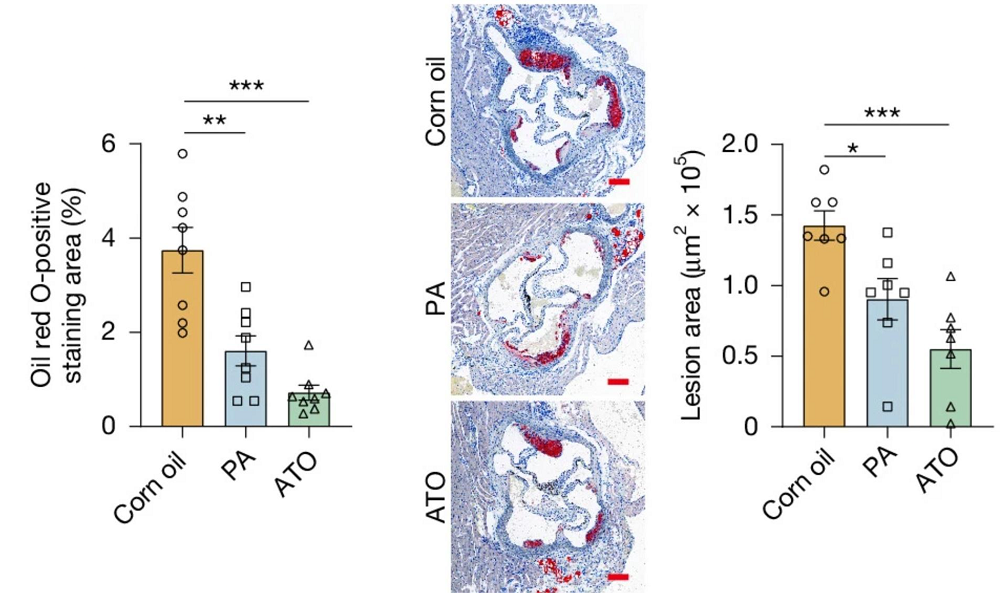
Like the bacterium, C15:0 reduced cellular and liver cholesterol. The researchers then investigated HMG-CoA reductase, an enzyme controlling a key step in cholesterol synthesis and the target of statin drugs. The experiments showed that C15:0 directly bound the enzyme and inhibited its activity.
However, C15:0 is a weaker inhibitor than atorvastatin, consistent with its more modest effect on atherosclerosis. The authors suggest that its greater persistence and exposure in mice might partly compensate for this.
Finally, the researchers measured C15:0 in people with abnormally high blood lipid levels (dyslipidemia) and healthy controls. The former had significantly lower C15:0 concentrations. Reanalysis of existing microbial sequencing datasets also showed lower levels of C15:0-production genes in people with atherosclerotic cardiovascular disease.
The findings underline new ways in which the microbiome might be harnessed to protect the heart, said study co-author Wenjing Zhao, a microbiologist at Sun Yat-sen University in Shenzhen, to Nature. However, more studies – especially in humans – are needed. Currently, it is not clear that C15:0, which can be purchased as a supplement, is superior to statins in any way. However, this still might prove to be the case; for instance, if further research shows a better safety profile or a larger tolerable dose.
Literature
[1] Yin, C., Chen, Y., Lin, G. et al. (2026). A gut microbial odd-chain fatty acid alleviates atherosclerosis in mice. Nature.
[2] Haghikia, A., Zimmermann, F., Schumann, P., Jasina, A., Roessler, J., Schmidt, D., … & Landmesser, U. (2022). Propionate attenuates atherosclerosis by immune-dependent regulation of intestinal cholesterol metabolism. European heart journal, 43(6), 518-533.
[3] Jie, Z., Xia, H., Zhong, S. L., Feng, Q., Li, S., Liang, S., … & Kristiansen, K. (2017). The gut microbiome in atherosclerotic cardiovascular disease. Nature communications, 8(1), 845.
View the article at lifespan.io


