• Log in with Facebook Log in with Twitter Log In with Google      Sign In    
  • Create Account
  LongeCity
              Advocacy & Research for Unlimited Lifespans


Adverts help to support the work of this non-profit organisation. To go ad-free join as a Member.


Photo
- - - - -

Should The Us Go To War With Iraq?


  • This topic is locked This topic is locked
952 replies to this topic

#451 Lazarus Long

  • Life Member, Guardian
  • 8,116 posts
  • 242
  • Location:Northern, Western Hemisphere of Earth, Usually of late, New York

Posted 15 March 2003 - 10:43 PM

BTW, I hapen to fully agree with this:

"Beware of entangling alliances."
- George Washington


You see I see our already entangled alliances both covert and overt as being a great cause of what is going wrong and forcing us into Iraq. Not as a warning about doing business with the world at large.

#452 bobdrake12

  • Guest
  • 1,423 posts
  • 40
  • Location:Los Angeles, California

Posted 16 March 2003 - 05:06 AM

You see I see our already entangled alliances both covert and overt as being a great cause of what is going wrong and forcing us into Iraq.


Lazarus Long,

What are the entangled alliances that are forcing the US into Iraq? [?]

bob

Edited by bobdrake12, 16 March 2003 - 05:07 AM.


#453 bobdrake12

  • Guest
  • 1,423 posts
  • 40
  • Location:Los Angeles, California

Posted 17 March 2003 - 12:39 AM

http://www.msnbc.com...p?0cv=KA01#BODY

Posted Image

The Arrogant Empire (Part I and Part III included)

America’s unprecedented power scares the world, and the Bush administration has only made it worse. How we got here—and what we can do about it now

By Fareed Zakaria - NEWSWEEK


March 24 issue — PART I: The United States will soon be at war with Iraq. It would seem, on the face of it, a justifiable use of military force. Saddam Hussein runs one of the most tyrannical regimes in modern history.

FOR MORE THAN 25 years he has sought to acquire chemical, biological and nuclear weapons, and has, in several documented cases, succeeded. He gassed 60,000 of his own people in 1986 in Halabja. He has launched two catastrophic wars, sacrificing nearly a million Iraqis and killing or wounding more than a million Iranians. He has flouted 16 United Nations resolutions over 12 years that have warned him to disarm or else, including one, four months ago, giving him a “final opportunity” to do so “fully and immediately” or face “serious consequences.” But in its campaign against Iraq, America is virtually alone. Never will it have waged a war in such isolation. Never have so many of its allies been so firmly opposed to its policies. Never has it provoked so much public opposition, resentment and mistrust. And all this before the first shot has been fired.

Watching the tumult around the world, it’s evident that what is happening goes well beyond this particular crisis. Many people, both abroad and in America, fear that we are at some kind of turning point, where well-established mainstays of the global order—the Western Alliance, European unity, the United Nations—seem to be cracking under stress. These strains go well beyond the matter of Iraq, which is not vital enough to wreak such damage. In fact, the debate is not about Saddam anymore. It is about America and its role in the new world. To understand the present crisis, we must first grasp how the rest of the world now perceives American power.

It is true that the United States has some allies in its efforts to topple Saddam. It is also true that some of the governments opposing action in Iraq do so not for love of peace and international harmony but for more cynical reasons. France and Russia have a long history of trying to weaken the containment of Iraq to ensure that they can have good trading relations with it. France, after all, helped Saddam Hussein build a nuclear reactor that was obviously a launching pad for a weapons program. (Why would the world’s second largest oil producer need a nuclear power plant?) And France’s Gaullist tendencies are, of course, simply its own version of unilateralism.

But how to explain that the vast majority of the world, with little to gain from it, is in the Franco-Russian camp? The administration claims that many countries support the United States but do so quietly. That signals an even deeper problem. Countries are furtive in their support for the administration not because they fear Saddam Hussein but because they fear their own people. To support America today in much of the world is politically dangerous. Over the past year the United States became a campaign issue in elections in Germany, South Korea and Pakistan. Being anti-American was a vote-getter in all three places.

Look at the few countries that do publicly support us. Tony Blair bravely has forged ahead even though the vast majority of the British people disagree with him and deride him as “America’s poodle.” The leaders of Spain and Italy face equally strong public opposition to their stands. Donald Rumsfeld has proclaimed, with his characteristic tactlessness, that while “old Europe”—France and Germany—might oppose U.S. policy, “new Europe” embraces them. This is not exactly right. The governments of Central Europe support Washington, but the people oppose it in almost the same numbers as in old Europe. Between 70 and 80 percent of Hungarians, Czechs and Poles are against an American war in Iraq, with or without U.N. sanction. (The Poles are more supportive in some surveys.) The administration has made much of the support of Vaclav Havel, the departing Czech president. But the incoming president, Vaclav Klaus—a pro-American, Thatcherite free-marketer—said last week that on Iraq his position is aligned with that of his people.

Some make the argument that Europeans are now pacifists, living in a “postmodern paradise,” shielded from threats and unable to imagine the need for military action. But then how to explain the sentiment in Turkey, a country that sits on the Iraqi border? A longtime ally, Turkey has fought with America in conflicts as distant as the Korean War, and supported every American military action since then. But opposition to the war now runs more than 90 percent there. Despite Washington’s offers of billions of dollars in new assistance, the government cannot get parliamentary support to allow American troops to move into Iraq from Turkish bases. Or consider Australia, another crucial ally, and another country where a majority now opposes American policy. Or Ireland. Or India. In fact, while the United States has the backing of a dozen or so governments, it has the support of a majority of the people in only one country in the world, Israel. If that is not isolation, then the word has no meaning.

It is also too easy to dismiss the current crisis as one more in a series of transatlantic family squabbles that stretch back over the decades. Some in Washington have pointed out that whenever the United States has taken strong military action—for example, the deployment of Pershing nuclear missiles in Europe in the early 1980s—there was popular opposition in Europe. True, but this time it’s different. The street demonstrations and public protests of the early 1980s made for good television images. But the reality was that in most polls, 30 to 40 percent of Europeans supported American policies. In Germany, where pacifist feelings ran sky high, 53 percent of Germans supported the Pershing deployments, according to a 1981 poll in Der Spiegel. In France, a majority supported American policy through much of Ronald Reagan’s two terms, even prefer-ring him to the Democratic candidate, Walter Mondale, in 1984.

Josef Joffe, one of Germany’s leading commentators, observes that during the cold war anti-Americanism was a left-wing phenomenon. “In contrast to it, there was always a center-right that was anti-communist and thus pro-American,” he explains. “The numbers waxed and waned, but you always had a solid base of support for the United States.” The cold war kept Europe pro-American. For example, 1968 was a time of mass protests against American policies in Vietnam, but it was also the year of the Soviet invasion of Czechoslovakia. Europeans (and Asians) could oppose America, but their views were balanced by wariness of the Soviet threat and communist behavior. Again, the polls bear this out. European opposition even to the Vietnam War never approached the level of the current opposition to Iraq. This was true outside Europe as well. In Australia, for example, a majority of the public supported that country’s participation in the Vietnam War through 1971, when it withdrew its forces.

But today no such common threat exists, and support for America is far more fluid. Center-right parties might still support Washington, but many do so almost out of inertia and without much popular support for their stand. During the recent German election, Gerhard Schroder campaigned openly against America’s Iraq policy. Less noted was that his conservative opponent, Edmund Stoiber, did so as well, at one point (briefly) outflanking Schroder by saying he would not even allow American bases in Germany to participate in the war.

In one respect, I believe that the Bush administration is right: this war will look better when it is over. The military campaign will probably be less difficult than many of Washington’s opponents think. Most important, it will reveal the nature of Saddam’s barbarous regime. Prisoners and political dissidents will tell stories of atrocities. Horrific documents will come to light. Weapons of mass destruction will be found. If done right, years from now people will remember above all that America helped rid Iraq of a totalitarian dictator.

But the administration is wrong if it believes that a successful war will make the world snap out of a deep and widening mistrust and resentment of American foreign policy. A war with Iraq, even if successful, might solve the Iraq problem. It doesn’t solve the America problem. What worries people around the world above all else is living in a world shaped and dominated by one country—the United States. And they have come to be deeply suspicious and fearful of us.

PART III: WHERE BUSH WENT WRONG

George W. Bush came into office with few developed ideas about foreign policy. He didn’t seem much interested in the world. During the years that his father was envoy to China, ambassador to the United Nations, director of the CIA and vice president, Bush traveled two or three times outside the country. Candidate Bush’s vision amounted mostly to carving out positions different from his predecessor. Many conservatives thought the Clinton administration was over-involved in the world, especially in nation-building, and hectoring in its diplomacy. So Bush argued that America should be “a humble nation,” scale back its commitments abroad and not involve itself in rebuilding other countries.

Yet other conservatives, a number of whom became powerful within the administration, had a more sweeping agenda. Since the early ’90s, they had argued that the global landscape was marked by two realities. One was American power. The post-cold-war world was overwhelmingly unipolar. The other was the spread of new international treaties and laws. The end of the cold war had given a boost to efforts to create a global consensus on topics like war crimes, land mines and biological weapons. Both observations were accurate. From them, however, these Bush officials drew the strange conclusion that America had little freedom to move in this new world. “The picture it painted in its early months was of a behemoth thrashing about against constraints that only it could see,” notes the neoconservative writer Robert Kagan. For much of the world, it was mystifying to hear the most powerful country in the history of the world speak as though it were a besieged nation, boxed in on all sides.

In its first year the administration withdrew from five international treaties—and did so as brusquely as it could. It reneged on virtually every diplomatic effort that the Clinton administration had engaged in, from North Korea to the Middle East, often overturning public statements from Colin Powell supporting these efforts. It developed a language and diplomatic style that seemed calculated to offend the world. (President Bush has placed a portrait of Theodore Roosevelt in the White House. TR’s most famous words of advice are worth recalling: “Speak softly and carry a big stick.”) Key figures in the administration rarely traveled, foreign visitors were treated to perfunctory office visits, and state dinners were unheard of. On an annual basis, George W. Bush has visited fewer foreign countries than any president in 40 years. Still, he does better than Dick Cheney, who has been abroad only once since becoming vice president.

September 11 only added a new layer of assertiveness to Bush’s foreign policy. Understandably shocked and searching for responses, the administration decided that it needed total freedom of action. When NATO, for the first time in its history, invoked the self-defense clause and offered America carte-blanche assistance, the administration essentially ignored it. It similarly marginalized NATO in the Afghan war. NATO has its limitations, which were powerfully revealed during the Kosovo campaign, but the signal this sent to our closest allies was that America didn’t need them. Thus as seen by the rest of the world, 9-11 had a distressingly paradoxical effect. It produced a mobilization of American power and yet a narrowing of American interests. Suddenly, Washington was more powerful and determined to act. But it would act only for its own core security and even pre-emptively when it needed to. Bush later announced an expansive, vague Wilsonian vision—which has merit—but his style and methods overshadowed its potential promise.

The Bush administration could reasonably point out that it doesn’t get enough credit for reaching out to the rest of the world. President Bush has, after all, worked with the United Nations on Iraq, increased foreign aid by 50 percent, announced a $15 billion AIDS program and formally endorsed a Palestinian state. Yet none of these actions seems to earn him any good will. The reason for this is plain. In almost every case, the administration comes to multilateralism grudgingly, reluctantly, and with a transparent lack of sincerity. For a year now, President Bush has dismissed the notion that he should make any effort toward a Middle East peace process, even though it would have defused some of the anti-Americanism in the region as he sought to confront Iraq. Suddenly last week, to gain allies on Iraq and at the insistence of Tony Blair, Bush made a belated gesture toward the peace process. Is it surprising that people are not hailing this last-minute conversion?

Nowhere has this appearance of diplomatic hypocrisy been more striking than on Iraq. The president got high marks for his superb speech at the Security Council last September, urging the United Nations to get serious about enforcing its resolutions on Iraq and to try inspections one last time. Unfortunately, that appeal had been preceded by speeches by Cheney and comments by Rumsfeld calling inspections a sham—statements that actually contradicted American policy—and making clear that the administration had decided to go to war. The only debate was whether to have the United Nations rubber-stamp this policy. To make matters worse, weeks after the new U.S.-sponsored U.N. resolution calling for fresh inspections, the administration began large-scale deployments on Iraq’s border. Diplomatically, it had promised a good-faith effort to watch how the inspections were going; militarily, it was gearing up for war with troops that could not stay ready in the desert forever. Is it any wonder that other countries, even those that would be willing to endorse a war with Iraq, have felt that the diplomacy was a charade, pursued simply to allow time for military preparations?

President Bush’s favorite verb is “expect.” He announces peremptorily that he “expects” the Palestinians to dump Yasir Arafat, “expects” countries to be with him or against him, “expects” Turkey to cooperate. It is all part of the administration’s basic approach toward foreign policy, which is best described by the phrase used for its war plan—”shock and awe.” The notion is that the United States needs to intimidate countries with its power and assertiveness, always threatening, always denouncing, never showing weakness. Donald Rumsfeld often quotes a line from Al Capone: “You will get more with a kind word and a gun than with a kind word alone.”

But should the guiding philosophy of the world’s leading democracy really be the tough talk of a Chicago mobster? In terms of effectiveness, this strategy has been a disaster. It has alienated friends and delighted enemies. Having traveled around the world and met with senior government officials in dozens of countries over the past year, I can report that with the exception of Britain and Israel, every country the administration has dealt with feels humiliated by it. “Most officials in Latin American countries today are not anti-American types,” says Jorge Castaneda, the reformist foreign minister of Mexico, who resigned two months ago. “We have studied in the United States or worked there. We like and understand America. But we find it extremely irritating to be treated with utter contempt.” Last fall, a senior ambassador to the United Nations, in a speech supporting America’s position on Iraq, added an innocuous phrase that could have been seen as deviating from that support. The Bush administration called up his foreign minister and demanded that he be formally reprimanded within an hour. The ambassador now seethes when he talks about U.S. arrogance. Does this really help America’s cause in the world? There are dozens of stories like this from every part of the world.

In diplomacy, style is often substance. Consider this fact: the Clinton administration used force on three important occasions—Bosnia, Haiti and Kosovo. In none of them did it take the matter to the United Nations Security Council, and there was little discussion that it needed to do so. Indeed, Kofi Annan later made statements that seemed to justify the action in Kosovo, explaining that state sovereignty should not be used as a cover for humanitarian abuses. Today Annan has (wrongly) announced that American action in Iraq outside the United Nations will be “illegal.” While the Clinton administration—or the first Bush administration—was assertive in many ways, people did not seek assurances about its intentions. The Bush administration does not bear all the blame for this dramatic change in attitudes. Because of 9-11, it has had to act forcefully on the world stage and assert American power. But that should have been all the more reason to adopt a posture of consultation and cooperation while doing what needed to be done. The point is to scare our enemies, not terrify the rest of the world.

Edited by bobdrake12, 17 March 2003 - 12:49 AM.


sponsored ad

  • Advert

#454 bobdrake12

  • Guest
  • 1,423 posts
  • 40
  • Location:Los Angeles, California

Posted 17 March 2003 - 12:55 AM

http://www.signonsan...n15iraqmex.html

Mexico fears backlash from vote on Iraq (excerpts)

By Jerry Kammer - COPLEY NEWS SERVICE

March 15, 2003


WASHINGTON – As Mexico faces up to heavy U.S. pressure to vote its way in the Iraq crisis, it also confronts the possibility of a widespread U.S. backlash.

"If the perception of the average American is that his neighbor abandoned him at this crucial time, the stigma would last for generations and be made manifest in a multitude of individual actions," Mexican analyst and historian Enrique Krauze warned this month in a Mexico City newspaper.

Krauze cited danger of commercial boycotts, restrictions on trade and widespread resentment at the White House, in local and state governments and in the U.S. press. He fretted that Mexicans living in the United States might suffer "discrimination, persecutions, etc."

Krauze's pessimism is widely shared by Mexican diplomats here, some of whom acknowledge that they are praying that the U.S. resolution that would authorize a possible war with Iraq will never come to a vote. Indications are that Mexican President Vicente Fox, facing overwhelming public opposition to the war, would invoke Mexico's tradition of nonintervention and either vote "no" or abstain. Either way, he would antagonize the White House.

#455 Lazarus Long

  • Life Member, Guardian
  • 8,116 posts
  • 242
  • Location:Northern, Western Hemisphere of Earth, Usually of late, New York

Posted 17 March 2003 - 04:54 PM

Lazarus Long,

What are the entangled alliances that are forcing the US into Iraq?  

bob


This is complex but let us step back a bit and talk of a new player on the stage of global politics, a player with the power of nations but none of the commensurate allegiances, the Transnational Corporations.

These are definitely creating not only powerful conflicting commitments for modern countries, not only our own, but the are doing so covertly and with popular ignorance of these conflicted interests that then again make our actions more suspect and our motives more specious.

What other entangling alliances. How about five centuries of colonial warfare against native peoples?

The "Natives" here are subject prisoners in their own lands, in England they are called Celts and Irish, (And a most Happy St. Patty's Day to you m'bukko for that matter :) ) and in Spain they are called Basque. The Chinese might call them Islamic Mongols or Tibetans Buddhists and the Russians name them Chechen (Islamic) Separatists. In South America the Amerindian quechuan speakers are the last vestiges of the Incan peoples and in Africa and much of Asia the tribal alliances are too arcane and numerous to recount here but have been "played with” a consequence of Colonial and subsequent Cold War Politics that has reaped a harvest more arcane and Byzantine than I can do justice to in this simple post. Texts can be written and whole threads created for study but the truth is being drafted faster than it generally can be studied.

Look around the world and quickly it becomes a more complex puzzle when the domestic politics of insurrection by legitimate regional ethnic and cultural dissident voices are being reclassified everywhere as terrorists. Whose Democracy is it anyway?

Peoples like the Mayan Zapatistas confused for Shining Path cocaine dealers when it is the Armies of Latin America, not the rebels that made the pacts with the Drug Lords to fund their covert Paramilitaries. Shall I continue?

Well, I think I will let everyone digest this a bit first.

Washington fought Native Americans, and he admired them more than he felt threatened by them but he was more concerned about the Tories and possible Petty Tyrants among his own cohorts than terrified of this 18th Century "Red Menace".

He was more worried about individual Colonial States, Military Commanders, and Private Businesses creating these then the ones we would establish through Treaty by act of Congress. This is why such "Powers of Government" are spelled out in our Constitution.

It is the covert entanglements that endanger us ever so much more than the overt ones.

It is through our covert alliances that we helped to create al Qaeda in the first place and in destroying it we should beware of creating a million replacements. It is what our enemy desires through their martyrdom, it is what they expect to come. That doesn't mean it is inevitable but we would be willfully foolish to discount their homespun strategy aimed at this part of the world, where we have too little influence and that feels instinctive fear of the Industrial Colonialists as they perceive our Armada en route.

Another example is that if we had already moved against Iraq we probably would not have achieved the high profile arrests of al Qaeda, which we have already obtained. These were made by foreign powers that will be forced to reassess their relationship with us after the attack, and in the chaos and fog of war our trackers will likely lose the trails they have painstakingly followed to the lairs and keep’s of the enemies we must really confront. In the noise and distraction we are about to create worldwide, we are also practically insuring the escape of the highest levels of the real enemy. Why?

We could wait a bit and give our finest hunters a better chance at their targets before we spook all the game. We could cultivate our entangled alliance to our advantage with Pakistan that is helping us but is so threatened by our action that we could create a popular revolt among those that are already in our camp. Pakistan, some say gave us what we seek in order to gain immunity from abstaining in the Security Council Debate.

Why?

Why aren't Americans as members of a democracy demanding to know more of WHY?

Entanglements?

Halliburton and Bechtel are entangled with what is going on at the highest levels. The Bin Ladens are players in this high stakes game of International Intrigue and “We the People” are the dogs getting wagged by our tails. Some see this war in Iraq as a means of intentionally destroying the trail before too much of these entanglements become common knowledge.

I once barroom debated a crucial issue of tactics and law with someone that wanted to hang Ossama bin Laden High. They wanted a slow and tortuous revenge and while I could understand the venom, I couldn't concur because I want the knowledge inside the viper's head. The poison needs to be extracted in order to turn venom into a cure.

Too many think better a dead symbol than the exposed truth that may compromise the very ones we want to believe in. However, the need to know supercedes all demand for vengeance in this matter. That knowledge might insure the survival of the vilest. But it is a vastly more powerful strategy to subvert the martyr, than to create one.

But I am a very cold pragmatist and do not hate what I fear. We need a better battle plan more than sacrifices to the Gods of War. I do not wash my hands of such affairs; I am simply willing to be more honest.

#456 DJS

  • Guest
  • 5,798 posts
  • 11
  • Location:Taipei
  • NO

Posted 17 March 2003 - 08:19 PM

These strains go well beyond the matter of Iraq, which is not vital enough to wreak such damage. In fact, the debate is not about Saddam anymore. It is about America and its role in the new world. To understand the present crisis, we must first grasp how the rest of the world now perceives American power.


Once again trying to minimize the issue of Iraq. I feel like I'm reading talking points [ph34r] .

#457 Thomas

  • Guest
  • 129 posts
  • 0

Posted 17 March 2003 - 08:51 PM

US (with GB and maybe AUS) should go to Iraq, and do what is to do there.

Not less important, France and Co. must be humiliated and it must become at least partly evident to the 80% of war opposing people around the world, that they are either ... well not well informed - or this story will not end happily.

I think, it's about 80% probability, that this will be achieved.

And there was no other way to follow.

- Thomas

#458 Lazarus Long

  • Life Member, Guardian
  • 8,116 posts
  • 242
  • Location:Northern, Western Hemisphere of Earth, Usually of late, New York

Posted 17 March 2003 - 09:05 PM

Saying this policy of immediate war is shortsightedness isn't minimizing the importance of Iraq it is putting the world into a more realistic perspective. One that has been the demonstrable myopia that has affected virually all American Policy throughout our history. Iraq does take second place to numerous other issues and more dangerously so if it promises to have consequences that are yet to be appreciated by most people.

It is simply unnecessary at this precise moment to take this action and when it does become necessary we are already prepared but by doing this we are making ourselves relatively unprepared for many blowback consequences.

You and I are past agreeing to disagree and I recognize that we are moving to the next level of conflict. I for one would prefer it were otherwise but once battle is joined it will move to be total, not contained.

Watch the domestic front, have you ever worked in a prison?

I have worked in refugee camps as well. Watch for collateral damage on the domestic front and realize that it isn't about blame it is about responsibility. And really preventing the problems, not just doing what you think will prevent them or spinning damage control into false promise of a cure.

The reckoning on this will be monumental if it fails, little glory will be gained from victory. You and the Neo Right Wing may want to hold the pacifists responsible but you will have only yourselves to blame and the whole world will hold you accountable as well. There will be no amount of WMD's that will provide you anymore protection than Saddam. The Law is coming and it sadly appears that we are working diligently to make ourselves the World's Idea of an Outlaw State.

#459 Lazarus Long

  • Life Member, Guardian
  • 8,116 posts
  • 242
  • Location:Northern, Western Hemisphere of Earth, Usually of late, New York

Posted 17 March 2003 - 09:09 PM

Here is how it reads behind the lines of hegemony in the streets of Buenos Aires:

http://www.oneworld....?...331&s=klein

column | Posted March 13, 2003

LOOKOUT by Naomi Klein
No Peace Without a Fight

For more information about the Piquetero speaking tour of the United States, see www.autonomista.org.

In a muddy piece of squatted land in the outskirts of Buenos Aires, Florencia Vespignani is planning her upcoming tour of the United States, where she will be speaking with students and activists about Argentina's resistance movements.

"I'm a bit scared," she confesses.

"Of the war?" I ask.

"No. Of the plane. We have wars here all the time."

Vespignani, a 33-year-old mother and community organizer, is a leader in the Movimiento de Trabajadores Desocupados (MTD), one of dozens of organizations of unemployed workers, known as piqueteros, that have emerged out of the wreckage of Argentina's economy.

When Vespignani describes life as war, it is not a metaphor. In a country where more than half the people live in poverty and twenty-seven children die of hunger each day, she has learned that to stay alive, you have to go to the streets and fight--for every piece of bread, for every student's pencil, for every night's rest.


From the perspective of the International Monetary Fund, the piqueteros are the collateral damage of neoliberalism--a fluke explosion that happened when rapid-fire privatization was mixed with "shock" austerity. In the mid-1990s, hundreds of thousands of Argentines suddenly found themselves without paychecks, welfare checks or pensions. Rather than disappearing quietly into the scavenged shantytowns that surround Buenos Aires, they organized themselves into militant neighborhood-based unions. Highways and bridges were blocked until the government coughed up unemployment benefits; abandoned land was squatted on to build homes, farms and soup kitchens; a hundred closed factories were taken over by their employees and put back to work. Direct action became the alternative to theft and death.

But that's not why Vespignani describes life in Argentina as a war. The war is what happens next, after she and her neighbors dare to survive: the visits by armed thugs, the brutal evictions from squatted land and occupied factories, the assassinations of activists by police, the portrayal of piqueteros as menacing terrorists. Last month Buenos Aires police used tear gas and rubber bullets to clear sixty families out of an abandoned building near the trendy Plaza Dorrego. It was the most severe repression in the city since two young leaders of the MTD were killed by police during a road blockade last June.


The police said they were concerned about the safety of the squat, but many people here think the violent eviction was simply part of the latest economic adjustment being cooked up at the Sheraton Hotel, where IMF delegations have been meeting with bankers and candidates in the upcoming presidential election for weeks now. The IMF hopes to assess whether Argentina can be trusted with new loans: whether it will pay off foreign debts while continuing to cut social spending. But there is another criterion, left unspoken, that presidential aspirants must meet to merit foreign capital: They must show that they are willing to use force to control those sectors hurt by such agreements. Squatters, piqueteros--even the cartoneros, the armies of scavengers who comb through garbage looking for cardboard to sell--are under siege. According to the former owner of the city's largest privatized garbage company, now running for mayor on a platform of "Let's Take Back Buenos Aires," garbage is private property and the cartoneros are "thieves."

In short, the desperate quest of millions of Argentines to stay alive is a threat to the economy's recovery and must be stopped.

John Berger recently wrote, "Without money each daily human need becomes a pain." In Argentina, any attempt to alleviate that pain is becoming a crime. That is the war Florencia is talking about, and as she travels across the United States, she will have the difficult task of trying to make that case to activists who are almost exclusively focused on ending a different kind of war, one in which the strategy is "shock and awe," not daily brutality and mass marginalization.

Standing amid the torn-up cobblestones outside the squat on the night the sixty families were evicted, with tear gas still hanging in the air and dozens of people in jail, I found myself thinking about the calls for "peace" coming from Europe and North America. The antiwar message resonates forcefully here, and tens of thousands participated in the global day of action on February 15. But peace? What does peace mean in a country where the right that most needs defending is the right to fight?

My friends in South Africa tell me that the situation there is much the same: Families evicted from miserable shantytowns from Soweto to the Cape Flats, police and private security using bullets and tear gas to force people from their homes, and, last month, the suspicious murder of Emily Nengolo, a 61-year-old activist fighting water privatization. Instead of devoting their energy to securing food, jobs and land, social movements around the world are being forced to spend their time fighting the low-level war against their own criminalization.


The great irony is that these movements are actually waging the real war on terrorism--not with law and order but by providing alternatives to the fundamentalist tendencies that exist wherever there is true desperation. They are developing tactics that allow some of the most marginal people on earth to meet their own needs without using terror--by blockading roads, squatting in buildings, occupying land and resisting displacement.

February 15 was more than a demonstration--it was a promise to build a truly international antiwar movement. If that is going to happen, North Americans and Europeans will have to confront the war on all its fronts: to oppose an attack on Iraq and reject the branding of social movements as terrorist. The use of force to control Iraq's resources is only an extreme version of the force used to keep markets open and debt payments flowing in countries like Argentina and South Africa. And in places where daily life is like war, the people who are militantly confronting this brutality are the peace activists.


Because we all want peace. But let's remember, it won't come without a fight.

#460 Lazarus Long

  • Life Member, Guardian
  • 8,116 posts
  • 242
  • Location:Northern, Western Hemisphere of Earth, Usually of late, New York

Posted 17 March 2003 - 09:27 PM

These are the words of a former slave and self taught social activist and educator, Fredrick Douglass

"The history of the progress of human liberty shows that all concessions yet made have been born in struggle...

If there is no struggle there is no progress. Those who profess to favor Freedom and yet depreciate agitation are (those) who want crops without plowing up the ground...

Power concedes nothing without demand. It never has and it never will."

Realize my Neo Hawk advocates that those who are struggling for peace "have not yet begun to fight." This war will be coming home.

#461 Thomas

  • Guest
  • 129 posts
  • 0

Posted 17 March 2003 - 10:37 PM

Saddam is nearly the worst, what the humanity is able to produce.

And if this same humanity, was not able to neutralize such a mistake ... well, then the human kind wouldn't be so positive - after all.

Aliens, having brutal dictators, tolerated by the majority of the alien population ... I don't want, that something like this exists in our Galaxy. Let alone on this planet.

- Thomas

#462 Lazarus Long

  • Life Member, Guardian
  • 8,116 posts
  • 242
  • Location:Northern, Western Hemisphere of Earth, Usually of late, New York

Posted 18 March 2003 - 03:39 PM

Turkey Shoot
http://slate.msn.com/id/2080262/
Posted Image
How Bush made enemies of our allies.
By Paul Glastris
Posted Monday, March 17, 2003, at 2:27 PM PT

There are no double-blind studies in diplomacy, so we can never know for certain if a president's strategy for a given crisis is wise or if a different one might have worked better. Occasionally, however, history throws up a comparison that is so apt that it can serve as a pretty reasonable test. If, for instance, you want to know whether the collapse of George W. Bush's efforts to gain international support for war on Iraq is the inevitable result of difficult circumstances and intransigent allies or a fundamentally flawed strategy, consider the following comparison.

For months, the administration has been trying to gain permission from the government of Turkey, a NATO ally, to use that country as a base of operations for an Iraq war. In 1999, the Clinton administration asked the same thing of Greece, also a NATO ally, in the run-up to the war in Kosovo. In both countries, over 90 percent of the public opposed the war in question. Both countries also legitimately worried about being destabilized by a flood of refugees—for Turks, Kurds from Iraq; for Greeks, Albanians from Kosovo. And both countries were being asked to take part in wars against co-religionists—Serbs, like Greeks, are predominantly Orthodox Christians; Iraqis, like Turks, are mostly Muslim. Yet the Clinton administration succeeded in getting Greek support, while the Bush administration has so far failed to bring the Turks on board. Indeed, the Turks have refused even to commit to allowing U.S. planes to fly over Turkish airspace, a potentially serious blow to U.S. war plans.

What explains the different outcomes in Turkey and Greece? After all, it's not as if getting Turkey to support a war on Iraq is an inherently harder sell than getting Greeks to support war in Kosovo. If anything, the opposite is true. Public opinion is actually more anti-American in Greece than in Turkey. The Turkish government has always been the more cooperative, thanks to the strong influence of its pro-U.S. military. Turkey never threatened to eject NATO bases from its soil, as Greece did in the 1980s, and Turkey cooperates much more closely with America's ally Israel than does Greece. Moreover, Greeks sympathized openly with the Serbs who controlled Kosovo, whereas Turks have little sympathy for the Arabs who run Iraq.

Another possible explanation is that the Clinton administration's diplomats were more silver-tongued than the Bush administration's. There may be something to this. Certainly, members of the Turkish parliament who voted against their own government in defiance of Washington have said that they did so in part as a reaction to the brusque demands of some members of the Bush team, especially Vice President Dick Cheney. On the other hand, when it comes to smooth diplomacy, Colin Powell is no slouch. And the Clinton team included plenty of people, such as Richard Holbrooke, willing to throw elbows.

The decisive difference, I think, has to do with the basic war strategies of the two administrations. Unlike Clinton, who acted through an existing alliance, NATO, Bush from the beginning has rejected relying on existing international bodies in favor of waging war through a "coalition of the willing." That approach, however, makes it harder to win over reluctant partners because it puts their elected officials in a less tenable position. Turkish politicians are essentially being asked to defy popular will in order to support the dictates of a more powerful country, the United States. Greek politicians were asked to defy their voters not for the sake of relations with the United States—if that were the case, they'd never have done it—but in support of NATO, an alliance in which Greece has a vote, and therefore power.


The difference is crucial. Alliances give less powerful countries some feeling of control over the military power of larger partners. That, in turn, gives the lesser country's elected officials reason to support (and cover for supporting) the alliance's majority decisions—decisions usually orchestrated by the big boys. This largely explains why France supported war in Kosovo but balks at war in Iraq. (It's not just a question of location.)

While French politicians are a bit keener these days to throw their weight around thanks, among other things, to waning French influence in an enlarging European Union, France is still pretty much the same prickly pain-in-the-ass country it was five years ago. Then, as now, France was worried about attacking a criminal regime (Serbia) with which it enjoyed economic and historical ties. Then, as now, it was highly suspicious of U.S. military power and had ways to check that power—in Kosovo through its vote in NATO, in Iraq through its seat on the U.N. Security Council. It even has the same president, Jacques Chirac. Yet Clinton won Chirac's support, while Bush has gotten only his veto threat. Why? At least in part because, from Day 1, Bush has said he's going act as he sees fit regardless of how the United Nations votes. By so doing, he not only put Chirac in the same political position as he did the Turkish MPs; worse, he created a constituency for France's view of the world, that American hegemony is the real problem.

Rather than make the most of the extraordinary support the world offered the United States after 9/11, the Bush administration seems almost willfully to have squandered it. In the months after Sept. 11, the administration withdrew from one international agreement after another, from the ABM treaty to the International Criminal Court. It refused NATO's offer of help in Afghanistan, eventually accepting some troops from NATO-member countries but no shared NATO decision-making. Though German Chancellor Gerhard Schröder braved a no-confidence vote to win parliamentary approval to put German combat troops in Afghanistan, he received little thanks from Bush. Nor was he seriously consulted as Bush formulated his Iraq policy, despite (or perhaps because of) growing signs of German discomfort with that policy. Cut out of the loop, Schröder then began to exploit the anti-Iraq war backlash among German voters and become a fierce opponent of Bush on Iraq.


Why did the administration stiff-arm NATO? Partly because administration hawks wanted to act unilaterally in order to lay a precedent for the new hegemonic military doctrine that the Pentagon would later codify. There is also a related belief, widespread within the administration, that any restraint on the U.S. military's freedom of action is unacceptable. It is certainly the case that trying to get 19 NATO allies to agree on a military plan can be frustrating, as Gen. Wesley Clark, who ran NATO's Kosovo campaign, describes in his book Waging Modern War. "We read your book," Defense Secretary Donald Rumsfeld told Clark shortly after 9/11, "And no one is going to tell us where we can or can't bomb." (Alas, they didn't read it very carefully.)

No alliance comes without compromises, even a "coalition of the willing." Desperate to win Ankara's support, for instance, the Bush administration agreed to allow Turkish troops to march into Kurdish-controlled northern Iraq. That compromise sparked a Kurdish threat to attack the Turks if they tried. Yet even with this inordinately generous concession, plus billions of dollars in promised aid, the Bush administration couldn't get Turkey on board. By contrast, the Clinton administration didn't have to offer big bribes and concessions to win Romania's and Bulgaria's support for the war in Kosovo, even though most voters there opposed the war. Instead, the administration merely noted that if those countries ever wanted to join NATO—and they did—they'd better get behind the war.

Rather than dismissing NATO—and possibly crippling it permanently—what if the Bush administration had brought the alliance into the later stages of the Afghanistan war so that the political leaders of France and Germany could have basked in the glory of having helped vanquish the Taliban?


And what if, instead of asserting publicly for months America's right to attack Saddam unilaterally and then turning on its heels and asking the United Nations for a vote, the Bush administration had simply gone to its European allies and asked for their support in the disarming of Iraq (perhaps hinting behind the scenes of our willingness to use force unilaterally if we didn't get their support)? Might it have been possible, in the afterglow of a successful Afghan campaign fought with NATO, to convince alliance members to agree to enforce any new U.N. resolutions against Iraq?

Might it have been easier to pass a second U.N. resolution, or at least get majority support in the Security Council, if it were NATO calling for the vote, and not just the United States, Great Britain, and Spain?

Indeed, would such a resolution have even been necessary? And if it were Brussels, not Washington, demanding that Turkey support an invasion of Iraq, would Turkey, desperate to join the European Union, have dared refuse?

Of course, we'll never know the answer to these questions. History doesn't do controlled experiments. But we do know that George H.W. Bush worked sincerely and energetically to put together an international war coalition and succeeded; Bill Clinton worked sincerely and energetically to put together an international war coalition and succeeded; and George W. Bush worked grudgingly and sporadically to do the same and failed.

History will almost certainly judge Chirac and other European politicians harshly for blocking what could have been a unified front against Saddam—especially if the war is swift, casualties are low, and new evidence emerges of Saddam's brutality and possession of weapons of mass destruction. Still, the excuses now being made by the Bush administration and its allies ("The French are perfidious!" "The Turks will be sorry!") have a certain dog-ate-my-homework quality—of blaming others for a failure that was equally the result of their own desultory efforts. Even as his strategy was failing, the president recently remarked that "we really don't need anybody's permission" to invade Iraq. In a strict sense, of course, that's true. But his words suggest that he still doesn't fully understand—as virtually all his recent predecessors did—the value of formal alliances in fighting wars and in keeping the peace afterward. America should have been able to invade Iraq with an alliance, or at least a broad coalition. Instead, all we have is a gang.


Suggested reading
http://slate.msn.com...idebar/2080267/

http://slate.msn.com...idebar/2080268/

http://slate.msn.com...idebar/2080269/

http://slate.msn.com/id/2080237/

#463 Lazarus Long

  • Life Member, Guardian
  • 8,116 posts
  • 242
  • Location:Northern, Western Hemisphere of Earth, Usually of late, New York

Posted 18 March 2003 - 03:57 PM

(Un)Intended Consequences
What's the future if we don't act?
By Christopher Hitchens
Posted Monday, March 17, 2003, at 10:25 AM PT

There has been a certain eeriness to the whole Iraq debate, from the moment of its current inception after Sept. 11, 2001, right through the phony period of protracted legalism that has just drawn to a close. It was never really agreed, between the ostensibly contending parties, what the argument was "about." (Nor had it been in the preceding case of Kuwait in 1991: You may remember Secretary of State James Baker on that occasion exclaiming that the justification could be summarized in the one word "jobs.") Nobody has yet proposed that this is a job-creating war—though it may turn out to be—nor has anyone argued that it will be a job-losing one (though it might turn out to be that, too). The president bears his share of responsibility for this, for having made first one case and then another. So do the "anti-war" types, for picking up and discarding a series of straw arguments.

Conspicuous among the latter, and very popular recently, is the assertion that proponents of regime change have been TOO consistent. On every hand, I hear it darkly pointed out that several neoconservative theorists have wanted to get rid of Saddam Hussein for a very long time. Even before Sept. 11! Even before the invasion of Kuwait! It's easy to look up the official papers and public essays in which Paul Wolfowitz, for example, has stressed the menace of Saddam Hussein since as far back as 1978. He has never deviated from this conviction. What could possibly be more sinister?

The consistency with which a view is held is of course no guarantee of that view's integrity. But it seems odd to blame Wolfowitz for having in effect been right all along. Nor, by his repeated hospitality and generosity to gangsters from Abu Nidal to Islamic Jihad and al-Qaida (in the latter instance most obviously after Sept. 11, 2001), has Saddam Hussein done much to prove him wrong. So, the removal of this multifarious menace to his own population, to his neighbors, and to targets further afield would certainly be an "intended consequence" of a policy long-meditated at least on some peoples' part.

What of the "unintended" consequences? By some bizarre convention, only those who favor action to resolve this long-running conflict are expected to foresee, or to take responsibility for, the future. But there's no evading the responsibility here, on either side. (I wouldn't want, for example, the responsibility of having argued for prolonging the life of a fascist regime.) But who can be expected to predict the future?

The impossibility doesn't stop people from trying. Jimmy Carter, in 1991, wrote a public letter to Arab heads of state urging them to oppose the forcible eviction of Saddam Hussein from Kuwait. An American-led counterattack would, he instructed them, lead at once to massive rioting and disorder across the Islamic world. It would cause untold numbers of casualties. And it would lead to an increase in terrorism.

Carter said all this again recently in a much-noticed op-ed piece. He could even be right this time, but not for any reason or reasoning that he's been able to demonstrate.

As an experiment, let's take a Carter policy. As president, he encouraged Saddam Hussein to invade Iran in 1979 and assured him that the Khomeini regime would crumble swiftly. The long resulting war took at least a million and a half lives, setting what is perhaps a record for Baptist-based foreign policy and severely testing Carter's proclaimed view that war is a last resort.

However, of these awful casualties, an enormous number were fervent Iranian "revolutionary guards," who were flung into battle as human waves. Not only did this rob Shiite fundamentalism of its most devoted volunteers, but it left Iran with a birth deficit. The ayatollahs then announced a policy of replenishment, financing Iranian mothers with special inducements and privileges if they would have large families. The resulting baby-boom generation is now entering its 20s and has, to all outward intents and purposes, rejected the idea of clerical rule. The "Iranian street" is, if anything, rather pro-American. How's that for an unintended or unforeseen consequence?


Or take another thought-experiment, this time from one of Carter's lugubrious warnings. There are many smart people who have come to believe that the first bombing of the World Trade Center, in 1993, was in fact a terrorist revenge for Kuwait on Saddam Hussein's part. Ramzi Yusef, generally if boringly described as the "mastermind" of that and related plots—and the nephew of the recently apprehended Khalid Sheikh Mohammed of al-Qaida—may have been an Iraqi agent operating with a Kuwaiti identity forged for him during Saddam's occupation of that country.

One cannot be sure. But suppose that this was a terrorist counterstroke of the sort that is now so widely predicted to be in our future rather than our past. Would it have been better to have let Saddam Hussein keep Kuwait and continue work on what was (then) his nuclear capacity? That seems to be the insinuation of those who now argue that a proactive policy only makes our enemies more cross.

If consequences and consistency are to count in this argument, then they must count both ways. One cannot know the future, but one can make a reasoned judgment about the evident danger and instability of the status quo. Odd that the left should think that the status quo, in this area of all areas, is so worthy of preservation.

#464 Lazarus Long

  • Life Member, Guardian
  • 8,116 posts
  • 242
  • Location:Northern, Western Hemisphere of Earth, Usually of late, New York

Posted 18 March 2003 - 07:45 PM

How much will war cost?
Tuesday, March 18, 2003 Posted: 0727 GMT ( 3:27 PM HKT)

NEW YORK (CNN/Money) -- Even as speculation about the possibility of war in Iraq draws to a close -- it looks increasingly likely that it will happen, and soon -- there's still one mystery that remains to be solved: How much it will cost?

Posted Image

American, British and Spanish officials on Monday announced the end of diplomatic efforts to reach consensus with other nations about disarming Iraq. Meanwhile, United Nations inspectors have been asked to leave Iraq, and President Bush is expected to tell the nation at 8 p.m. ET that Saddam Hussein must also leave the country to avert war.

Bush has so far avoided answering questions about the possible costs of war and rebuilding in Iraq, saying he believes the costs of not acting to disarm and remove Saddam from power outweigh the costs of not doing so.

"In terms of the dollar amount, we'll let you know here pretty soon," Bush said in a news conference earlier this month, saying that his administration's estimate of the cost of war would come in a supplemental budget request to Congress, "at the appropriate time."

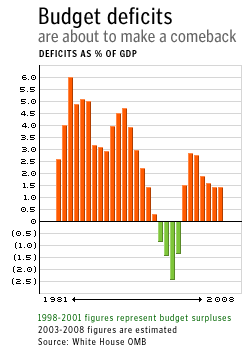
Democrats have criticized Bush for his reticence and warned that the costs of war could dramatically worsen the federal budget, which is already expected to record the highest deficit (in dollar amount) in U.S. history in 2003.

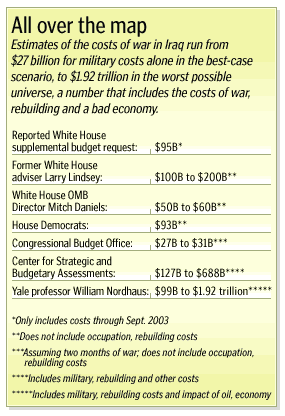
Earlier this month, CNN reported that White House officials working on that supplemental request might ask Congress for up to $95 billion to cover two months of war, post-war costs through September and aid to other countries in the region.

White House won't talk about cost
Administration officials have occasionally hazarded guesses about the costs, but the administration has been quick to distance itself from those guesses.

In September 2002, former Bush economic adviser Larry Lindsey said war could cost between $100 billion and $200 billion, speculation that was immediately dismissed by White House Office of Management and Budget Director Mitch Daniels.

Daniels himself said in December that war could cost between $50 billion and $60 billion, but quickly clarified that it was impossible to tell how much the war might cost and that he was simply trying to compare a new war with its only close historical precedent, the first Gulf War, which cost about $60 billion.

Last fall, Democrats in the House estimated war could cost $93 billion. The bipartisan Congressional Budget Office (CBO), however, said the war would only cost between $9 billion and $13 billion for initial troop deployment and another $9 billion a month thereafter.

As a measure of just how wide the range of possible costs is, the Center for Strategic and Budgetary Assessments, another nonpartisan think tank, said in February that war could cost between $18 billion and $85 billion, that five years of post-war occupation could cost between $25 billion and $105 billion, and that humanitarian and other relief efforts could cost between $84 billion and $498 billion.

Posted Image

Many observers have criticized the Bush administration for keeping Americans in the dark about these potential costs and the possibility that it could take several years and many billions of dollars to rebuild Iraq and help it restructure its government.

"U.S. officials have yet to fully describe to Congress and the American people the magnitude of the resources that will be required to meet post-conflict needs," said a report called "Iraq: The Day After," a report on the costs and consequences of rebuilding Iraq sponsored by the Council on Foreign Relations, a nonpartisan think tank.

The report, authored in part by James R. Schlesinger, defense secretary under Presidents Nixon and Ford, and Thomas R. Pickering, ambassador to the United Nations under the first President Bush, estimated that post-war rebuilding -- including reconstruction, humanitarian aid and the deployment of a minimum of 75,000 troops -- could cost $20 billion per year for "several" years.

Rebuilding help may not come
While U.S. coalition partners in the first Gulf War paid for much of that war's costs, it's unclear how much help the United States will get this time, especially after the long and sometimes bitter debate about war in the United Nations in recent months.

"European governments have a card they could play in the current crisis: token assistance in the rebuilding of Iraq, which would largely stick the United States and the United Kingdom with the entire tab," Wachovia Securities economist Jay Bryson wrote in a recent research note.

Some analysts have speculated that the sale of Iraqi oil could help defray some rebuilding costs, but it could take some time to get Iraqi oil fields up and running at full speed, and U.S. officials will want to avoid the appearance that they have commandeered Iraqi oil production and sales, the Council on Foreign Relations report said.

William Nordhaus study
These estimates do not include the potential costs or benefits of a post-war surge or drop in oil prices, nor do they include the potential costs or benefits of a post-war rebound or recession in the U.S. economy.

Yale professor -- and war opponent -- William D. Nordhaus, in a study published late last year, said a short and successful war for the United States and its allies could have a positive impact on oil markets and the economy that would shave about $57 billion from the total costs of the war.

On the other hand, in his worst-case scenario, assuming the war and post-war period go very badly, then the shocks to the oil market and economy could add a staggering $1.2 trillion to the total bill.

Nordhaus' range of total costs for the next decade ran from $99 billion in the best case scenario to $1.92 trillion in the worst case

#465 DJS

  • Guest
  • 5,798 posts
  • 11
  • Location:Taipei
  • NO

Posted 19 March 2003 - 01:39 AM

War Has Come
Next stop: the battlefield.

The president reviewed the history of disarming Saddam Hussein, and reminded us it is not pretty: violation of the 1991 armistice accords, obstruction of U.N. resolutions, sanctions, and inspectors, a record of aggression, hatred of America, and a propensity to abet and engage in terrorism.

He made a good case that we didn't ask for this war. But war nonetheless has come due to the 12 years of U.N. dereliction and the moral cowardice of the world — a policy of appeasement that nearly ruined the 20th century, but in an age of frightful weapons would surely result in global suicide of our own.

The fact is that U.S. Marines will find more deadly weapons in the first hours of war than the U.N. did in three months. And by day two the world will have forgotten Dominique de Villepin and be listening instead to Tommy Franks, who will practice a different sort of diplomacy. Get out of town in 48 hours sounds tough — but not when it results in liberation, rather than subjugation, and reconstruction instead of destruction.

Critics have claimed that Mr. Bush has backed himself into a corner; it is hard to see how when his promise was democracy and freedom for a tyrannized Iraq. We should not underestimate the power of his message of human liberty or the need of overwhelming force to ensure it. The EU, the U.N., NATO, the European street, the American Left, and a host of others, by failing to understand the post 9/11 world and its requirement to neutralize Saddam Hussein, have unnecessarily put their perceived wisdom, prestige, and influence in jeopardy — and with the liberation of Iraq they all are going to lose big time.

Now the battlefield, Thucydides's harsh schoolmaster, will adjudicate what talk cannot. The only question remaining is not the ultimate verdict, but to what degree the past failure of allies to support the United States emboldened Saddam Hussein, cost the American military tactical surprise, complicated logistics, and needlessly raised casualties.

Finally Mr. Bush's grim speech was a reminder why "a peaceful but not fragile" America is different from the U.N. and the nations that are in it. They either use force or embrace principles, but rarely both and never at the same time. It is impossible to imagine a French or German statesman ever giving such a tough speech about the price of freedom, and harder still to believe any of their people would ever listen to it.

#466 bobdrake12

  • Guest
  • 1,423 posts
  • 40
  • Location:Los Angeles, California

Posted 19 March 2003 - 01:53 AM

The fact is that U.S. Marines will find more deadly weapons in the first hours of war than the U.N.


Hopefully, they are found before they are used.

I wonder if anyone on this forum actually believes the Iraq doesn't have WMD?

bob

#467 DJS

  • Guest
  • 5,798 posts
  • 11
  • Location:Taipei
  • NO

Posted 19 March 2003 - 04:40 AM

I'll Take the Small Victories
Kissinger

Upon hearing Senator Daschle's comments and the new PR campaign being propagated by the left wing of American politics I can only say that I will take the small victories. The title of Newsweeks new cover story, "Arrogant Empire", illustrates the new negative spin that the Democrats intend to utilize. The new strategy of the democrats-- attack Bush's diplomatic performance. At least we can now see that the debate is shifting and change is in the air. Is it just me though, or do others here at Imminst.org also feel that they have just heard the new talking points for the DNC? The war hasn't even started yet and the politics has begun.

I think that is the one thing I always have to remind myself of -- that situations are constantly changing and arguments are never won. The other side always lives to fight another day. However, I think that the Democrats are falling into a very very deep hole that they may not recover from for many years. Right now, in this time of war, the American public wants to see strong leadership and strong defense. They see that in the Republican Party. The Republicans apologize for nothing. They are bold and have a style full of flare. It is becoming "fashionable" to be a Republican again. Say what you want about right and wrong, selling your vision is what the game is all about. The Democrats are a party devoid of ideas, struggling to come up with secondary alternatives to bold policy initiatives by the Republican Party. If the war in Iraq and the ensuing occupation are successful, you may see a political shift in the US not seen since FDR.

What has happen through out American politics is gradual shifts in American policy that have altered the very meaning of liberal and conservative. Is moderate becoming slightly conservative? Take a look at the MSNBC's latest attempt at "revitalization". I like to call it Fox Light. Are we on the verge of a Republican generation?

70% of American men now support military force being used against Iraq. 62% of American women also support military action. The "gender gap" on the issue of war is narrowing, I will not speculate on the cause, except to say that the result of this equalization is likely to be more of a tendency towards armed conflict. Success in Iraq will only bolster these numbers.

Then we have the rise of the investor class. The Bush Administration's policy on eliminating the double taxation on dividends was a major power play to grab this very influential and powerful voter block. And let's not even get into the Miguel Estrada affair which is obviously a coup for the Republican Party.

Bush, the "ignorant cowboy". Bush the "unilateralist". Call him what you will, but Bush may be the President who, through bold policy initiatives, was able to turn the Democratic Party into a permanent minority party. And the 21st Century into the American Century.

#468 Lazarus Long

  • Life Member, Guardian
  • 8,116 posts
  • 242
  • Location:Northern, Western Hemisphere of Earth, Usually of late, New York

Posted 19 March 2003 - 05:00 AM

A small victory is better than any level of defeat because if this turns ugly and there is a failure it won't just be the Bush administration that gets taken down, it will be us all.

The stakes here are very high and our lot is thrown in together, whether we like it or not, but as I have warned you there will be a reckoning and I don't expect the Dem's to come up with a McGovern/Muskie strategy this time. If they do they deserve what they get.

And wasn't the Anthrax that targeted the Senate aimed at Daschle?

#469 DJS

  • Guest
  • 5,798 posts
  • 11
  • Location:Taipei
  • NO

Posted 19 March 2003 - 07:01 AM

Answering the New Democratic Challenge
(And why the diplomatic loggerheads supports the belief of real politik)
Kissinger

Over the past few days the Democrats new talking points have began to filter down to me. First, that Bush had bungled America's diplomacy at the UN and the result was war. Simplified, Bush's incompetence is the reason for this war. We are really getting dirty on this one, aren't we?

Second point. That after the war America needs to initiate some kind of "damage control" in regards to our diplomatic relations with such nations as France, Germany, Russia and China.

Third point. America's popularity has suffered abroad because of the current Administration's handling of foreign policy.

All of these contentions are wrong.

The first point has been eluded to by the French numerous times.

"We believe that war is the failure of diplomacy." -- J. Chirac

No shit Shirlock. Of course, what he is saying to the French public is that America's inability to negotiate with Iraq was a failure by the current Adminstration. I would just keep asking Chirac the same questions over and over again. "Where are the chemical and biological agents that we knew he had in 1998? Where are the thousands of liters of anthrax?" Diplomacy can only take you so far in dealing with a tyrant like this. Plus, the French argument is so obviously hypocritical that a large majority in the United States view their arguments as disingenious.

How could diplomacy have not failed? Well, Iraq was obviously not going to comply. France, Russia and China also all had obvious economic interests in a Saddam Iraq. And finally there is the real politik-balance of power-international politics that so taints this debate from the very start. Bush took this one as far as he could diplomatically and he deserves credit for that. He showed that he was still willing to pay some measure of homage to the UN. This act showed that although he is an aggressive leader, he did care about international precedent.

The second point about reconciliation is typical boiler plate for a common ground issue. I do not believe the Democrats are going to get what they desire. The Republican majority in this country views the issue of Iraq as a litmus test for assessing our strategic interests through out the world. SOFAs (Status of Forces Agreements) are going to go through drastic changes over the next two or three years. The realignment of troops to eastern Europe seems all but a certainty now. Other than realignment however, I do not see any other "retaliatory" actions that should be taken against nations who opposed us in this endeavor.

France will become irrelevant as a result of the diminishing of the Security Council. I also think that France has shown its fangs to eastern Europe and the consequences of this have yet to be realized. American influence in the future EU will, without a doubt, be significant.

Russia should be allowed into the rebuilding process in Iraq. Having good strategic relations with Russia is important. Especially since we are going to have to deal with Iranian proliferation very soon. Russia is the kind of weak link that we have to work to strengthen. I think better relations is possible, especially if we grant them polarity with western Europe.

China. China stood meekly behind the opposition. They realized that it was their strategic obligation to object. However, they still operate under the realization that their time to openly oppose has not yet come. The Bush Administration's approach to China will not change because of China's stance on Iraq at the UN.

Our relationships with opposing nations on the security council has not, and will not change. Iraq was simply an indicator of "how things are in the world today".

And the last point that the Democrats are definitely going to bring up -- "The Bush Administration's arrogance has caused America's popularity to falter internationally". This is pure nonsense.

International sentiment is not strongly opposed to United States and its interests. One of the advantages that the US has always had in promoting its influence is its ability to act as a counter balance to regional - potentially adversarial - nations. This has not changed. Countries as varied as Poland and Japan have a great interest in a very strong America. I think that the unreported story of the diplomatic phase of the Iraq situation was Japan's strong support of American policy. I am talking lock step. I assure you, this will not be forgotten. Finally, international support for any great power nation is always broken down into lack luster approval numbers. You have support, opposition, and uncertainty. 1/3, 1/3, 1/3 or something along those lines. Aggressive action will always temper the attitudes of smaller powers.

In addition, the alignment of nations in this current time of crisis illustrates that all of the strategic advantages lie with the United States. Eastern Europe, England, Spain, Japan, Australia, and most of the Middle East have great strategic interests in a strong United States. I would love to see public opinion numbers of the French in eastern Europe, or the Chinese public opinion numbers in Japan. I would put our popularity up against their popularity any day.

And all of this comes full circle to the practice of real politik. There hasn't been such an obvious attempt at balance of power since Pre WWI Europe. The article entitled "Arrogant Empire" also went into the vast power of the United States and why it makes other great powers nervous. We are getting more and more powerful.

Goals of our foreign policy for the next (hopefully) 14 years:

REFORM MIDDLE EAST

1. Modernize and liberalize Russia.
2. Strengthen our alliance with and the contribution of Japan (especially when dealing with China).
3. Continue to use European ambiguity on foreign policy to our advantage.
4. Get tougher on China.
5. Bring India more into the fold (especially when dealing with China).

So much strategic analyses needs to be done concerning the New World Allignment. Balance of power is going to become more clearly defined in the next 20 years. I think in the end, the world will find in our favor. Our lack of being located on the EurAsian continent may possess advantages not considered by the naysayers. Either way, the battle rages on, and the terms for the future have yet to be established.

The odds look in our favor.

Edited by Kissinger, 19 March 2003 - 07:20 AM.


#470 Lazarus Long

  • Life Member, Guardian
  • 8,116 posts
  • 242
  • Location:Northern, Western Hemisphere of Earth, Usually of late, New York

Posted 19 March 2003 - 08:18 AM

International sentiment is not strongly opposed to United States and its interests. One of the advantages that the US has always had in promoting its influence is its ability to act as a counter balance to regional - potentially adversarial - nations. This has not changed. Countries as varied as Poland and Japan have a great interest in a very strong America. I think that the unreported story of the diplomatic phase of the Iraq situation was Japan's strong support of American policy. I am talking lock step. I assure you, this will not be forgotten. Finally, international support for any great power nation is always broken down into lack luster approval numbers. You have support, opposition, and uncertainty. 1/3, 1/3, 1/3 or something along those lines. Aggressive action will always temper the attitudes of smaller powers.


As in so many of the scenarios you are trying to present this is not only wishful thinking it is blind to the possibility that many democratic peoples could turn against us, and that a number of former friends and foes can consolidate their forces to achieve par with much of what we think we have as strategic advantage.

Our weapons are not going to force people to be our friends and our image worldwide is suffering more seriously than you want to admit. The odds are we don't have 14 years to recover from what is about to happen. I advise you to see beyond small victories and realize that we are in many ways snatching defeat from the jaws of victory.

I study global media sources practically 24/7 and I also am in constant contact with various individuals from various countries routinely. I am not nearly as confident about how this is playing to the grassroots as you and the WAR ON TERRORISM IS A STREET BATTLE. It must be won in the hearts of the world's people or none of us will ever be safe. Ever.

The following article addresses some of your misguided assumptions. It takes a common threat, as we now appear to many people world wide to unite the "smaller, weaker" interests into a forceful global coalition and in this instance possibly against us.

I would love to see public opinion numbers of the French in eastern Europe, or the Chinese public opinion numbers in Japan. I would put our popularity up against their popularity any day.


Since you asked here are the figures. The odds favor the house, always.


U.S. image a casualty of war
Wednesday March 19, 02:52 AM
http://uk.news.yahoo...9/80/dvrfz.html

WASHINGTON (Reuters) - The international image of the United States has become an early casualty of the looming war with Iraq, with negative views toward America holding sway even in allied nations such as Britain, a survey suggests.

The nine-nation survey, released a day after U.S. President George W. Bush issued his 48-hour ultimatum to Iraqi President Saddam Hussein, said anti-war sentiment and disapproval of Bush administration policies have dramatically undercut U.S. favourability ratings in Europe, Russia and Turkey over the past six months.


In France, which spearheaded war opposition in the U.N. Security Council, only 31 percent of the public held a positive opinion about the United States, down from 63 percent in 2002, according to survey findings compiled by the Pew Research Center for the People & the Press.


Favourable U.S. ratings fell to 25 percent from 61 percent over the same period in France's anti-war ally, Germany.


The U.S. public image has slumped even in countries that have joined the White House's "coalition of the willing."


Only 14 percent of the Spanish public had a favourable view of the United States, down from 50 percent earlier, while positive attitudes in Britain fell to 48 percent from 75 percent.

The country with the highest opinion about America was Poland, where 50 percent of the public was still positive, versus 79 percent six months ago.

Criticism of U.S. foreign policy was almost universal, with disapproval among overwhelming majorities eliminating a ratings boost for Bush after the September 11, 2001 attacks on New York and Washington.

In Turkey, which the United States still wants to play a war role, only 12 percent of the public still held favourable opinions of America versus 30 percent in 2002. Russians' positive views of the United States, which surged from 37 percent to 61 percent after September 11, fell to 28 percent.

However, researchers noted that 73 percent of French and 71 percent of Germans believe that Iraq and the Middle East would be better off in the long run if Baghdad were disarmed and Saddam removed from power.

The findings reflected the opinions of more than 5,000 people who were contacted by telephone from March 10 to 13. Results had a 3.5 percent margin of error for the United States and Britain, and 5 percent for other countries.

#471 Thomas

  • Guest
  • 129 posts
  • 0

Posted 19 March 2003 - 10:46 AM

Well ... USA should secure the next two or three decades. Longer term plans are not necessary, since the Singularity will happen, as we all know. lol

But a failure of the USA to do so, could delay even that Event.

- Thomas

#472 Lazarus Long

  • Life Member, Guardian
  • 8,116 posts
  • 242
  • Location:Northern, Western Hemisphere of Earth, Usually of late, New York

Posted 19 March 2003 - 02:56 PM

Honorable and Esteemed Mr. President,

I ask but for a moment of your time during this eleventh hour. I ask as but a single citizen for the chance to provide my opinion and be heard by you as is the right of but a single member of Our Society to Our Commander and Chief, the chosen and Sworn Defender of Our Constitution.

In five Minutes Mr. President few can say anything of great significance and even less are generally heard. So I thank you in advance for your time and the time this reflects of the Nation as the Holder of this Honored Office.

I ask that you consider the comparison of two choices, two paths that stand before you as do the burning Twin Towers that helped to pave this avenue upon which we find ourselves together at this moment. I understand that I am only a simple citizen but I ask that you consider how at this moment in history the events set in motion no matter the motive can have outcomes far beyond even the scope of the most able planners, those for Good and yes, those for Evil purpose.

Beware that the Road to Perdition is paved with even the best intentions. Before us are two roads one high and the other low and no matter what we claim of our intentions we are not only to be judged by history, but by the world at large through our actions. Upon both options are flames, upon them both a pox. But from one choice there may be hope and the other holds only destruction. Test your most scrupulous values against yourself to judge which course we seek. Beware of the path of self aggrandizement in favor of one that demonstrates the very standards of Compassionate Conservatism that is the claimed wellspring of our actions as a people. Remember it is by the results, not the goals by which our deeds are ultimately determined to be Good or Ill.

Please understand that what we are about to do is not simply about honor, this Great Nation should never go to war simply to save face. This course you have set for Our Nation, also needs to make us recognized worldwide without dispute to be deliberate, considerate, and respectful of the opinions of our allies and partners as well as worthy of respect by our enemies.

I for one disagree with much that has gone into the period leading up to this moment for I feel too much has been squandered of opportunity among the Capable that didn’t coalesce into a Willing Coalition. It cannot be entirely blamed upon the UNwilling that they have refused participation. Clearly our noble purpose was not sufficiently clear to them. I believe our purpose might have been better understood if we had made the case not just against the status quo of Containment but for Containment with Constriction too. I think this approach might have averted the implied and obvious threat an American Hyper-Power display of Blitzkrieg makes to the world unless that of course is the only image we desire to display.

This is to be the first major battle of the conflict to define this century but it most certainly will not be the last and for us to find a truly Global Community that is willing to help turn the screws not just on Saddam but on the many situations that are now confronting us, we must be able to demonstrate a rational posture and perhaps stay our hand a little longer even though I understand that the desire to apply pressure to this despot must be apparent and demonstrable, and certainly credible. Nevertheless, it is eminently prudent as we face conflicts on multiple fronts and levels to maintain a vigil in more than one direction at a time and develop a constructive relationship with ALL those of like “Civil Mindedness” for our common defense of Liberty.

It is my observation that the War on Terror would not be benefited by increasing the “Global Fog,” which would be generated by invading Iraq and creating a Theater of Operations such that the entire world’s level of destabilization would grant all too many protagonist combatants a chance to obscure themselves or seek to relocate under the cover this natural consequence of such wide spread and heightened conflict. We must not be forced to lose the myriad of barely discernable trails that lead to individuals in this conflict that are of significant importance to our purpose. One of the goals of being patient may be to find a better target. These too are becoming apparent as a consequence of the pressure this buildup is generating but as we actually go to battle this advantage of the calm before this storm will be lost, along with targets as significant as bin Laden and Associates.

In these past few days, through the direct assistance of Foreign Governments and Joint Force Action, significant advances have been made in the Primary War on Terror. There is a great likelihood that such cooperation would become less forthcoming in the immediate aftermath of an attack on a sovereign Nation that is NOT sanctioned by the United Nations and the International Community as a whole.

Containment with Constriction is more systematic and utilizes the advantage of the Rapid Deployment Force capabilities to isolate whole regions of Iraq sector by sector and safely secure both the targets and the most dangerous assets. It is also one that is more pragmatically diplomatic as it might be able to garner support among the dissident voices we now have to cope with among even our traditional allies. It is also one that could receive sanction and thus legitimacy from the United Nations that would then demonstrate a respect for the principle of the Rule of Law as it pertains to the complex and arcane shifting politics of the Age in which we inhabit.

It is a strategy that combines the abilities of our troops with the humanitarian objectives of stabilization and security of civilians instead of the possibly theatric effect of Shock & Awe. This cannot be allowed to be misconstrued for simple drama. This strategy would also provide for a more effective assimilation of local populations and civil infrastructures, to include the stand down and debriefing of any and all civil and military authorities that cooperate.

I understand that I am no longer a soldier or a government employee but this should not matter, were I but an old woman of the most unassuming heritage it should matter no more than even the holder of the highest office of this great Democracy. My credentials as a citizen should be enough to grant me voice. The value of an opinion is not simply weighted by who holds it; it is predicated upon the principle and merit of the ideas expressed.

I would be remiss if I didn't remind my President that the United States is not, and can never be solely responsible for the Security of this precious Earth no matter what level of military and economic power we wield and there is no rhetoric from the fringes of our society that would be welcomed in a true coalition of Freedom Loving Peoples, if this is perceived as favoring a state of global dictatorship. Should our actions get judged to be such then there will be no amount of Force that will prevent the outcome from becoming the worst possible but if we can demonstrate that our purpose is not just benign, but truly beneficial to the world then cooperation and participation could no doubt follow.

Our technology and security are created by and dependent upon an open global community that has developed it. Intelligence both as a concern of security, or technology, and the wisdom to guide our course abroad is ultimately best provided by communication from ordinary citizens here with those whom are the residents of those communities. The technology upon which our society depends also relies upon shared assets around the world. The only responsible manner to defend our Constitution and the Liberty of our country is to practice it and not curtail it. Never for a second can we grant by simple caveat the power this entails to those until now deprived of such voice and even less so will it be achieved and preserved for them at gunpoint only. We must also find a way to move forward from the awkward position in which we find ourselves with respect to the United Nations by seeking a constructive transformation of that institution that more clearly and definitive defines the power sharing arrangement of the world as we go forward.

Should we fail to build this sense of common purpose then we will have united all those unwilling into a Global Coalition in Opposition to Our Noble Purpose, and we are demonstrably pushing many people that consider themselves our traditional allies in this manner.

These two choices you face Mr. President are not only defined by Good and Evil, they are defined by the one that depends solely upon military might as opposed to the one that demonstrates good will through diplomacy WHILE showing a significant and clearly recognizable position of strength. This is much more than just a conflict over the acquisition of arsenals of weapons of mass destruction; it is a conflict that must be understood by all to be reducing the threat of authoritarian disregard of National Sovereignty and thus the motivation to acquire such weapons. In order for this to be the case beside the war we about to wage, we must be seen to be prepared for the peace and this requires an inclusive not exclusive posture.

Some of those that we should want to bring over to the side of reason are those that are still our perceived enemy; yet we are seen to be threatening those that we would count as friend. Why is this necessary?

So I ask you to be respectful in such a manner that this may be understood as more than just a diplomatic dance that may be giving the wrong impression and I would encourage this problem of impression be addressed too.

Our policies toward curbing proliferation are demonstrably inadequate but they also depend upon a responsible leadership abroad to be effective. This Policing of Iraq is only a first step over the line, and it is near its limits of application already. To improve upon our tactics and go forward with an effective strategy then we must respect diplomacy as well as might or we will never recognize the opportunities for peace.

Peace through Strength has never been enough and will forever only go halfway to this noble goal so fervently claimed by each and every fighter for this cause. True Peace can only be accomplished after the enemy’s hearts are won over, or there are mostly dead on all sides. If only the road of death is developed there will never be peace, only death. To win the hearts and minds of the world’s masses will require a scrutiny of deeds not words, and the finest diplomacy to make that case. If, as we desire to prevent the use of Weapons of Mass Destruction, we also promulgate their use then we are perceived to fail by many people around the world even if this is a tactical reality. We must also be prepared to minimize the loss of life and suffering this kind of Police Action requires and not behave toward citizens anywhere in the world as mere collateral damage in a total war.

I understand that religious beliefs form the core of your decisions and I appeal to the integrity you have in this matter. I would only advise that you apply your faith in your ability as well to the task of seeking opinion from more than just those that surround you and recognize that the voice of God is found in the humble words of the poorest field worker and simplest souls that are the very same people you are seeking to save from the most heinous threats that civilization in common around the world faces. I ask as well that you remember to have faith in those that are at the cutting edge of our technology and seek the council of individuals that represent the healers and not just the warriors of our society. I can only trust that the voices of those that grant value to our more tranquil existence should be remembered as giving purpose to that peace.

I have not supported you Mr. President in your steadfast determination to go this course, I have disagreed respectfully with many of the conclusions that I as a citizen have been offered to examine but I nevertheless stand alongside you and our Nation as one that honors the Oath I have taken to defend this land. The actions we are about to take must be guided by the most sound judgment, for all the faith and hope in this world alone will not protect us from the consequences of unjust and unwise decisions.

Regardless of this I respect, and consider prudent a demonstration of unity as you order this Nation into the breach and only wish it were possible that the willing sacrifice of but a single individual, myself alone, were sufficient to avert the unwilling offering of so many souls to the purpose of those that would rule for little more than ambition. I only ask you to always seek the path most likely to succeed justly, building a world worthy of what created US, and with the highest regard to why we are willingly to make this ultimate sacrifice for this Land, for Our Liberty, Our Lives, and Our Principles as defined by Our Constitution that together we are oath bound in common to uphold.


_____________________________
Kenneth X. Sills

#473 Lazarus Long

  • Life Member, Guardian
  • 8,116 posts
  • 242
  • Location:Northern, Western Hemisphere of Earth, Usually of late, New York

Posted 19 March 2003 - 03:07 PM

Any and all who want to plagiarize this feel free to. Include my name, or not if you agree and wish to forward it to any that care.

To each of us comes a day at least once in every life upon which we must stand and say;
“I am Spartacus.” [ph34r]

#474 Saille Willow

  • Guest
  • 112 posts
  • 0
  • Location:Somerset West, Western Cape, South Africa

Posted 19 March 2003 - 09:51 PM

Lazarus Long

If only there were more voices like yours

#475 Saille Willow

  • Guest
  • 112 posts
  • 0
  • Location:Somerset West, Western Cape, South Africa

Posted 19 March 2003 - 10:09 PM

19 March 2003, The Star

Baghdad- The sound of screaming fills the maternity ward at Elwiyah hospital as women rush to give birth ahead of an impending Us invasion.

Many pregnant women yesterday demanded caesareans rather than risk delivering their babies during war, even though they were well short of their due date.

A sense of foreboding hung oer the diapdated hospital with patients expecting US President George W Bush to order an attack onb Iraq before the end of the week.

...Medical staff said families recalled the 1991 Gulf War when some women could not reach hospitals because of coalition bombing raids and died during delivery.

"Many had their babies t seven months. They fear there will be curfews, that roads, water and electricityt will be cut and that the birth of their babies will become impossible," Dr Kholoud Younes said.

Hard working doctors said they were trying to induce women rather than give them caesareans, but after years of economic sanctions, there was no anaesthetic for epidural injections, meaning patients faced agonising, draining deliveries.

Younes said even those women who had reached the natural end of their pregnancies were taking longer to give birth because of fear and stress.- Reuters

#476 DJS

  • Guest
  • 5,798 posts
  • 11
  • Location:Taipei
  • NO

Posted 20 March 2003 - 04:32 AM

American Unilateralism?
Posted March 19, 2003

By J. Michael Waller

Apart from Iraq itself, France has made itself the most vehement opponent of U.S. efforts to oust the terrorist-supporting regime of Saddam Hussein. The U.S.-led "Coalition of the Willing" outnumbers the vocally unwilling.

Insight's count of declared and reported actions shows that 23 countries are supporting the United States with military resources and that another 22 openly have declared support for President George W. Bush's decision to destroy the regime in Baghdad. At least 13 Muslim or predominantly Muslim countries are assisting or supporting the United States. Insight's tally differs from an official State Department list of 30 nations in the so-called coalition.

The United Kingdom, Poland and Australia are providing troops. Bulgaria, the Czech Republic, Romania, Slovakia and Ukraine are providing chemical-weapons experts and other noncombat personnel. Bahrain, Croatia, Denmark, Ireland, Israel, Italy, Jordan, Kuwait, Oman, Portugal, Qatar, Spain, Turkey and the United Arab Emirates are allowing the United States to use their military bases or airspace. Saudi Arabia is playing it both ways, publicly declaring opposition to the military effort, while quietly allowing U.S. forces to operate from its territory.

In Europe, Albania, Estonia, Georgia, Hungary, Iceland, Latvia, Lithuania, Macedonia and the Netherlands have voiced support. Canada has taken positions both for and against military action. Other open U.S. supporters include the African nations of Eritrea and Ethiopia, and the Latin American governments of Colombia, El Salvador and Nicaragua. In Asia, Afghanistan, Azerbaijan and Uzbekistan have declared support for the war against Saddam, along with the Philippines, South Korea and Japan. Japanese Prime Minister Junichiro Koizumi declared Tokyo's support for President Bush's ultimatum to Saddam.

According to Secretary of State Colin Powell, another 15 countries privately support the war effort.

Communist China backed off criticism of the United States after Bush issued his ultimatum. Beijing's new president, Hu Jintao, issued a simple statement: "On the Iraq issue, China always advocates a political solution in the framework of the United Nations."

So France stands alone in the active attempt to save Saddam, having promised a U.N. Security Council veto of an American-British-Spanish resolution of force. Paris has outdone Russia and China, which did not pledge to veto, and which are believed to have been willing to abstain in a U.N. vote. Other declared opponents of the United States in this matter of life and death include Belgium, Canada (playing both sides), Greece, Indonesia, Iran, Lebanon, Malaysia, Mexico, New Zealand, Saudi Arabia (also playing both sides), South Africa, Sudan, Switzerland and Syria.

The score on the eve of the war: 45 backing the United States, 17 against.

#477 Thomas

  • Guest
  • 129 posts
  • 0

Posted 20 March 2003 - 08:34 AM

Here the NATO referendum on Sunday is waiting to happen. Then I guess, Slovenian government will join America's effort.

At least I hope, it will. The president (former communist), the prime minister (former communist youth), the foreign minister (former dissident) are all pro US.

But their priority now is to join NATO. And nobody wants to destabilize the for NATO boat now. The very proamerican opposition leader (former dissident) also doesn't want to support America at this moment. Too tricky in the light of referendum.

The opposition against NATO - and even more against USA - is quite strong here. Silly European sentiment, what can you do?

[blush]

- Thomas

Edited by Thomas, 20 March 2003 - 08:39 AM.


#478 DJS

  • Guest
  • 5,798 posts
  • 11
  • Location:Taipei
  • NO

Posted 20 March 2003 - 09:33 AM

The opposition against NATO - and even more against USA - is quite strong here. Silly European sentiment, what can you do?


Why is there anti-US in your country? Is it the "perceived arrogance" that the US media says is alienating the rest of the world? Or is it more of a "balance of power" calculation? Why would anyone in eastern Europe be anti-American when America is the only counter weight to their former oppressor (Russia)?

I read a very small book at Barnes and Noble the other day about the growing gap in US-European relations. It had a few interesting thoughts on hard and soft power. Both the US and Europe have a lot of soft power--AKA economic leverage. However, only the US has the hard power -- AKA military leverage -- necessary to maintain global order. The book points out that nations that have hard power are more likely to us it than nations that do not. [huh] Similarly, those that do not have it do not want those who have it to use it because it only illuminates the power differentials. In general, nations with only soft power will look for soft power solutions.

Simplified, Europe wants to reign in the US. If Europe can get the US to "refute" its hard power, then it would be on equal footing with the US because only soft power would be a measure of import.

I'm still not sure how much of the anti-Americanism in Europe is jealousy, fear, or just differing world views. I don't think that Europe fears us. Other parts of the world fear us, but not Europe. So I think it really comes down to jealousy and world view. Of course, it differs from nation to nation. In Germany, I think it is mostly world view. Where as, in France it is mostly jealousy.

Thomas, do you think the nations of eastern Europe would embrace a US troop transfer (realignment) from western to eastern Europe?

Second question-- you are always saying that nations in eastern Europe do support the US but because of "EU membership issues" are reluctant to come out openly as such. Is this not simply a basic cost-benefit analysis on the part of eastern Europe? Eastern Europe has two major concerns (correct me if I am wrong). First, they want to remain free. Second, they want to be wealthy. The staying free part means protection from Russia. I guess they feel we have as much interest in protecting them as they have in us protecting them. Inotherwords, threats to freedom in eastern Europe, although still taken seriously, are viewed as stable.

The getting rich part is what is still very much in question for eastern Europe. Getting richer basically means getting into the EU. And getting into the EU is probably predicated on a nod from Germany and France.

Is western Europe's soft power (economic influence) the greatest force dictating policy in eastern Europe?

#479 Thomas

  • Guest
  • 129 posts
  • 0

Posted 20 March 2003 - 11:45 AM

Why is there anti-US in your country?  


10-20% leftist's (which are still non converted) organizations has been strongly founded by George Soros Open Society Found during past more than 10 years!

So they have quite an influence in media and they have their results. Of course, Soros is to be blamed only partly. The main problem is domestic.

Why would anyone in eastern Europe be anti-American when America is the only counter weight to their former oppressor (Russia)?


We were never directly under Russia - not since 1948, so it's smaller factor here.

However, only the US has the hard power -- AKA military leverage -- necessary to maintain global order.


I know. Many don't.

I don't think that Europe fears us.


Only as a "major war provoker." Not as a direct threat. The left is a different story.

do you think the nations of eastern Europe would embrace a US troop transfer (realignment) from western to eastern Europe


I think, they would. Even here, only the radical left would oppose. But we consider us to be too small for being interesting as a US base candidate.

you are always saying that nations in eastern Europe do support the US but because of "EU membership issues" are reluctant to come out openly as such.  Is this not simply a basic cost-benefit analysis on the part of eastern Europe?  


It is. But Poland, Chezs and Hungarian has a little fear toward France or Germany, since they are already in NATO. EU will not dare to harass them. For others, you should wait till may 2004.

Eastern Europe has two major concerns (correct me if I am wrong).  First, they want to remain free.  Second, they want to be wealthy.  


We are wealthy already. 16000 US$ per capita GDP and growing fast.

The staying free part means protection from Russia.


Here, people are not afraid of Russia. Or anybody at the moment. More on the east - they are.

Getting richer basically means getting into the EU.  And getting into the EU is probably predicated on a nod from Germany and France.  


Very much so!

Is western Europe's soft power (economic influence) the greatest force dictating policy in eastern Europe?


The German economic power is not so great any more. But yes, you are basically right.

More later!

- Thomas

#480 Limitless

  • Guest
  • 105 posts
  • 1

Posted 20 March 2003 - 07:19 PM

Toronto activists gather at U.S. consulate
Larger protests take place in San Francisco, Washington

COLIN PERKEL
CANADIAN PRESS
(March 20th, 2003)


As they did before American bombs started dropping on Iraq, Canadians voiced their opposition to the war today in protests held in cities across the country.
The demonstrations were initially small, with fewer peace activists turning out than they had for previous weekend protests, possibly due to the mid-week start of the war.
Several dozen protesters stood across from the U.S. consulate in Toronto, singing and chanting. Police kept demonstrators on the other side of University Avenue due to a three-metre construction barrier surrounding the building.
Protesters alternated between singing John Lennon's Give Peace A Chance and chanting anti-U.S. slogans, while others stood in a circle, praying for peace.
Greenpeace joined the protesters by having men and women in U.S. Army uniforms raise the American flag over barrels of oil.
"What George Bush is not telling the world is that this war is about oil," said Greenpeace spokesperson Peter Tabuns.
"Does anyone think that these armies would be massed in the Persian Gulf if Iraq was primarily exporting orange juice and had no oil?"
Protester Issam Shukri, a former Iraqi now living in Toronto, said he agrees Saddam is a brutal dictator, but the U.S.-led war will only hurt the Iraqi people, not the leadership.
"Thousands of lives will be sacrificed for overthrowing Saddam, then their future will be dark and will be controlled by the American puppets and their military machine that will be stationed in Iraq for such a long, long time."
The protests weren't just limited to Canada. South of the border, other demontrations were under way.
Anti-war protesters blocked morning rush-hour traffic in Washington and San Francisco and chanted "no blood for oil" outside the White House.
As many as 150 demonstrators temporarily shut down the inbound travel lanes of one of the Potomac River crossings, snarling rush-hour traffic. Some 50 demonstrators bicycled through downtown Washington carrying signs that said, Bikes not Bombs. Three people were arrested.
"There are many, many people here and around the world that are opposed to this war," said Dana Hubbard, 54, of Washington.
Outside the White House, about 50 anti-war protesters gathered in the chilly rain, shouting "no blood for oil!"
Hundreds of protesters marched on the U.S Consulate in Vancouver on Wednesday night, minutes after the first bombs fell on Iraq.
Those demonstrations followed widespread anti-war rallies across Canada on the weekend, including a massive one in Montreal where some 200,000 people marched through the city's downtown core in a vocal but peaceful protest.

Edited by Limitless, 20 March 2003 - 07:29 PM.


6 user(s) are reading this topic

0 members, 6 guests, 0 anonymous users