• Log in with Facebook Log in with Twitter Log In with Google      Sign In    
  • Create Account
  LongeCity
              Advocacy & Research for Unlimited Lifespans


Adverts help to support the work of this non-profit organisation. To go ad-free join as a Member.


Photo
- - - - -

Should The Us Go To War With Iraq?


  • This topic is locked This topic is locked

952 replies to this topic

#511 bobdrake12

  • Guest
  • 1,423 posts
  • 40
  • Location:Los Angeles, California

Posted 21 March 2003 - 10:56 PM

http://www.gendercid...case_anfal.html

Case Study: The Anfal Campaign (Iraqi Kurdistan), 1988 (excerpts)

It was these displaced populations of Barzani tribespeople who, after the onset of the Iran-Iraq war in 1980, would fall prey to one of the largest gendercidal massacres of modern times. Martin van Bruinessen writes:

In July-August 1983, Iraqi security troops rounded up the men of the Barzani tribe from four resettlement camps near Arbil. These people were not engaged in any antigovernment activities. ... Two of Barzani's sons at that time led the Kurdistan Democratic Party and were engaged in guerrilla activities against the Baghdad government, but only a part of the tribe was with them. ... All eight thousand men of this group, then, were taken from their families and transported to southern Iraq. Thereafter they disappeared. All efforts to find out what happened to them or where they had gone, including diplomatic inquiries by several European countries, failed. It is feared that they are dead. The KDP [Kurdish Democratic Party] has received consistent reports from sources within the military that at least part of this group has been used as guinea pigs to test the effects of various chemical agents. (van Bruinessen, "Genocide in Kurdistan?," in George J. Andreopoulos, ed., Genocide: Conceptual and Historical Dimensions ([University of Pennsylvania Press, 1994], pp. 156-57, emphasis added.)


One Barzani woman described the roundup of the menfolk: "Before dawn, as people were getting dressed and ready to go to work, all the soldiers charged through the camp [Qushtapa]. They captured the men walking on the street and even took an old man who was mentally deranged and was usually left tied up. They took the preacher who went to the mosque to call for prayers. They were breaking down doors and entering the houses searching for our men. They looked inside the chicken coops, water tanks, refrigerators, everywhere, and took all the men over the age of thirteen. The women cried and clutched the Qur'an [Koran] and begged the soldiers not to take their men away." In 1993, Saddam Hussein strongly hinted at the final fate of the Barzani men: "They betrayed the country and they betrayed the covenant, and we meted out a stern punishment to them, and they went to hell." As Human Rights Watch noted, "In many respects, the 1983 Barzani operation foreshadowed the techniques that would be used on a much larger scale during the Anfal campaign." (Human Rights Watch, Iraq's Crime of Genocide, pp. 4, 26-27.) Khaled Salih notes that "No doubt, the absence of any international outcry encouraged Baghdad to believe that it could get away with an even larger operation without any hostile reaction. In this respect the Ba'ath Party seems to have been correct in its calculations and judgement of the international inaction." (Khaled, "Anfal: The Kurdish Genocide in Iraq")

Among the most horrific features of the Iraqi campaigns against the Kurds in the 1980s was the regime's resort to chemical weapons strikes against civilian populations. On April 16, 1987, a chemical raid on the Balisan valley killed dozens of civilians; in its wake, "some seventy men were taken away in buses and, like the Barzanis, never seen again. The surviving women and children were dumped on the plain outside Erbil and left to fend for themselves." (Jonathan C. Randal, After Such Knowledge, What Forgiveness?, p. 230.)


Posted Image

Aftermath of Iraqi chemical attack on Halabji, March 1988.

Less than a year later, on March 16, 1988, a far more concentrated chemical attack was launched on the town of Halabji, near the Iranian border, which had briefly been held by a combined force of Kurdish rebels and Iranian troops. Thousands of civilians died, and with the town still under Iranian occupation after the raid, journalists and photographers were able to reach the scene. "Their photographs, mainly of women, children, and elderly people huddled inertly in the streets or lying on their backs with mouths agape, circulated widely, demonstrating eloquently that the great mass of the dead had been Kurdish civilian noncombatants." (Iraq's Crime of Genocide, p. 72.) Although it took place during the Anfal campaign, however, the attack on Halabji is not normally considered part of that campaign.

Edited by bobdrake12, 21 March 2003 - 11:03 PM.


#512 bobdrake12

  • Guest
  • 1,423 posts
  • 40
  • Location:Los Angeles, California

Posted 22 March 2003 - 01:32 AM

http://abcnews.go.co...son_030214.html

Posted Image

Son of Saddam - Odai Hussein Brutal to Iraqis, Behind Torture of U.S. Prisoners (excerpts)

By Brian Ross


Feb. 14 — It was a father's dilemma: What to do with a wayward son? In Saddam Hussein's case, the problem was his son Odai, who has been accused of murders and rapes too numerous to count.

For Saddam, the answer was to put Odai in charge of Iraq's Olympic committee. In the 16 years since, Odai Hussein has more than lived up to his reputation for capricious cruelty.

One example: 20/20 uncovered evidence linking Odai with the torture and interrogation of some 20 American prisoners captured during the 1991 Gulf War, including former Navy Cmdr. Jeff Zaun, who was forced at gunpoint to appear on Iraqi television and forced to denounce his country.

In his first television interview, Zaun told 20/20 that he was routinely beaten and threatened with death before he made the tape.

"They brought me in and told me they were going to kill me," he said. "I'll remember — for the rest of my life I'll remember — the guy with the pistol in his hand."


According to Odai's former press secretary, Abass al-Janabi, the dictator's son was one of five people supervising the treatment of the American prisoners. If the pilots did not give information, the orders were to torture them, Janabi said. He said he did not know if any of the pilots revealed accurate information.

American investigators believe Odai is one of the few who could know the whereabouts of American pilot Scott Speicher, who remains missing after his plane crashed in northern Iraq.

"If you say that this is a sadistic regime ... then it is possible to understand that Saddam and Odai might keep an American pilot alive ... for the purpose of causing other people pain," said Peter Galbraith, a former U.S. diplomat who works with Indict, a London-based group that tracks alleged human rights abuses by Iraqi officials.

Olympic Horror

But Odai saved some of his harshest cruelty for his own countrymen. "Odai Hussein as head of the Olympic committee has personally directed the torture of athletes who have not done well. He has participated himself in beatings, in amputations," Galbraith said.

"It's the only Olympic committee in the world that has its own prison. …
It has really become a chamber of horrors," said Galbraith, whose group receives funding from the U.S. government.

If only a fraction of what is said about 38-year-old Odai, Saddam's eldest son, is true, he would still be considered at least as brutal as his father — and more deviant.

"I think the best comparison is with the [former] Ugandan dictator Idi Amin ... who also was a sadist, who enjoyed killing people, and who engaged in all sorts of very erratic behavior," said Galbraith.

Galbraith says Odai is guilty of a long list of atrocities, from his treatment of Olympic athletes, to rapes and murders, to his reported role in ordering the torture of American prisoners of war.

In the event of war with Iraq, Odai will be "one of the top targets for the United States," Galbraith said.


Defectors Tell of Torture

Former members of Iraq's Olympic teams gave numerous first-person accounts of Odai's behavior to 20/20 and ESPN.

A former player on Iraq's soccer team, Sharar Haydar, said Odai sent him and other players to prison as punishment for the team's defeat by Jordan. Haydar, who defected in 1998, said he was beaten daily with 20 blows to the feet, and given only bread and water.

Another defector, weightlifter Ahmed Reham, who was the flag bearer for the Iraqi team at the 1996 Atlanta Games, also says he was tortured.

"They used special sticks — electric sticks. Pipes filled with stones, and the special sticks. If you get hit on the head you might die. You have no idea how cruel these guys are," he said.


Rape Called a ‘Hobby’

When it comes to women, Odai's behavior is reputed to be even more dangerous.

"Raping is one of his, let me say, hobbies," said Janabi, Odai's former press secretary. "I am not exaggerating."

Janabi, who defected in 1998, says he witnessed Odai committing numerous rapes.

According to Janabi, Odai's rape victims were as young as 12 and powerless to resist him. After a visiting Russian ballerina resisted Odai's advances in 1994, Odai had his men secretly film her making love with her trainer, Janabi said, then invited her to a party and told her he had a surprise. "He showed her the film. And he raped her after that." said Janabi.

Latif Yahia, who for years served as Odai's security double, says Odai found violence sexually exciting. "He loves to hear the woman scream. … He loves the rape. … He's a sadist."

Yahia described, in detail, nighttime scenes in Baghdad of group sex and violent acts. He said he once saw Odai beat and rape a pregnant woman. "Odai, he can't sleep with a woman if he don't hit her and see the blood coming out of her," he said.

Yahia, who wore the same French suits and aftershave as his boss to fool potential attackers, admits that he sometimes took advantage of his assumed status and had women brought to him.

Odai has made his share of enemies. He was seriously wounded in a 1996 assassination attempt, and now walks with a limp. His younger brother Qusai has emerged in recent years as a top military adviser to Saddam, and Odai is said to be jealous of his brother's power.


Allegation From Visiting French Students

Such stories from defectors are hard to confirm. But in Paris a former French official told 20/20 of an equally bizarre, more recent account allegedly involving Odai and a delegation of French college students in 2000.

Two of the students, a man and a woman, told French authorities that Odai invited them to a party in their honor at a Baghdad hotel. But when they got to Odai's room, they say three of his bodyguards forced them at gunpoint to have sex with each other while being taped on video.

According to Alexis Debat, who was a desk officer at the French Ministry of Defense at the time, the French government concluded there was little they could do about it. "I mean, after all, this is Saddam Hussein's son," said Debat, who is now a consultant for ABCNEWS.


A ‘Bully’ Unlikely to Fight

When the United States last attacked Baghdad in January 1991, Odai went into hiding, according to former aides, at one point literally cowering in his bedroom by himself at a protected safe house on a small island in the Tigris River. Janabi says Odai spent the first 23 days of the war at the safe house.

Odai does have several thousand troops supposedly loyal to him, but his detractors doubt he will make a last-ditch stand and fight to the end.

"Odai Hussein is like any bully," said Galbraith. "He enjoys exercising power on those who are weak, and when he is threatened, he behaves like a coward. So I don't think Odai Hussein will fight to the end.

"I think there is an excellent chance that he will be captured and will be put on trial for the multiple crimes he has committed," Galbraith said. "The only problem will be if the Iraqi people get to him first. Then there might not be more than very tiny pieces left of him."

Copyright © 2003 ABCNEWS Internet Ventures

Edited by bobdrake12, 22 March 2003 - 01:38 AM.


#513 bobdrake12

  • Guest
  • 1,423 posts
  • 40
  • Location:Los Angeles, California

Posted 22 March 2003 - 01:59 AM

http://www.geocities...37/terr33a.html

Posted Image

Fear -- Saddam's Chosen Method of Staying in Power (excerpts)


December 16, 2002) Over the years numerous reports have been published that detail Saddam Hussein's violations of human rights in Iraq. Numerous articles have also been published over the years by International Review, which have detailed Saddam's crimes at home and abroad.

Britain's Foreign Office recently released a 23-page human rights report outlining "the barbarity of his regime." The report says Iraq "is a terrifying place to live" with "fear Saddam's chosen method for staying in power."

The British report also details that not only is torture systematic in Iraq but also that the most senior figures in the regime are personally involved.

Published in December, 2002, this latest report was prepared largely from information already researched by human rights organizations and academics. It summarizes Saddam's "regime of unique horror" - torture, public beheadings, gassing, systematic rapes, and mass executions of the Iraqi people.

"According to the United Nations High Commissioner for Refugees in 2001, Iraqis have become the second largest group of refugees in the world. Three or 4 million Iraqis -- some 15 percent of the population -- have fled their homeland of Iraq rather than live under Saddam's dictatorship. Those who remain must confront his "cruel and callous disregard for human life and suffering," the report said. In Iraq's northern Kurdish region, 100,000 Kurds were killed or disappeared in 1987-88 alone, as human rights organizations have reported over the years. Many hundreds of thousands of Iraq's Muslims have been displaced internally."

Shi'ite

Hundreds of Shi'ite civilians, who make up more than half of the Iraqi population, died when security forces fired on a peaceful demonstration in early 1999.

"In response to attacks on government buildings and officials in southern Iraq during 1999, the Iraqi army and militia forces destroyed entire Shia villages in the south."

"During the 1990s, Saddam pursued a policy of draining the marshes area of southern Iraq so forcing the population to relocate to urban areas where it was less able to offer assistance to antiregime elements and could be controlled more effectively by the regime's security forces. As an UN Environment Programme report put it - 'The collapse of Marsh Arab society, a distinct indigenous people that has inhabited the marshlands for millennia, adds a human dimension to this environmental disaster. Around 40,000 of the estimated half-million Marsh Arabs are now living in refugee camps in Iran, while the rest are internally displaced within Iraq. A 5,000- year-old culture, heir to the ancient Sumerians and Babylonians, is in serious jeopardy of coming to an abrupt end.'"

Political Prisoners

The document listed first-hand accounts by Iraqi victims of torture -- with methods including eye gouging, piercing of hands with electric drills, acid baths, electric shocks to the genitals, extraction of finger and toe nails, and rape.

Political prisoners face "inhumane and degrading" conditions, the report affirms. Some prisons are "cleansed" of prisoners, including the Abu Ghraib prison where 4,000 prisoners were executed in 1984. Other prisons with similar "cleansing" methods are detailed.

Saddam Hussein is accused in the report of initiating punishments himself, such as cutting off of ears and tongue amputation for criminal offences and for speaking out against him or his family, which is a criminal offense.

Public beheadings

According to Amnesty International, in October 2000, dozens of women accused of prostitution were beheaded without any judicial process, as well as men accused of pimping. Some of the victims were reportedly accused for political reasons and had not been involved in prostitution.

Ra'id Qadir Agha, a member of the Patriotic Union of Kurdistan, recalls vividly the execution of prisoners. "Also, on the day after Udayy (Saddam's son) was shot at, the death chamber section had more than 800 prisoners in it. You could see things for yourself from the rooms which overlooked the solitary section. It happened that the inmates of those two rooms, during that night, would draw a line on the wall for every dead body they saw taken out. Thus that very night more than 2000 prisoners were put to death. For they had brought a guillotine that beheaded 12 by 12, that is, twenty-four prisoners per minute."

Chemical attacks

Amnesty International estimates that over 100,000 Muslim Kurds were killed or disappeared during 1987-1988, in an operation known as the Anfal campaigns, to quell Kurdish insurgency and activities.

"The campaign included the use of chemical weapons. According to Human Rights Watch, a single attack on the Kurdish town of Halabja killed up to 5,000 civilians and injured some 10,000 more."

"In early 1998, the Iraqi regime obstructed a UN weapons inspection team which was trying to investigate claims that Iraq had conducted biological weapons experiments on prisoners during the mid-1990s."

Rapes

One state employee, Aziz Salih Ahmed, is described as a "fighter in the popular army." His assigned "activity" is described as "violation of women's honor. (i.e. a professional rapist)." Women in Iraq are raped, tortured and summarily executed when it is in the interest of state security.

"Members of Saddam Hussein's gang have raped women, especially dissident women. The wives of dissidents have been either killed or tortured in front of their husbands in order to obtain confessions from their husbands. Women have been kidnapped as they walk in the streets by members of the gangs of Udayy and Qusayy [Saddam's sons] and then raped."

"Under Saddam Hussein's regime women lack even the basic right to life. A 1990 decree allows male relatives to kill a female relative in the name of honour without any punishment. Women have been tortured, ill-treated and in some cases summarily executed too, according to Amnesty International."

Speaking of "family" connections, the following two brief biographies of family are enlightening.


Udayy Saddam Hussein

Saddam's elder son. He has been frequently accused of serial rape and murder of young women. He maintained a private torture chamber, known as "al-Ghurfa al-Hamra" (the Red Room), disguised as an electricity installation, in a building on the banks of the Tigris.

He personally executed dissidents in Basra during the uprising that followed the Gulf War in March 1991.


In one infamous incident of mass torture, Udayy Hussein ordered the national football team to be caned on the soles of their feet after losing a World Cup qualifying match.

As a member of the National Security Council, he bears command responsibility for all crimes committed with the authority or acquiescence of that body.

Qusayy Saddam Hussein

Saddam's younger son. As head of the Iraqi internal security agencies, he has permitted and encouraged the endemic use of torture, including rape and the threat of rape, in Iraq.

Qusay, as heir apparent, oversees all Iraqi intelligence and securiy services -- the Republician Guard and the Special Republician Guard.

He is the first to help Saddam eliminate any real or preceived threat to the regime by using bloody "tools of repression" to blackmail, force confessions, and "eliminate" opponents. He is known in Iraq as the person most responsible for jailing and execution of political prisoners and their families, and for "prison cleansing."

International Review

Edited by bobdrake12, 22 March 2003 - 02:00 AM.


sponsored ad

  • Advert

#514 bobdrake12

  • Guest
  • 1,423 posts
  • 40
  • Location:Los Angeles, California

Posted 22 March 2003 - 04:22 AM

http://www.kdp.pp.se/chemical.html

Bloody Friday - Chemical massacre of the Kurds by the Iraqi regime - Halabja-March 1988 - Part 1 (excerpts)

Prepared by Alex Atroushi


Posted Image

Joy and happiness permeated the air in Halabja.
Smiles never faded from the lips of the ever oppressed people of this town.
The Iraqi fighter planes carried out the chemical bombing of Halabja,
and some hours later the news came that Khormal, too, had suffered
chemical bombing.
The sound of laughter died down.
Children sought the shelter of their mothers' arms.
March 16, was the beginning of the great crime of history.
On Thursday March 17, 1988, and on Friday March 18, there took place one of
the most shameful and fearful inhumane crimes of history in Halabja. The town of
Halabja was bombed with chemical and cluster bombs more than twenty times
by Iraqi fighter planes.
In every street and alley women and children rolled over one another.
The sound of crying and groans rose from every house in the town.
Many families who were sleeping happily in their beds in their liberated town,
were subjected before sunrise to chemical bombing,
and poisonous gases did not even allow them to rise from their beds.
Such was the situation on the bloody Friday of Halabja.


A Glance at the position of the town of Halabja

City of Halabja, with a population of about 70,000 is in the province of Sulaimanya, 260 kilometers north-east
of the city of Baghdad. It is surrounded by the heights of Suran, Balambu, Shireh-roudi and Shaghan in the north,
south and east.The lake of the dam of Darbandikhan is to the west of this town. Halabja which is within 1 1 kilometers
of the nearest Iranian borderline occupies a green and fertile area covered with forest vegetation. Most of the people
of Halabja are farmers or cattle breeders. Halabja and its surrounding villages such as Khormal and Dojeyleh have for
long witnessed the struggles of the Kurds against the Iraqi regime.

Posted Image


What happened to Halabja on the Bloody Friday?

The brutal massacre of the oppressed and innocent people of Halabja began before the sunrise of Friday, 18th of
March 1988. The Iraqi regime committed its most tragic and horrible crime from the beginning of the imposed war
until now against the civilian people on Friday, 18th of March. On that day, Halabja was bombarded more than twenty
times by Iraqi regime's warplanes with chemical and cluster bombs. That Friday afternoon, the magnitude of Iraqi crimes
became evident. In the streets and alleys of Halabja, corpses piled up over one another. Tens of children, while playing in
front of the their houses in the morning, were martyred instantly by cyanide gases. The innocent children did not even have
time to run back home. Some children fell down at the threshold of the door of their houses and never rose again.

Posted Image


A mother who embraced her one-year-old baby, fell down two steps from her house and was martyred. In a 150 meter area in
the main street of Halabja, at least fifty women and children were martyred as a result of the deployment of the chemical weapons.
A father was sitting over the bodies of his wife and ten of his children in one of the alleys of Halabja and was wailing. The sound of
his wailing touched any cruel human being. The crimes were huge, very huge.

In a Simorgh Van, the corpses of 20 women and children who had been prepared to leave the town and the chemical bombardment
of the town had deprived them of this opportunity, made any observer stop and ponder about the depth of the catastrophe. Fatal wounds
on the corpses of these innocent people were evident.

The doors of most houses were left open and inside of each house, there were some martyred and wounded people.
The enemy had heightened the cruelty and heart-handedness to its peak and took no pity on its own people.
Saddam's crime in the chemical bombardment of Halabja has indeed been unprecedented in the history of
the imposed war. Saddam's crime in Halabja can never be compared to the tragedy of the chemical bombardment of Sardasht.
In Halabja more than five thousand people were martyred and over seven thousand more people were wounded.
Women and children formed 75 percent of the martyrs and wounded of the bloody Friday of Halabja.

Along with Halabja, Khormal, Dojaileh and their surrounding villages were also chemically bombarded frequently
but the center of the catastrophe was Halabja.


Posted Image

Nadriyeh Mohammed Fattah, a 15 year-old girl who studied in the technical high school of Halabja


The Repetition of a Crime which Has Been Condemned Several Times

The Iraqi regime signed the 1925 protocol of Geneva of the prohibition of the deployment of the chemical and biological
weapons in wars in 1931. The regulations of the 1972 Convention of Geneva requesting all countries to cease production,
completion and conservation of all kinds of chemical and biological weapons and to demolish them and the UN 37/98 resolution
emphasizing the necessity of observing the articles and contents of the 1925 protocol and the 1972 Convention of Geneva have
also been accepted by the UN member countries including Iraq.

In late April 1987, twenty four villages of Iraq's Kurdistan were targeted by the chemical bombardment These villages were
chemically bombarded twice in less than 48 hours. Saber Ahmad Khoshnam, one of the inhabitants of the bombarded villages
in Loqmanodulleh Hospital in Tehran on 28th of April 1987, told reporters that the Iraqi warplanes dropped 18 chemical bombs
at Sheikh Dassan, Kani Bard, Pasian and Tuteman villages. He said that more than one hundred people of these villages were
wounded and that he had witnessed that an entire family in Parsian village lost their sight. In the course of the chemical
bombardment of the late April 1987 of the Iraqi villages, more than 130 innocent villagers were martyred and about five hundred
of them were wounded.

The Iraqi regime has deployed chemical weapons against its own people while the UN general secretary's representatives
during their visits to Iran in two occasions, prepared detailed reports from the deployment of the chemical weapons against
the civilian people and submitted them to the United Nations in reports number S/1 6433 and S/18852 and after the submission
of these reports by the general secretary to the Security Council, eventually this council, too, joined those individuals and
organizations who condemned Iraq's deployment of chemical weapons. But despite all these condemnations, Baghdad's
rulers have continued their crimes.

#515 bobdrake12

  • Guest
  • 1,423 posts
  • 40
  • Location:Los Angeles, California

Posted 22 March 2003 - 04:30 AM

http://www.kdp.pp.se/chemical.html

Bloody Friday - Chemical massacre of the Kurds by the Iraqi regime - Halabja-March 1988 - Part 2 (excerpts)

Prepared by Alex Atroushi


The Gases Deployed against the People of Halabja

The Iraqi regime, in the chemical bombardment of Halabja and the surrounding towns and villages, has deployed
three kinds of chemical gases. According to the findings of Iranian physicians, the mustard, nerve and cyanide gases
have been used against civilians in Halabja and its surroundings. A group of the martyrs of the chemical bombarderat
of Halabja, after inhaling the cyanide gas, were suffocated immediately. Post-mortem examination of the bodies of
the chemical bombarderat of Halabja, has proved that the suffocation of the most of the martyrs has been due to the inhalation of cyanide gas.

Posted Image


Mass media and Iraq's crimes in Halabja

The Iraqi regime's crimes in chemically bombing the Halabja town were too grave for any humanbeing to overbook.
Correspondents of the western and American mass media who have visited Halabja, found out some facts about
the horrible crimes committed by the Iraqi regime.

Also, the radio and televisions network in the United States, France, and Britain, by broadcasting a short film of
the chemical massacre of the Halabja residents, made their audiences familiar with the most horrible crimes in
the history after the atomic bombardment of Hiroshima and Nakazaki Some of the materials reelected by
the world press concerning the chemical bombardment of Halabja are as follows:

Article by the correspondent of the London Daily., the independent, published on 23rd of March, 1988:
" ... The reported slaughter of 5,000 Kurds in Iraqi poison gas attacks underlines a dangerous new dimension
in the volatile middle east: the growth of the chemical warfare capability of several important regional powers, and
the fear that, despite efforts to curb these weapons, they could be used more widely.

".. (in producing chemical weapons) Iraq has apparently been helped by British, west German, Indian, Austrian, Belgian,
and Italian companies, despite bans on the sale of chemical that could have military use...

"... There is evidence that the Iraqis did drop poison gas bombs on the towns because the traditionally rebellious Kurds,
who have been fighting for autonomy from Baghdad for years, welcomed the Iranian (troops)."

French Television m 23rd, and 24th of March, 1988

Different French Television networks, on Thursday and Wednesday on 23rd and 24th of March 1988, the first pictures of corpses
of thousands of those martyred and wounded of the chemical bombing in Halabja were broadcast.

The commentators of the French Television, described these crimes as intolerable, disgusting and horrible. Some commentators
considered the crimes of Saddam as even more horrible than some of Hitter's crimes.

The first channel of the French Television noted that it is not the first time that the Baghdad regime had deployed chemical weapons,
however this is the first time that Iraq, is so vastly deploying them against the civilians.

Andrew Gowers, middle east editor, and Richard Johns of the London Daily, Financial Times, writing on 23rd of March, 1988:

"... What has been happening in the last year, especially the last week, in a remote corner of north-east Iraq reveals unplumbed
depths of savagery...

Alistair Hay, pathology professor at Leeds university, England, speaking on BBC Television News, and BBC Radio
World Service oh 22nd and 23rd of March, 1988:

" The Kurds have claimed for a number of months, perhaps over a year, that Iraq has been using chemical agents against them.
But this latest occasion seems to be the first really documented case that we have where chemical agents have been used.


Posted Image


Iraq has used chemical agents against Iran on a very large scale for three years now. And although the west and other
countries have been condemnatory about that use, the country (Iraq) still felt secure enough to use chemical agents.
They have used them because these agents are very effective against and opposition that has no protection and until
such time as there is perhaps an end to war war, or suff icient sanctions against Iraq to persuade it not to use chemical
agents, I'm afraid they will continue to use them or so it seems."


Posted Image


The United Nations have had three investigations into the use of chemical warfare agnets in the Iraq-Iran war and
they have said unequivocally on all three occasions that Iraq has used chemical warfare agents. They have said that
mustard gas was certainly used on all three occasions, that is in 1984, 1986 anti 1987. and they have also said that
they have evidenced that a nerve agent, tabun, was also used. The investigation was carried by a well qualified team, so
l have no doubt in my mind that they have been used."

Article from Halabja by David Hirt, Middle East correspondent of London Daily, the Guardian, published on March 23, 1988:

" No wounds, no blood, no traces of explosions can be found on the bodies - scores of men, women and children,
livestock and pet animals - that litter the flat-topped dwellings and crude earthen streets in this remote and neglected
Kurdish town...


Posted Image


The skin of the bodies is strangely discolored, with their eyes open and staring where they have not disappeared into
their sockts, a grayish slime oozing from their mouths and their fingers still grotesquely twisted.

" Death seemingly caught them almost unawares in the midst of their household chores. They had just the strength, some
of them, to make it to the doorways of their homes, only to collapse there a few feet beyond. Here a mother seems to
clasp her children in a last embrace, there an old man shields an infant from he cannot have known what...


Posted Image


"It is hard to conceive of any explanation for the chemical bombardment of Halabja other than the one which
Iranians and Kurds offer - revenge...

"As artillery continues to rumble round the hills, Halabja stands silent and deserted except for what they can
find and a dazed old man, absent during the bombing, who has come back in search of his family..."

#516 bobdrake12

  • Guest
  • 1,423 posts
  • 40
  • Location:Los Angeles, California

Posted 22 March 2003 - 04:36 AM

http://www.kdp.pp.se/chemical.html


On the borders of Kurdistan


Posted Image


On the borders
Where throats are
Choked with good-byes
And eagerness is
Suspended in the eyes
And people asked
When.. where are we ? why..?!

Here a child dies..
There a baby lies, and
Another face-down cries:


My wound is hurting
My breath is hurting
My stomach is hurting,
Mother: Am I to die ?
And my white pigeon ?!
Are we going to die ?


In tears she said:
There beyond the border posts..
Only days: we won't die
For us, God will try..

Again, the child cries:


Will my pigeon die ?
Mother: I love her..
She is my life
Because I love,
She does not deserve to die
I love her...

All broke in tears

Dear.. your pigeon died
When the planes pried

And she broke in tears
My white pigeon was gassed ?!
My Kurdish pigeon died

Mother.. my hair is falling
why ? Am I do die ?

Some water please..
W-a-t-e-r ...

Edited by bobdrake12, 22 March 2003 - 04:39 AM.


#517 bobdrake12

  • Guest
  • 1,423 posts
  • 40
  • Location:Los Angeles, California

Posted 22 March 2003 - 04:49 AM

http://www.state.gov...s/2001/1322.htm

Posted Image
Posted Image

Press Statement
Richard Boucher, Spokesman
Washington, DC
March 16, 2001


Anniversary of the Halabja Massacre


Today marks the thirteenth anniversary of Saddam Hussein's chemical weapons attack on Halabja, a predominantly Kurdish city in northeastern Iraq. On March 16, 1988, an estimated 5,000 civilians were killed and 10,000 injured when Iraqi air forces bombarded Halabja with mustard and other poison gases. Thirteen years after the massacre, the people of Halabja still suffer from very high rates of serious diseases such as cancer, neurological disorders, birth defects and miscarriages.

Saddam Hussein's chemical weapons attack on Halabja was not an isolated incident. It was part of a systematic campaign ordered by Saddam Hussein and led by his lieutenant, Ali Hassan al-Majid, the infamous "Chemical Ali," against Iraqi Kurdish civilians. International observers estimate Iraqi forces killed 50,000 to 100,000 people during the 1988 campaign known as "Anfal" which means "the spoils." Further, the Iraqi regime also killed thousands of Iranians with chemical weapons during the Iran-Iraq War from 1983 to 1988.

We are working towards the day when those ultimately responsible for the decision to order the poison gas bombardment of Halabja can be brought to justice before an international tribunal, in a free and democratic Iraq, or wherever they may be found. These crimes will not be forgotten. As we remember Halabja, we wish to reaffirm to ourselves and the international community that Saddam Hussein’s regime must never be permitted to rebuild its programs for the development of weapons of mass destruction.


[End]

Released on March 16, 2001

Edited by bobdrake12, 22 March 2003 - 04:50 AM.


#518 Lazarus Long

  • Life Member, Guardian
  • 8,116 posts
  • 242
  • Location:Northern, Western Hemisphere of Earth, Usually of late, New York

Posted 22 March 2003 - 06:00 AM

Yes Halabja is horrible so why did we give him these weapons he used in the first place? We certainly weren't worried at the time about him using them on his own people, Rumsfield's comments from that time period willfully ignore complaints about Saddam's behavior.

I suggest we gave them to him and trained Chemical Ali, along with others so that they would use them on Iran, which they also did. Saddam is despicable but so is the violation of the principle of the rule of law, and so was our manipulation of these tactics and weapons in the first place. If we make them and then distribute them are we not also complicit in how they are used?

We are taking the "law into our own hands." This is the way much of the rest of the world now sees us, whether in our camp or opposed. We are no more legitimate than we treat home grown vigilanties. We have squandered an important opportunity to create a principled system of Global Law that would have granted us a legitimate warrant to accomplish what we are doing anyway but would have been recognized and respected by most of the world.

Another difference is now we may not have another opportunity and we can insure that those that saw us before as the threat will conspire against us with those that didn't see us this way until now. We have increased the pace and desire for WMD proliferation, as well as setting a precedent that allows others to act toward their neighbors as we do.

#519 Lazarus Long

  • Life Member, Guardian
  • 8,116 posts
  • 242
  • Location:Northern, Western Hemisphere of Earth, Usually of late, New York

Posted 22 March 2003 - 06:52 AM

I have been reviewing the foreign press and this is the take I found in the India Press. As you see Bush is considered to have virtually killed the UN and now it may be harder to rebuild a new institution before the world instead divides into warring factions and camps. This needs to be treated as a more serious problem for if there is no way to legitimately redress grievance we are encouraging the worst type of return to a rule of the jungle.

Are many of you actually saying you prefer the Rule of the Jungle to the Rule of Law?

No one sees Saddam as having been beyond the law, or above it, what those that rationally protest is the idea that some think we are. The failure of Due Process in this case and for 12 years AND MORE can also be tied to ourselves. We have lowered the standards of diplomacy and juris prudence by our actions not raised the bar. I expect many counties that before were only thinking about it to advance rapidly now in the quest for WMD's and we will see more of them and their use as well. You see we also set a standard that once you have them you belong.

BY the way expect business to begin to dry up as world markets lose the ability to redress grievences like pirating and counterfeit copyright theft. Instead we are saying:

Everybody grab your guns [!] [ph34r] [!]

http://in.news.yahoo...2/43/22hjx.html
Saturday March 22, 9:19 AM
Iraq invasion: New hegemony in making (SPECIAL ARTICLE)
By J.N. Dixit

While launching the war against Iraq, President George W. Bush declared that no outcome "other than victory" would be acceptable to the United States and its allies. That declaration has clearly and consciously marginalised the U.N. in the future management of critical and important aspects of international relations.

The clearest physical manifestation of the U.N. not having the capacity to resist the power of the U.S. was Secretary General Kofi Annan's plea for a role for the world body even as all U.N. personnel, including weapons inspectors, were withdrawn from Iraq within 24 hours of Bush's ultimatum to President Saddam Hussein.

Equally significant is the fact that the U.S. has rendered the U.N. Security Council impotent, which includes the rejection of the tempering or balancing factor of veto by the permanent members of the Council if it goes against U.S. policy orientations.

It is also clear that attempts by Bush and his Secretary of State Colin Powell at garnering political support by lobbying important countries was at best a casual attempt to acquire legitimacy for a decision which they had already taken.

The initial questions requiring an answer are the reasons for the U.S. decision to go to war. First is Hussein's and his government's track record in governance and in inter-state relations over the past 23 years. Leaving aside absolute principles of international law prohibiting external interference in the internal affairs of a sovereign state, facts cannot be denied about Hussein's using chemical weapons against his own citizens.

Second, his having launched aggressive war against two sister Islamic and non-aligned countries - Iran and Kuwait - and third, and most important: despite his defeat in the Gulf War he continued to build up a stockpile of weapons of mass destruction.

There are some segments of international public opinion, which feel that Hussein has not been guilty of this. Even chief weapons inspector Hans Blix had felt that Iraq was cooperating and accusations against Hussein were not entirely accurate.

But, according to a fact sheet prepared by the International Atomic Energy Agency on Iraq's nuclear weapons programme last year, the facts are that with sufficient black-market uranium or plutonium Iraq probably could fabricate a nuclear weapon, if undetected and unobstructed, and it could produce weapons grade fissile material within several years.

Again, Iraq has been engaged in clandestine procurement of special nuclear weapon-related equipment and retains a large and experienced pool of nuclear scientists and technicians, besides nuclear weapons design and, probably, related components and software.

Iraq had an extensive nuclear weapon development programme that began in 1972, involved 10,000 personnel and had an ongoing budget totalling about $10 billion.

It was considering two delivery options for nuclear weapons: either using unmodified al-Hussein ballistic missile with a 300-km range or producing an Al-Hussein derivative with a 650-km range.

Iraq has retained a stockpile of biological weapons (BW) munitions including over 150 R-400 aerial bombs and 25 or more special chemical/biological Al-Hussein ballistic missile warheads.

Iraq had retained a stockpile of chemical weapons (CW) munitions, including 25 or more special chemical/biological al-Hussein ballistic missile warheads, 2,000 aerial bombs, 15,000-25,000 rockets and 15,000 artillery shells and was believed to possess sufficient precursor chemicals to produce hundreds of tonnes of mustard gas, VX and other nerve agents.

If undetected and unobstructed, Iraq could resume production of Al-Hussein missiles, could develop a 3,000-km range missile within five years and an inter-continental ballistic missile (ICBM) within 15 years.

So there is some logic in the determination of the U.S. to neutralise Hussein and his government as a dangerous and destabilising factor in the Asian region, which is of vital strategic and economic interest to the U.S.

There are, however, motivations beyond the logic articulated by Bush in justification of his decision to go to war. These are inherent in the National Security Objectives Document issued by the White House in September 2002.

It asserts that the world's stability, respect for democracy and human rights and an equitable economic order are dependent on the U.S. retaining its supreme and powerful position in the international community. The U.S. reserves the right to take pre-emptive and interventionist political and military action against the phenomenon of possession of nuclear weapons, existence of terrorism, real or potential, and disrespect for human rights and democracy or the possibility of nuclear confrontation due to inter-state disputes like Kashmir.

The National Security Documents issued by the U.S. since 1992 have repeatedly emphasised that the U.S.'s supreme international position depends on controlling the development and dissemination of sophisticated technologies, unhindered access to the world's natural resources, particularly, energy resources and ensuring that no other country in the world emerges as a competing power. This includes preventing the rise of any regional power, which may potentially oppose U.S. policies and interests.

More specific but unarticulated policy objectives are (a) to have geo-political control of oil and natural gas resources stretching practically from Kazakhstan to Saudi Arabia; and (b) to have enhanced strategic presence in the Gulf and the Middle East by having influence in Afghanistan and Iraq and general dominance of Central Asian countries and the Gulf.

American influence in Iraq will enable the U.S. to act against Iran and, if necessary, against Syria and militant terrorist groups operating in the Middle East. The politico-strategic dimensions of the Middle East is linked to the U.S. plans and policies to stabilise the region and impose some kind of solution of the Palestinian issue, safeguarding Israel's interests.

It is pertinent to note that the U.S. mentions India as a possible and significant strategic ally for international security and stability. In this context, a practical approach for India would be not to oppose the U.S. in its Iraq policies because it will not succeed and will only unnecessarily generate misunderstandings in Indo-U.S. relations, which are of substantive importance to India at this stage.

Equally important for India is to be in a position to have good working relations with the new political dispensation that could come about in Iraq. This is important for obvious political and economic reasons in terms of countering militancy and terrorism and having access to long-term energy supplies.

This should however not make us ignore profoundly negative precedents, which are going to be established as a result of the U.S actions. The U.S. assuming the right to bring about regime changes negates the right of peoples of different countries to decide on their own governments.

The U.S. reserving the right to a pre-emptive action against weapons and defence capacities of foreign governments negates the fundamental sovereign rights of nation states to decide autonomously on their own defence and military needs.

By institutionally negating the U.N.'s role the U.S. is relegating the U.N. to being just a debating society shorn of the responsibility of ensuring or orchestrating collective international peace and conflict resolution.

This is not just PAX Americana. The prospects are of a U.S. imperium - a prospect looked upon with concern by important countries like France, Germany, Russia, China and Iran.

The remedy does not lie in confronting the U.S. but in establishing broad political and strategic understandings with these powers to temper the new hegemony in making.

(The writer is a former foreign secretary) [of india]

#520 bobdrake12

  • Guest
  • 1,423 posts
  • 40
  • Location:Los Angeles, California

Posted 22 March 2003 - 11:04 AM

Yes Halabja is horrible so why did we give him these weapons he used in the first place? We certainly weren't worried at the time about him using them on his own people, Rumsfield's comments from that time period willfully ignore complaints about Saddam's behavior.


Lazarus Long,

By the term "we", I presume you are speaking about those running the United States government at that time.

How about backing about what you say with URLs and sources like I do?

With all due respect, I do not believe that the US government provided weapons to Iraq so that they would deliberately attack civilians. Is that the claim you are making? If so, I would be very interested in your sources and exact quotes.

bob

#521 bobdrake12

  • Guest
  • 1,423 posts
  • 40
  • Location:Los Angeles, California

Posted 22 March 2003 - 11:11 AM

No one sees Saddam as having been beyond the law, or above it, what those that rationally protest is the idea that some think we are. The failure of Due Process in this case and for 12 years AND MORE can also be tied to ourselves. We have lowered the standards of diplomacy and juris prudence by our actions not raised the bar.


Lazarus Long,

Again, I would appreciate your providing sources as to why the protestors are protesting.

By ourselves, who do you mean? The entire UN or the United States?

By the term "we" in "we have lowered the standards of diplomacy..." can you get more specific?

bob

#522 bobdrake12

  • Guest
  • 1,423 posts
  • 40
  • Location:Los Angeles, California

Posted 22 March 2003 - 11:26 AM

Are many of you actually saying you prefer the Rule of the Jungle to the Rule of Law?


Lazarus Long,

What I have provided is numerous links regarding how the current government of Iraq has "operated" and ignored the "Rule of Law".

Somehow, you appear to be ignoring this information.

I have clearly stated that I would have preferred the diplomacy by the Bush Administration to be handled in a more patient manner. But given the track record of the current government of Iraq, I have concluded that war was only a matter of time.

bob

#523 bobdrake12

  • Guest
  • 1,423 posts
  • 40
  • Location:Los Angeles, California

Posted 22 March 2003 - 11:33 AM

As you see Bush is considered to have virtually killed the UN and now it may be harder to rebuild a new institution before the world instead divides into warring factions and camps.


Lazarus Long,

Opinions of a few newspaper writers do not equal a fact.

I appreciate your concern about the Rule of Law. Somehow, what has been layed aside for far too long is the disdain that the government of Iraq has had for the Rule of Law as displayed by their actions as well as their non-compliance with the UN sanctions.

bob

#524 Lazarus Long

  • Life Member, Guardian
  • 8,116 posts
  • 242
  • Location:Northern, Western Hemisphere of Earth, Usually of late, New York

Posted 22 March 2003 - 02:34 PM

I appreciate your concern about the Rule of Law. Somehow, what has been layed aside for far too long is the disdain that the government of Iraq has had for the Rule of Law as displayed by their actions as well as their non-compliance with the UN sanctions.

bob


I have not been laying it aside I have been shocked that no sufficiently serious effort was made to strengthen and apply the rule of law.

We have been treating the UN like it was “our” Kangaroo Court and it is demonstrable so to the rest of the world. If we respect the Rule of Law then we need to have made a better case and lived with result but instead we made a half assed case in my opinion and we went in never really interested in anything but a Rubber Stamp. If you don't like the Judge it doesn't mean you should kill him: and to where will we change the venue anyway, the Court of World Opinion or a more Final Judgment?

The fact is through four administrations no Nation has so steadfastly blocked the creation of a World Court as we have.

The fact is that instead of "negotiating" alternative strategies for approaching this monster we have conveniently stood off at a distance and single-mindedly followed a Policy of Containment for 12 years that wasn’t defined by the UN but the US and Britain.

Yes Saddam, attempted to evade our pressure, but all the while we have been attempting to be the only party allowed to define the terms and methods of that pressure even when they neither fir the problem or worked with the concerns of the other members of the Global community involved.

The guilt of Saddam and Iraq does not grant us carte blanche for our actions, we cannot apply a rule of "Eye for an eye" or “two wrongs make a right” and expect the rest of the world not to follow our example. That is the point WE ARE ESTABLISHING PRECEDENT with profoundly bad potential misuse.

The two countries in history that used the example of invasion for regime change successfully were the Soviets in Hungary and Czechoslovakia, Germany in Czechoslovakia before that, and China in Tibet. Of course except for China, the success of the Soviets and Germans was limited and history shows the error of their ways.

No matter how apparently "good” we claim are our motives this pathway will lead to more destruction and unintended consequences.

I never ignored Saddam’s atrocities and I have for quite some time attempted to engage people in a more rational process of first of all paying attention (which the American public willfully did not until after 9/11) and second to develop a more comprehensive approach then the simplistic economic sanctions and our continuous remote controlled bombardment to little effect. As I said opportunity was squandered in part by OUR single-mindedness as well and now we are going too far too fast in a direction that I don't find will bear any but the bitterest fruit.

I argue “containment with constriction” and I argue we should have been raising the threat level consistently and with determination deliberately but we also should demonstrate responsible leadership and respect for global institutions at the same time, and patience with regard to process.

I have clearly stated that I would have preferred the diplomacy by the Bush Administration to be handled in a more patient manner. But given the track record of the current government of Iraq, I have concluded that war was only a matter of time.

bob


This may be true but there is a great qualitative difference between what is actually perceived world wide as a "just' war and an open act of "authoritarian" unilateralism. The first Gulf War did nothing to actually destabilize the world and in fact was the backdrop of negotiations between former Soviet States and the West that made the interventions in Kosovo and Bosnia later possible.

Much of the squandered opportunity was the Clinton Administration's reluctance as well to better capitalize on the shifting relationships that George the first made possible. One of the reasons I voted for the father against Clinton was that I understood his agenda at that time to engage in and INCLUDE many States in a serious reevaluation of Global Law.

But when this became a suspicion of the extreme elements of the Republican Hawks and Religious Right he then lost their support.

With all due respect, I do not believe that the US government provided weapons to Iraq so that they would deliberately attack civilians. Is that the claim you are making? If so, I would be very interested in your sources and exact quotes.


Also I am not saying that Saddam wasn’t pursuing WMD's on his own both before AND after our manipulation of that fact for our purposes, I am saying only that we were complicit and that some of the same people making policy were the specific persons involved in this action during the 80's. Proof is less forthcoming for it is still classified but yes there are more than a few pieces in the puzzle visible. Enough so that deniability is where they are confronting the plausibility.

We may have felt that he served our vindictive purposes against Iran, we may have been trying to divert his attention away from Nuclear weapons that he had been trying to develop since the 70's but for whatever reason we did declassify and make available to Iraq a considerable amount of source stock for Anthrax (which was available naturally in his country anyway) and Chemical weapons.

Clearly BOTH his use of these weapons and his ability to manufacture in quantity appear to coincide with the Reagan Administration willingness to deal with that devil. After the incidents in question like Halabja both Cheney and Rumsfield, which were members of the administration at the time, downplayed Saddam’s behavior and attempted to actually cover up the events. I don't have more time today but their comments at the time are a matter of Public record and a thorough search will find them.

I have heard it argued that Halabja was a battle gone awry. That shifting tides of conflict between ground and air forces of Iran and Iraq lead to this community getting bombed as "collateral damage".

Personally, this does nothing to reduce the horror of what was done for me nor lend such policy any legitimacy, so I have not used this case, but it too is an element of the record. As far as I am concerned we shouldn't have given Saddam such weapons UNDER ANY CIRCUMSTANCES, even as revenge for the Iranian takeover of our embassy. We were a contributory cause of proliferation in this case and when one does this, the ends of where this leads are never known.

As a fellow American when I use the term "we” I mean the United States of America.

Frontline Reports How we came into Conflict with Iraq Links

Gunning for Saddam

Frontline World Reports Links

http://www.questia.c...&docId=29180937

http://www.questia.c...&docId=89778934

http://users.erols.c...28/iraniraq.htm

Iran/Iraq War Questia Library Links

http://www.questia.c...&docId=28587214

As to "why" people protest I will only add at the moment that there are those around the world that will fight Globalism under any and all circumstances and they perhaps are also against the UN and World Bank, as well as the IMF and ALL the institutions that the United States and the rest of the emerging technocracies have worked diligently to build, but what the demonstrators in this Nation generally are against is our abandonment of legitimate diplomatic channels prematurely and a demand for our intervention unilaterally in a region Moreover that it was done in such a manner that was not inclusive at all but seen by the inhabitants of that region as a resurrection of the ancient coalitions of the Crusades and is seen as a war of US against Them. If the quest to bring Democracy becomes a Crusade it will have no more effect at uniting that region then Christianity did for almost a millennium of conflict before.

I am not someone who was totally against intervention under any and all circumstances but I feel that we have acted unwisely and prematurely and we did not allow a process that requires due diligence either the time or the attention it required.

Regardless, I am glad that the ground war proceeds with apparent minimal loss of life both civilian and military and that clearly greater concern has been made to reduce the collateral damage to civilian populations, AND I DO NOTICE.

I have heard the words of my President and I approve of the intentions but not the means, but the only real test that will matter is that of time. Slaughter would not impress me positively and "Shock and Awe" does no good if kills the innocent that are to be impressed by such theatrics. I am still hopeful that Shock and Awe are meant to impress the survivors of which there should be many more than the dead.

So how do we demonstrate a respect for the Rule of Law when we defy it too?

#525 bobdrake12

  • Guest
  • 1,423 posts
  • 40
  • Location:Los Angeles, California

Posted 22 March 2003 - 04:24 PM

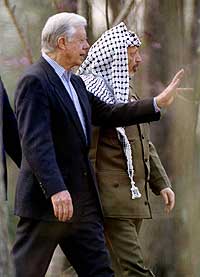
Posted Image

President Carter was voted out of office. I believe the reason for his resounding defeat was because the American people did not agree with President Cater's policies.

As a fellow American when I use the term "we" I mean the United States of America.


Lazarus Long,

The United States does not operate under a tyrannical consensus. The US govermental policies are determined by its elected officials and should follow the system outlined by the Constitution.

For example, I felt the US should have gone into Iran with military strength sufficient to end the Iranian Hostage stituation, but President Carter simply rung his hands while pacing in the Rose Garden. Then with too little too late, formulated a rescue mission with little chance to succeed was scrambled together. I openly opposed the manner in which President Carter handled the Iranian Hostage situation.

In the current situation prior to the war with Iraq, I posted several articles by two Senators which were concerned about the way the Iraq diplomatic situation was being handled.

The point is the United States is not a tyrannical dictatorship like Iraq which controls by fear where superficial consensus reigns.

The US is a Republic where individual leaders are voted in office and then out of office. And can be removed from office as defined by law.

To state "we" when referring to the actions by duely elected officials of the United States government does not accurately represent the way this Republic works.

To repeat, officials can be voted in office and officials can be voted out of office. This is where "we the people" are bought into the equation along with the allowing for dissent such as peaceful assembly.

bob

Edited by bobdrake12, 22 March 2003 - 04:34 PM.


#526 bobdrake12

  • Guest
  • 1,423 posts
  • 40
  • Location:Los Angeles, California

Posted 22 March 2003 - 04:39 PM

There are some segments of international public opinion, which feel that Hussein has not been guilty of this. Even chief weapons inspector Hans Blix had felt that Iraq was cooperating and accusations against Hussein were not entirely accurate.


Lazarus Long,

I have already posted the UN Resolutions a few pages back on this topic. How about getting specific here?

bob

#527 bobdrake12

  • Guest
  • 1,423 posts
  • 40
  • Location:Los Angeles, California

Posted 22 March 2003 - 04:44 PM

I appreciate your concern about the Rule of Law. Somehow, what has been layed aside for far too long is the disdain that the government of Iraq has had for the Rule of Law as displayed by their actions as well as their non-compliance with the UN sanctions.

bob


I have not been laying it aside I have been shocked that no sufficiently serious effort was made to strengthen and apply the rule of law.


Lazarus Long,

Oh? Can you please point me to two articles that you posted in this Forum delineating the horrors under Hussein's regime?

bob

Edited by bobdrake12, 22 March 2003 - 04:47 PM.


#528 bobdrake12

  • Guest
  • 1,423 posts
  • 40
  • Location:Los Angeles, California

Posted 22 March 2003 - 04:52 PM

I argue “containment with constriction” and I argue we should have been raising the threat level consistently and with determination deliberately but we also should demonstrate responsible leadership and respect for global institutions at the same time, and patience with regard to process.


Lazarus Long,

And count yourself very lucky that you live in a country which you can continue to practice dissent.

In a tryannical regime such as Iraq, you wouldn't be allowed to say or write anything against the actions of those controlling the government. I have included just a few articles about the way the tyrannical government of Iraq has operated but somehow the horrors included in these articles are being dismissed.

bob

Edited by bobdrake12, 22 March 2003 - 05:35 PM.


#529 bobdrake12

  • Guest
  • 1,423 posts
  • 40
  • Location:Los Angeles, California

Posted 22 March 2003 - 05:03 PM

No one sees Saddam as having been beyond the law, or above it, what those that rationally protest is the idea that some think we are. The failure of Due Process in this case and for 12 years AND MORE can also be tied to ourselves. We have lowered the standards of diplomacy and juris prudence by our actions not raised the bar.


Lazarus Long,

Again, I would appreciate your providing sources as to why the protestors are protesting.

By ourselves, who do you mean? The entire UN or the United States?

By the term "we" in "we have lowered the standards of diplomacy..." can you get more specific?

bob


As to "why" people protest I will only add at the moment that there are those around the world that will fight Globalism under any and all circumstances and they perhaps are also against the UN and World Bank, as well as the IMF and ALL the institutions that the United States and the rest of the emerging technocracies have worked diligently to build, but what the demonstrators in this Nation generally are against is our abandonment of legitimate diplomatic channels prematurely and a demand for our intervention unilaterally in a region Moreover that it was done in such a manner that was not inclusive at all but seen by the inhabitants of that region as a resurrection of the ancient coalitions of the Crusades and is seen as a war of US against Them. If the quest to bring Democracy becomes a Crusade it will have no more effect at uniting that region then Christianity did for almost a millennium of conflict before.


Lazarus Long,

With due respect, you have not provided data.

To presume why the millions of people that so far have demonstrated without data appears to be a stretch.

I personally believe that there were a number of motives, but note I use the word "believe" rather than stating what I sense as a fact.

bob

#530 bobdrake12

  • Guest
  • 1,423 posts
  • 40
  • Location:Los Angeles, California

Posted 22 March 2003 - 05:08 PM

Regardless, I am glad that the ground war proceeds with apparent minimal loss of life both civilian and military and that clearly greater concern has been made to reduce the collateral damage to civilian populations, AND I DO NOTICE.


Lazarus Long,

I don't enjoy seeing anyone killed.

The concern I have that is when the US gets to Bagdad, the troops of Iraq will fear their tyannical leadership and continue to fight because of that fear.

It could get very ugly.


bob

Edited by bobdrake12, 22 March 2003 - 05:23 PM.


#531 bobdrake12

  • Guest
  • 1,423 posts
  • 40
  • Location:Los Angeles, California

Posted 22 March 2003 - 05:10 PM

So how do we demonstrate a respect for the Rule of Law when we defy it too?


Lazarus Long,

Once you talk with those who have greatly suffered horror under the tyrannical government of Iraq to the degree that you understand what they experienced, maybe you will be able to answer this question regarding the decision of the current Administration.


bob

Edited by bobdrake12, 22 March 2003 - 05:41 PM.


#532 Lazarus Long

  • Life Member, Guardian
  • 8,116 posts
  • 242
  • Location:Northern, Western Hemisphere of Earth, Usually of late, New York

Posted 22 March 2003 - 05:47 PM

Lazarus Long,

Oh? Can you please point me to two articles that you posted in this Forum delineating the horrors under Hussein's regime?

bob


There are more than two and more than two in the just the list I gave that you are replying to, did you examine them?

In the very beginning I started with a history of how we destroyed the democracy in Iran and how this lead to our involvement with the Iran/Iraq war in the first place and listed articles that refer to the articles in Iraq that ensued.

True I have not made Our behaving like a "Big Bbrother" hero the paramount issue, I have made the quiet unrecognized and disrespected unspectacular heroism of constructing a Rule of Law the parampunt issue and argue the Institutional Imortance or we risk succeeding today and only create a scenario of ever worsening possiblities as we proceed. I also see many of the interests involved as possible conspirators in a willful destruction of the United Nations so their choices are predictable as such, and more than a little consistent with such predictions.

I feel we were complicit in what happened at Halabja so I am not seeing this as a reason for just going after Saddam. I see it as a reason to alter our policy from the ground up and not justt favor the the most extreme methods we have as options for confronting extreme behaviors in others.

When I pointed out the atrocities at the time THEY HAPPENED to my Republican Compatriots I was met with deaf ears and the same complacency of the likes of Kissinger when I discuss the impending collapse ofthe food supply in the face of climactic change. When I argued at the time that we needed to be careful about fomenting a revolt by Iraqi Kurds if we were unwilling to go forward with their willing sacrifice that we were opening ourselves up to making the problems worse, again I was met with deaf ears. I didn't begin this discussion with you, I began it decades ago.

#533 Lazarus Long

  • Life Member, Guardian
  • 8,116 posts
  • 242
  • Location:Northern, Western Hemisphere of Earth, Usually of late, New York

Posted 22 March 2003 - 05:50 PM

And count yourself very lucky that you live in a country which you can continue to practice dissent.


It is NOT about luck. It is about a committment to struggle for such social justice, our system gave us nothing we deserve, only what we demand. It is about honoring the responsibilities of our inheritance.

#534 bobdrake12

  • Guest
  • 1,423 posts
  • 40
  • Location:Los Angeles, California

Posted 22 March 2003 - 05:53 PM

The fact is that instead of "negotiating" alternative strategies for approaching this monster we have conveniently stood off at a distance and single-mindedly followed a Policy of Containment for 12 years that wasn’t defined by the UN but the US and Britain.


Lazarus Long,

The Policy of Containment had a huge price of human suffering attached to it. This policy needed to end.

bob

#535 bobdrake12

  • Guest
  • 1,423 posts
  • 40
  • Location:Los Angeles, California

Posted 22 March 2003 - 06:07 PM

Shown below is a commentary made last year regarding Saddam's human rights violations.

bob

http://www.hrw.org/e...iraq_032202.htm

The Wall Street Journal March 22, 2002

Indict Saddam

By Kenneth Roth


Bush administration's frustration with a decade of increasingly porous sanctions against Iraq has led to active consideration of military action. Yet one alternative has yet to be seriously tried -- indicting Saddam Hussein for his many atrocities, particularly the 1988 genocide against Iraqi Kurds.

As deposed Yugoslav President Slobodan Milosevic discovered, indictment for grave abuses can delegitimize a dictator and undermine his grasp on power. Even if Saddam escapes arrest, his indictment for heinous crimes would demonstrate that Iraq's desire for normal international relations is a pipe dream so long as Saddam is at the helm. That would weaken Saddam's support among the many governments that have been lining up for years to do commercial deals with him in anticipation of an end to sanctions. It would also encourage Iraqi officials to overthrow him.

Cowardice

Unfortunately, governmental cowardice and opportunism have stymied past attempts to indict Saddam, as Human Rights Watch learned during its intensive efforts to bring him to justice in the 1990s. At the top of any indictment should be Saddam's 1988 genocidal Anfal campaign against Iraqi Kurds, described by Jeffrey Goldberg in this week's New Yorker. Named after a Koranic verse justifying pillage of the property of infidels, the Anfal campaign unfolded as the 1980-88 Iran-Iraq war was winding down. Iraqi Kurds had taken advantage of Saddam's preoccupation with Iran to seize control of parts of mountainous northern Iraq. But as soon as Iraqi troops could be withdrawn from the Iranian front, Saddam shifted them to the north.

Several thousand Kurdish villages were destroyed, forcing residents to live in appalling camps. In at least 40 cases, Iraqi forces under Saddam's cousin, Ali Hassan al-Majid, used chemical weapons to kill and chase Kurds from their villages. Then, during the Anfal campaign from February to September 1988, Iraqi troops swept through the highlands of Iraqi Kurdistan rounding up everyone who remained in government-declared "prohibited zones." Some 100,000 Kurds, mostly men and boys, were trucked to remote sites and executed. Only seven are known to have escaped.

The full scope of the Anfal horror became known only after Saddam's defeat in the Gulf War. The Iraqi military's withdrawal from the region in October 1991 after the imposition of a no-fly zone made it feasible for the first time in years for outsiders to reach the area.

Human Rights Watch investigators took advantage of this opening to enter northern Iraq and document Saddam's crimes. Some 350 witnesses and survivors were interviewed. Mass graves were exhumed. And Kurdish rebels were convinced to hand over some 18 tons of documents that they had seized during the brief post-war uprising from Iraqi police stations. These documents were airlifted to Washington, where Human Rights Watch researchers poured through this treasure trove of information about the inner workings of a ruthless regime.

With this extraordinarily detailed evidence of genocide, Human Rights Watch launched a campaign to bring Saddam to justice. At the time the U.N. Security Council was creating special tribunals for Rwanda and the former Yugoslavia, but there was no consensus for similar action on Iraq. France and Russia, each with extensive business interests in Iraq, threatened to wield their veto. China, worried about analogies to its treatment of Tibetans, was disinclined to support an International Criminal Tribunal for Iraq. With no International Criminal Court then in the works, and the Pinochet option of exercising universal jurisdiction in national courts not yet widely recognized, the prospect of criminal prosecution was remote.

Human Rights Watch thus turned to the only available remedy -- a civil suit before the International Court of Justice in The Hague, commonly known as the World Court. The relevant U.N. treaty -- the Convention on the Prevention and Punishment of the Crime of Genocide -- assigned the World Court the task of adjudicating disputes under the treaty. We hoped for a declaratory judgment that the Iraqi government had committed genocide, damages for the survivors, and an order that the perpetrators be prosecuted.

The problem was that only governments can bring suit before the World Court. Washington was a logical first choice, and ultimately the Clinton administration endorsed the case. But restrictions in the U.S. ratification of the Genocide Convention stood in the way of a successful suit.

Human Rights Watch staff then circled the globe trying to convince another government to bring the suit. None would. At best, a couple of governments said they would join a coalition to bring the case, but only on the condition that at least one European government joined as well. Several European governments gave the matter serious consideration, but in the end none would take the plunge.

There were many reasons for this reluctance, some stated openly, others only hinted at. Governments feared the loss of business opportunities when Iraq emerged from U.N. sanctions. They feared a loss of influence in the Middle East for suing an Arab state. They feared terrorist retaliation by Iraqi agents. And they feared the expense of bringing the lawsuit (although offers were made to raise the funds).

This frustrating experience highlighted the importance of an International Criminal Court -- that is, a global tribunal that does not depend on the political courage of individual governments or the vagaries of consensus among the veto-wielding members of the U.N. Security Council. But the ICC will apply only to crimes that are committed after the treaty takes effect in several weeks. Many governments are ratifying the ICC treaty as an insurance policy against future Saddams. But the court cannot act retroactively on a crime such as the Anfal genocide.

Security Council

The best option remains Security Council action to establish an International Criminal Tribunal for Iraq, since the council would be free to grant the tribunal jurisdiction over past crimes. But council action depends on overcoming the veto of Russia, France and China. To date, that obstacle has been insurmountable, although no effort has been made in the post-Sept. 11 climate.

Saddam could also be prosecuted by any government that has given its courts universal jurisdiction for the crime of genocide, although in this case the actions of a single government would probably carry less weight than the pronouncements of an international court. Finally, one or more governments could sue in the World Court for a declaration that Iraq had committed genocide.

Regardless of the approach, formal condemnation of Saddam for such a heinous crime would signal definitively to Iraqis and Saddam's international sympathizers that he is beyond the pale -- not simply because of the threat he poses to others, but also because he has flouted the most basic norms on the treatment of his own people. That delegitimization would not guarantee his ouster, but it would certainly help build consensus that he is unfit to govern, and thus that something must be done to end his rule.

Mr. Roth is executive director of Human Rights Watch.

Edited by bobdrake12, 22 March 2003 - 06:13 PM.


#536 Lazarus Long

  • Life Member, Guardian
  • 8,116 posts
  • 242
  • Location:Northern, Western Hemisphere of Earth, Usually of late, New York

Posted 22 March 2003 - 06:08 PM

With due respect, you have not provided data.


You asked my opinion and I gave it. IN fact all you had to do was listen to what has been being said by the protests going on around the world for the last few years at Davros, Seattle and other gatherings of the of GAT, IMF and othrs and you can confirm my allegations for yourself.

I wasn't attempting so much to make a formal case, as answer your request for an opinion. I gave an personal opnion of "belief" as such not a brief. You are corect that such a case needs to be made. Also look the first post on the thread " Beyond Good and Evil" and you will see I did raise the horrors of saddam a long time ago. You and I are not so far appart, but we still know how to "respectfully disagree".

Also I must add I am relating "Why" I have heard people say they are protesting and that data isn't in books or print, it is in the voices of the people protesting. Again i posted the article from Inia to demonstrate how what we say is being heard. I posted the Portugese writer to the same effect. A search of world wide opinion will reap a harvest of protest opinion and it can't be simply written off as misguided.

I wish it were otherwise but I am not able to continue this debate because of personal commitments elsewhere that demand my attention so I have weighed in only when I saw no one address the opinions being offered with what I am familiar with as alternative perspectives.

Knowing how you (and I) have been interested in the truth I thought this was responsible but I am concerned that too few make any serious attempt to confront the "propagandistic" character of the general debate and your challenge for substantive support for my arguments is valid, but I am unpaid as such an analyst and now need to return to supporting my family, and my many other projects as Spring approaches.

Nevertheless, the importance of this debate keeps bringing me back into the fray.

#537 Lazarus Long

  • Life Member, Guardian
  • 8,116 posts
  • 242
  • Location:Northern, Western Hemisphere of Earth, Usually of late, New York

Posted 22 March 2003 - 06:16 PM

The concern I have that is when the US gets to Bagdad, the troops of Iraq will fear their tyannical leadership and continue to fight because of that fear.

It could get very ugly.


This is likely and historically consistent. I am also be concerned with a loose nuke minefield. Saddam had no realistic delivery mechanism for any possible nuclear weapons he may have built, or acquired, but as we concentrate our forces over his terrain we risk the trap that he explodes such a device on top of himself with a concurrent devastating effect on our concentrated force and with an ensuing chaos that could offer an avenue of escape to a well prepared adversary.

#538 bobdrake12

  • Guest
  • 1,423 posts
  • 40
  • Location:Los Angeles, California

Posted 22 March 2003 - 06:20 PM

When I argued at the time that we needed to be careful about fomenting a revolt by Iraqi Kurds if we were unwilling to go forward with their willing sacrifice that we were opening ourselves up to making the problems worse, again I was met with deaf ears. I didn't begin this discussion with you, I began it decades ago.


Lazarus Long,

I disagreed with this policy as well.

bob

#539 Lazarus Long

  • Life Member, Guardian
  • 8,116 posts
  • 242
  • Location:Northern, Western Hemisphere of Earth, Usually of late, New York

Posted 22 March 2003 - 06:22 PM

http://www.hrw.org/e...iraq_032202.htm

The Wall Street Journal March 22, 2002

Indict Saddam

By Kenneth Roth


Yes we should have indicted Saddam not tried to coopt the Grand Jury. That is my point we had a damn good case and only made it after the fact. We have never given due process the respect it deserved.

Damn good article by the way and a clear demonstration of too little too late.

Why wasn't this the approach of this adminstration from the beginning?

#540 bobdrake12

  • Guest
  • 1,423 posts
  • 40
  • Location:Los Angeles, California

Posted 22 March 2003 - 06:23 PM

Saddam had no realistic delivery mechanism for any possible nuclear weapons he may have built, or acquired, but as we concentrate our forces over his terrain we risk the trap that he explodes such a device on top of himself with a concurrent devastating effect on our concentrated force and with an ensuing chaos that could offer an avenue of escape to a well prepared adversary.


Lazarus Long,

Hopefully, the war was started soon enough to avert such a possiblity.

bob


14 user(s) are reading this topic

0 members, 14 guests, 0 anonymous users