• Log in with Facebook Log in with Twitter Log In with Google      Sign In    
  • Create Account
  LongeCity
              Advocacy & Research for Unlimited Lifespans


Adverts help to support the work of this non-profit organisation. To go ad-free join as a Member.


Photo
- - - - -

Should The Us Go To War With Iraq?


  • This topic is locked This topic is locked
952 replies to this topic

#601 Lazarus Long

  • Life Member, Guardian
  • 8,116 posts
  • 242
  • Location:Northern, Western Hemisphere of Earth, Usually of late, New York

Posted 26 March 2003 - 01:39 PM

Russia scorns U.S. "liberation" claim
Wednesday March 26, 11:32 AM
By Maria Golovnina

MOSCOW (Reuters) - Russia has fired a new broadside against the United States over its military action against Iraq, scorning claims its troops were "liberating" Iraqis and accusing it of defying world opinion.

Foreign Minister Igor Ivanov, using language at times reminiscent of the Cold War rivalry with Washington, said: "What the United States is doing challenges not only Iraq, but the whole world."

Addressing parliament as U.S. and British forces pressed forward to Baghdad, Ivanov said the evidence so far contradicted U.S. efforts to portray its troops as a liberating force freeing Iraqis from Saddam Hussein's rule.

"It is already becoming clear how far removed from reality are their attempts to present military action against Iraq as a triumphant march for the liberation of the Iraqi people with minimal casualties and destruction," he told the Federation Council (upper house).

And he counselled Washington and London not to make unsubstantiated claims to have found caches of banned weapons in Iraq to justify their military offensive.

"If there are claims by coalition forces about discovering weapons of mass destruction...only international inspectors can make a conclusive assessment of the origin of these weapons," he said. "No other evaluation and final conclusion can be accepted."

Ivanov, mindful of the political capital Moscow has built up with Washington by backing the U.S.-led war on terror, strove to maintain a balance in his criticism, saying international relations depended on Russian and U.S. strategic ties.

"It is the nature of our partnership that allows us to be honest with each other (and) discuss issues we do not agree on," he said.

But his sharp attack, following President Vladimir Putin's fierce denunciation at the onset of U.S. military action on March 20, nonetheless marked another downturn in relations between the onetime superpower rivals-turned-friends.


PROTECTING TIES WITH U.S.

Putin, who needs U.S. support and investment to turn Russia's economy round, has fought to protect his newly-forged ties with U.S. President George W. Bush.

But Russia's opposition to U.S. military action against its former close economic partner and Putin's call for a rapid end to military action has brought the relationship under pressure.

Russia, with other U.N. heavyweights France and China, tried unsuccessfully to stop U.S. military action to topple Saddam. All three argued for more time to be given to U.N. arms inspectors searching for weapons of mass destruction in Iraq. Baghdad denies holding any banned arms.

The atmosphere has been further soured by Moscow's suspicions that Washington will disregard Russia's big economic and oil interests in Iraq after the war is over and shut it out of the picture.


Highlighting Russia's fears, the head of a Russian state firm with big oil interests in Iraq said on Wednesday that Moscow had little chance of getting a slice of the pie after the fighting was over.

"Americans don't need anyone else in Iraq, they will control Iraqi crude themselves. Nobody will give the green light for Russian or French firms in Iraq," said Nikolai Tokarev, head of Zarubezhneft, in an interview with Reuters.

Since the U.S. offensive, the two powers have become locked in a row over U.S. claims that Russian firms have supplied Iraq with electronic jamming equipment, night vision goggles and anti-tank missiles that Washington says could put the lives of their soldiers at risk. Russia denies such deliveries were made.

And the State Duma (parliament lower house) has delayed a vote to ratify a U.S.-Russia nuclear arms reduction treaty that would slash numbers of deployed warheads held by each side.


In a reference to the row over alleged weapons sales, Ivanov bemoaned signs that Washington was "trying to drag Russia into an information war" on Iraq.

"We hope our U.S. partners are responsible about what they are doing and that they don't take steps that could hurt our relations," he said.
http://uk.news.yahoo...6/80/dwaxw.html

#602 Lazarus Long

  • Life Member, Guardian
  • 8,116 posts
  • 242
  • Location:Northern, Western Hemisphere of Earth, Usually of late, New York

Posted 26 March 2003 - 05:10 PM

And now for the view from the "Right". well sort of. Here is the reasonably historical account of the developmental process that went into the lead up to war and the "actual commitment" to Diplomacy as it was understood at the White House.

Some of it is no doubt spin but a lot is eye witness reporting. The article is quite long and worth the read so I will only post the lead part of the first page but follow the link and you will be rewarded.

Posted Image

First Stop, Iraq

How did the U.S. end up taking on Saddam?
The inside story of how Iraq jumped to the top of Bush's agenda—and why the outcome there may foreshadow a different world order
Posted Image

By Michael Elliott and James Carney
Posted Sunday, March 23, 2003; 2:31 p.m. EST

"F___ Saddam. We're taking him out." Those were the words of President George W. Bush, who had poked his head into the office of National Security Adviser Condoleezza Rice. It was March 2002, and Rice was meeting with three U.S. Senators, discussing how to deal with Iraq through the United Nations, or perhaps in a coalition with America's Middle East allies. Bush wasn't interested. He waved his hand dismissively, recalls a participant, and neatly summed up his Iraq policy in that short phrase. The Senators laughed uncomfortably; Rice flashed a knowing smile. The President left the room.

A year later, Bush's outburst has been translated into action, as cruise missiles and smart bombs slam into Baghdad. But the apparent simplicity of his message belies the gravity at hand. Sure, the outcome is certain: America will win the war, and Saddam will be taken out. But what is unfolding in Iraq is far bigger than regime change or even the elimination of dangerous weapons.

The U.S. has launched a war unlike any it has fought in the past. This one is being waged not to defend against an enemy that has attacked the U.S. or its interests but to pre-empt the possibility that one day it might do so. The war has turned much of the world against America. Even in countries that have joined the "coalition of the willing," big majorities view it as the impetuous action of a superpower led by a bully. This divide threatens to emasculate a United Nations that failed to channel a diplomatic settlement or brand the war as legitimate. The endgame will see the U.S. front and center, attempting to remake not merely Iraq but the entire region. The hope is that the Middle East, a cockpit of instability for decades, will eventually settle into habits of democracy, prosperity and peace. The risks are that Washington's rupture with some of its closest allies will deepen and that the war will become a cause for which a new generation of terrorists can be recruited.

How did we get here? In one sense, this war is easy to explain. Saddam Hussein is a brutal dictator who hates America and has shown a wicked fondness for acquiring and using weapons of mass destruction (WMDs).

Since Sept. 11, 2001, the U.S. has been acutely aware of what can happen when powerful weapons fall into the hands of those with no compunction about their use and no sympathy for those they kill. Put those facts together, and you can argue that Saddam's days were numbered from the moment the attacks on New York City and Washington happened. But that suggests a fatalistic inevitability to the story and ignores the dramatic shifts in opinion and influence among Washington's key players. In truth, this war is just as much about an idea—that Iraq is but the first step in an American-led effort to make the world a safer place. For some in the Administration, the principles that have shaped policy on Iraq are generally applicable; they could be used with other nations, like Iran or North Korea, that have or threaten to acquire terrible weapons. The least understood story of the Iraq crisis is how the idea behind it took root and eventually brought America to the edge of Baghdad. (short excerpt)


FULL TEXT & LINKS

RELATED ARTICLES
The Road Back to Baghdad

Gulf Wars I and II

Voices of Outrage


********************

As of this moment I probably will not attend this Sunday's chat and I sincerely hope that a serious discussion ensues and not mere pandemonium and invective. This is too important an issue to allow personal feelings to cloud the substantive issues that DEMAND attention to their detail. It is also far too significant to be seen as unnecesary to debate and further more if people are not taking up both sides then something has gone very wrong.

This isn't about a few of us that heretofore have taken up the debate and weighed in on a daily basis with position statements and perspectives pro and con; this is about serious concerns that are going to determine much of the character of the rest of your lives.

You want to be immortal?

Then face the music, growing up goes on forever.

Your childhood is coming to an end humans and immortality is about maturity and responsibility and not about "Peter Pan-like" youthful fantasies and pretensions.

Remember the concept of nobless oblige?

Or are we still denying all things French?

Posted Image Posted ImagePosted Image

Well Lady Liberty was a French import too.

Edited by Lazarus Long, 26 March 2003 - 05:18 PM.


#603 DJS

  • Guest
  • 5,798 posts
  • 11
  • Location:Taipei
  • NO

Posted 28 March 2003 - 07:35 AM

Confronting the naysayers
Some simple thoughts...


1. More American's will die in auto accidents this year than in the second Gulf War.

2. Instability and extremism in the Middle East has become our business after 9/11.

3. The status quo in the Middle East would have remained if the US didn't invade Iraq.

4. The status quo is what caused 9/11.

5. Public opinion in the Middle East will remain against us as long as all media source in the Middle East portray us negatively. It doesn't matter what the US' actions are because we will get negative coverage anyway.

6. The Administration has recognized the fact that it is essential that we win the battles we can win. We can not restrain our foreign policy actions because we are afraid of negative blow back that may or may not occur.

7. By taking out Iraq will be able to start presenting our vision of how the Middle East should operate in the future.

sponsored ad

  • Advert

#604 DJS

  • Guest
  • 5,798 posts
  • 11
  • Location:Taipei
  • NO

Posted 28 March 2003 - 09:08 AM

By the way guys, the tanks can only go so fast. People are freaking out because the war has taken a week. Well guess what, it might take a few more. Nonetheless, the regime will fall, sooner rather than later, and the world will be better for it.

What will you do, Lararus, when your dooms day scenario does not play out? Or will you retreat to more theoretical postulations in an attempt to further advance the event horizon? Ah, to hell with it. You are right, in that there is very little glory in this endeavor. Tanks rolling through the Iraqi desert are dramatic images. The custodial nature of Iraq for the next two to ten years might not be as "dramatic".

Please, continue to make me pull out my hair in frustration. You are, after all, my loyal opposition.

By the way, what would you recommend --Army, Navy, or Marines when I go ROTC? I have decided that I am going to go ROTC for Spring 04, my second semester back. I do not think there is a better way to show ones love of country than to serve in the military.

#605 Lazarus Long

  • Life Member, Guardian
  • 8,116 posts
  • 242
  • Location:Northern, Western Hemisphere of Earth, Usually of late, New York

Posted 28 March 2003 - 04:25 PM

What will you do, Lararus, when your dooms day scenario does not play out?


I will sing and dance, play with my children and theirs, then languish for many a tranquil moment with those I love. I will gather fruit at our harvests and plant seed in the Spring. In other words, I for one will rejoice as I understand best how to. I savor life, I love life, and I will work to create life in its fullest and most precious forms always.

I am not a pessimist, I am a pragmatic realist, and I don't make spun promises of making lead into gold for fools to lose theirs. I am glad that you are at least paying attention. Remember that what is most important in all this is to give purpose to WHY we live, not just a meaning to why we kill.

As for which branch of the service; I do not know you well enough to recommend one, but I suggest you ask BOTH your heart and your head.

Go into what gives you a sense of purpose as well as a challenge to your innate abilites. It isn't about all the symbols, it is about the substance. It is about finding yourself in the midst of other's challenging to dominate your identity and turn all your will to their defined purpose.

They will test you, in order to "identify" your MOS (Military Occupational Specialty) and then they will "offer" you options.

Just remember;

How can you tell when a recruiter is lying?

Answer: When he/she opens his/her mouth.

But there will be a set of alternative choices that you must evaluate well. Do not allow them to "pressure your decision", but expect them to, with all the tenacity of cold-calling "boiler room scammer". Also if you discuss this with various Branches, each will offer their "spin" to you on what they offer. You will have to figure out the pitfalls of each proposal for yourself, seek the counsel of those you trust and those who've had experience. I ended up working for HQ as a clerk.

Repeated recommendations that I be transferred to Intelligence by every Commander I had were met with denials of a security clearance and a kind of "what are you nuts?" response. Of course the Commanders understood better than the bureaurcrats the worth and abilities of their personnel. That is why Military Intelligence is still an oxymoron and maybe always will be. It is also their Achilles heel.

Edited by Lazarus Long, 28 March 2003 - 05:15 PM.


#606 Lazarus Long

  • Life Member, Guardian
  • 8,116 posts
  • 242
  • Location:Northern, Western Hemisphere of Earth, Usually of late, New York

Posted 28 March 2003 - 04:53 PM

Oh, and one last comment.

Remember this about the Military in a Democracy, it is comprised of Citizen/Soldiers. In that order.

We are citizens FIRST, then soldiers.

There will yet come a day when you remember this and understand that here will be your greatest test and challenge of all you hold dear to yourself, your integity, your values, your community, and the lives of all you know and love, including your own.

#607 bobdrake12

  • Guest
  • 1,423 posts
  • 40
  • Location:Los Angeles, California

Posted 29 March 2003 - 01:28 AM

Some say that Jimmy Carter should have been involved in the diplomacy.  

What do you think?


No Bob, I do not agree. I think Carter would be useful in certain diplomatic situations, but not Iraq. The problem with Carter is that he is too much of an activist. He wouldn't be fair and impartial. I think Colin Powell is a great diplomat, and did the best job a Secretary of State could do.

You have to remember that diplomacy does not imply a peaceful solution, it implies a cooperative solution. :)


Kissinger,

I agree that Carter was "too much of an activist" when it came to Iraq.

I have included Carter's statement below.

While I do feel that Carter's statement did make some valid points, but unfortunately it did not address the cost of human life in Iraq due to "containment" (AKA as "sanctions") as well as the significant human rights violations (AKA attrocities) by the government of Iraq on its own people.

The statement also did not discuss the strong adversarial relationship that the government of Iraq had with the US as well as the strong economic potential (oil) Iraq had once containment was lifted allowing Iraq to pursue WMD with considerable funding available.

I might add that I did not foresee Saddam's regime changing its philosophy (controlling the general public of Iraq by the use of human rights violations) once researching the conduct of two of Saddam's sons given political authority. In other words, Saddam's regime appeared to me to have "deep roots" which would carry on with or without Saddam unless it was violently overthrown.

bob

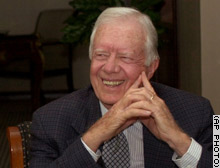
Posted Image

Former President Jimmy Carter


http://truthout.org/..._02/020303B.htm

Statement
Jimmy Carter
Former U.S. President, Nobel Laureate

An Alternative to War

Friday 31 January 2003


ATLANTA, Jan. 31 -- "Despite marshalling powerful armed forces in the Persian Gulf region and a virtual declaration of war in the State of the Union message, our government has not made a case for a preemptive military strike against Iraq, either at home or in Europe.

Recent vituperative attacks on U.S. policy by famous and respected men like Nelson Mandela and John Le Carre, although excessive, are echoed in a Web site poll conducted by the European edition of TIME magazine. The question was "Which country poses the greatest danger to world peace in 2003?" With several hundred thousand votes cast, the responses were: North Korea, 7 percent; Iraq, 8 percent; the United States, 84 percent. This is a gross distortion of our nation's character, and America is not inclined to let foreign voices answer the preeminent question that President Bush is presenting to the world, but it is sobering to realize how much doubt and consternation has been raised about our motives for war in the absence of convincing proof of a genuine threat from Iraq.

The world will be awaiting Wednesday's presentation of specific evidence by Secretary of State Colin Powell concerning Iraq's possession of weapons of mass destruction. As an acknowledged voice of moderation, his message will carry enormous weight in shaping public opinion. But even if his effort is successful and lies and trickery by Saddam Hussein are exposed, this will not indicate any real or proximate threat by Iraq to the United States or to our allies.

With overwhelming military strength now deployed against him and with intense monitoring from space surveillance and the U.N. inspection team on the ground, any belligerent move by Saddam against a neighbor would be suicidal. An effort to produce or deploy chemical or biological weapons or to make the slightest move toward a nuclear explosive would be inconceivable. If Iraq does possess such concealed weapons, as is quite likely, Saddam would use them only in the most extreme circumstances, in the face of an invasion of Iraq, when all hope of avoiding the destruction of his regime is lost.

In Washington, there is no longer any mention of Osama bin Laden, and the concentration of public statements on his international terrorist network is mostly limited to still-unproven allegations about its connection with Iraq. The worldwide commitment and top priority of fighting terrorism that was generated after September 11th has been attenuated as Iraq has become the preeminent obsession of political leaders and the general public.

In addition to the need to re-invigorate the global team effort against international terrorism, there are other major problems being held in abeyance as our nation's foreign policy is concentrated on proving its case for a planned attack on Iraq. We have just postponed again the promulgation of the long-awaited "road map" that the U.S. and other international leaders have drafted for resolving the Israeli-Palestinian conflict. This is a festering cancer and the root cause of much of the anti-American sentiment that has evolved throughout the world. At the same time, satellite observations of North Korea have indicated that nuclear fuel rods, frozen under international surveillance since 1994, are now being moved from the Yongbyon site to an undisclosed destination, possibly for reprocessing into explosives. It is imperative that this threat to Asian stability be met with aggressive diplomacy.

Since it is obvious that Saddam Hussein has the capability and desire to build an arsenal of prohibited weapons and probably has some of them hidden within his country, what can be done to prevent the development of a real Iraqi threat? The most obvious answer is a sustained and enlarged inspection team, deployed as a permanent entity until the United States and other members of the U.N. Security Council determine that its presence is no longer needed. For almost eight years following the Gulf War until it was withdrawn four years ago, UNSCOM proved to be very effective in locating and destroying Iraq's formidable arsenal, including more than 900 missiles and biological and chemical weapons left over from their previous war with Iran.

Even if Iraq should come into full compliance now, such follow-up monitoring will be necessary. The cost of an on-site inspection team would be minuscule compared to war, Saddam would have no choice except to comply, the results would be certain, military and civilian casualties would be avoided, there would be almost unanimous worldwide support, and the United States could regain its leadership in combating the real threat of international terrorism."

--------

Former U.S. President Jimmy Carter is chair of The Carter Center in Atlanta, Ga., a not-for-profit, nongovernmental organization that advances peace and health worldwide.

For more information, contact The Carter Center Public Information, 404-420-5108.

(In accordance with Title 17 U.S.C. Section 107, this material is distributed without profit to those who have expressed a prior interest in receiving the included information for research and educational purposes.)

© : t r u t h o u t 2002

Edited by bobdrake12, 29 March 2003 - 04:51 AM.


#608 bobdrake12

  • Guest
  • 1,423 posts
  • 40
  • Location:Los Angeles, California

Posted 29 March 2003 - 01:49 AM

I know you have never said this Bob, but Kissinger has and so has some of the rhetoric of Rush Limbaugh you have posted to be fair.


Lazarus Long,

As long as I was neutral on going to war with Iraq, I posted articles on both sides of the issue (some of which I did not agree with including those that were personally repugnant to me). This action is consistent with my philosophy of listening to everybody, reading everything but believing nothing until I perform my own research.

You might note that Kissinger thought I was favoring "your side" on not going to war with Iraq. In a way, Kissinger may have been correct because some of Limbaugh's articles were nothing but "batting practice soft balls" for you to take a good wack at.

With that said, I do believe that it is necessary to understand the whole issue (including mitigating circumstances) rather than just posting an agenda.

Now that the war has commenced, we are in a much different phase. It is my opinion that the rhetoric needed to change, thus I have stopped posting certain articles on both sides of the issue.

Based upon my personal research, I have come to the conclusion that war with Iraq was necessary. While I would have preferred that the diplomacy by the Bush Administration to have been handled differently, I believe that war with Iraq was inevitable as long as Saddam and his inner circle controlled the government of Iraq. I have included an article further below (by the International Monitor Institute) which is one of many that led me to that conclusion. An excerpt from that article is shown directly below:

The oil-for-food guidelines allow for the Iraqi government to sell petroleum and petroleum products to buy and distribute "medicine, health supplies, foodstuffs and materials and supplies for essential civilian needs" to the Iraqi people.

However there is mounting evidence that Saddam has used the profits on personal luxuries. According to the US State Department, "Saddam has spent over $2 billion on presidential palaces. Some of these palaces boast gold-plated faucets and man-made lakes and waterfalls, which use pumping equipment that could have been used to address civilian water and sanitation needs."

In the documentary "Uncle Saddam," journalist Joel Soler reports that Saddam has built some 21-46 palaces, one of them over 50 square-miles. Hussam Khadori, Saddam's Architect, gives Soler a tour of one palace that was decorated in a classic cathedral style, including Italian ceilings, crystal chandeliers, and giant Italian marble collums. Khadori mentions that "This house was bought after the sanctions."


bob

Edited by bobdrake12, 29 March 2003 - 06:32 AM.


#609 bobdrake12

  • Guest
  • 1,423 posts
  • 40
  • Location:Los Angeles, California

Posted 29 March 2003 - 03:24 AM

Three of Webster's definitions are shown below:

attrocious - "extremely wicked, cruel or brutal

collateral damage - "the killing of civilians in a military attack"

friendly fire - "as by artillary, by one's own forces, that causes casualties to one's own troops"


Incidents of both collateral damage and friendly fire do occur in war. The reality is that people are wounded or killed in war although that was not the direct intention of the attack.

On the other hand, being "attrocious" is intentional. Hopefully, most people are adroit to understand the difference between people being wounded or killed through attrocities and on the other hand though collateral damage and friendly fire.

bob


http://news.bbc.co.u...ast/2894867.stm

Posted Image

Last Updated: Friday, 28 March, 2003, 12:18 GMT

Iraqis 'fire on Basra civilians' (excerpts)


British military officials say paramilitary forces loyal to Saddam Hussein have opened fire on civilians attempting to leave Iraq's second city, Basra.
UK troops say they fired on the paramilitaries in response and tried to position themselves between the gunmen and the civilians
.

It is unclear how many people tried to leave the predominantly Shia southern city, with some reports speaking of up to 2,000 while others say hundreds.

While there are no reports of deaths and an unconfirmed number of casualties, military officials said they were trying to get ambulances into the city, which has been encircled by UK troops for the past five days.

#610 bobdrake12

  • Guest
  • 1,423 posts
  • 40
  • Location:Los Angeles, California

Posted 29 March 2003 - 03:42 AM

http://www.imisite.org/iraq.php

Posted ImagePosted Image
Posted Image


The Emergence of Saddam Hussein and the Ba'ath Party

Posted Image

Saddam Hussein at a military parade. (Archive# ME120)


Saddam Hussein entered the Iraqi political scene in the mid-1950's after joining the Iraqi branch of the Arab Ba'ath Socialist Party (ABSP). Unsatisfied with General Qassem's government, a Ba'athist hit team attempted to gun the general down in October of 1959 as he drove down Rashid Street in Baghdad. The assassination attempt failed, forcing Saddam to escape to Syria and then to Egypt. Seventy-eight other plotters were not so lucky and were brought to trial.

In February of 1963 the Ba'athists attempted a second political coup, this time with more success. Under the leadership of Abd al-Salam 'Aref, General Qassem's regime was overthrown in a coup during several days of violent street fighting. The first Ba'athi regime was installed in Iraq with 'Aref as president and Ahmad Hasan al-Bakr as vice-president. Both 'Aref and Bakr were Free Officers associated with Egyptian President Gamal Abd al-Nasser's pan-Arab nationalism.

The first nine months of the new 'Aref regime were marked by a relentless settling of accounts with opposing political parties. For the next four years, until the Six Day War, 'Aref remained in power as the head of the first Ba'ath regime. In the meantime, in February of 1964, Saddam raised his political stature when he was elevated to the Regional Command of the Iraqi branch of the ABSP.

In June of 1967 the Six Day War brought military and social catastrophe to the Arab world. All Free-Officer-led regimes were discredited for their failure to defeat Israel. At the war's end, the Ba'ath party led large demonstrations against the 'Aref regime, calling for action against those responsible for the humiliation of Arab forces.

On July 17, 1968 the ABSP, in alliance with non-Ba'athis army officers, organized a successful coup that overthrew the 'Aref regime. Supreme authority was passed to the Revolutionary Command Council (RCC) chaired by ABSP secretary-general Ahmed Hasan al-Bakr, who also became president and commander-in-chief of the armed forces. Saddam, already assistant secretary-general of the Ba'ath party, became deputy chairman of the RCC in charge of internal security.

Over the next twelve years the civilian branch of the Ba'athist party moved to solidify their hold on power with a combination of ruthless political suppression and economic development projects in alliance with the Soviet Union. Finally, in June 1979 Saddam staged a coup that ousted Bakr and led Saddam to power. To further consolidate his rule, Saddam purged the top commanders of the Ba'ath party in July 1979. After an important meeting of the ABSP leadership on July 20th, nearly one-third of the members of the RCC and some 500 top ranking Ba'athists were executed, leaving Saddam with complete control over Iraq.

The Kurds in Iraq

Posted Image

Over a million of Kurds fled to the border of Turkey and Iran after the Iraqi regime suppressed the uprising in northern Iraq. (Archive# ME097)


The Kurds are the largest minority group in the world without their own country. They have been fighting for their existence for nearly a century.

The constant quest to achieve national identity and to confront genocide characterizes the modern history of the Kurds in Iraq. Following the coup of 1958 in which Colonel Abdul Karim Qassem came to power, the new Iraqi regime promised the Kurds more substantial political and cultural rights but the relationship soon deteriorated. In September 1961 the Iraqi army launched the first major offensive against the Kurds in the mountainous terrain of northern Iraq. By the spring of 1962 a costly full-scale guerilla war had developed. After the Ba'athi coup of 1964, American diplomats encouraged Kurdish leaders to support the new government. The Ba'ath Party leadership issued a statement at the time saying it "recognized the rights of the Kurdish people" and entered into brief negotiations with the Kurds over autonomy. However, compromise over the oil-rich area of Kirkuk was impossible and a new round of hostilities between the Kurds and the government began.

After the final Ba'athi coup of 1968, protracted negotiations between Ahmed Barzani, titular head of the main Kurdish political party the Kurdish Democratic Party (KDP), and the regime led to the power-sharing agreement of 1970. The rapprochement between Iraq and the Soviet Union led Barzani to seek military and social aid from Iran and America. In 1973, the United States and Iran began funding the peshmerga (the generic term for Kurdish guerilla fighters) in their battle against the Iraqi regime for the autonomy of Kurdistan. However, in 1975 Saddam reached a surprise peace deal with the Shah of Iran. In exchange for border concessions, Iran was to completely give up support for the Kurds. Within days of the agreement all US support for the Kurdish position ended and Saddam began a counterattack with Iraqi forces. The Iraq regime declared a forbidden military zone along the Turkish and Iranian borders to suppress the peshmerga attacks. Kurdish villages were destroyed and the populations were resettled, in a foreshadowing of the brutal repression of the Anfal.

With the collapse of the Kurdish resistance in 1975, the Patriotic Union of Kurdistan (PUK), led by Jalal Talabani, was founded. The PUK was formed to reinstate the guerilla opposition in northern Iraq.

During the Iran-Iraq war, both the KDP and the PUK cooperated with the new Islamic regime in Iran against Iraq. In 1987 the KDP and PUK combined to form the Kurdish National Front, which began to claim large parts of Kurdish territory from the weakened Iraqi army. The end of the Iran-Iraq war allowed the Iraqi regime to refocus their efforts on suppressing the Kurds and this redoubled effort culminated in the use of chemical weapons by the Iraqis against the peshmerga in 1987 and of course the Anfal operation of 1988-1990. In March 1988, the peshmerga reclaimed the town of Halabja with the aid of Iranian troops. Iraqi planes dropped chemical weapons on the town, ultimately taking thousands of civilian lives.

After the end of the Gulf War, the Kurdish political parties rose up and attacked the Iraqi presence in Kurdish northern Iraq. After a few weeks of independent Kurdish control, the Iraqi Republican Guard fought back and took control. Fearing massive retaliation and chemical weapons attacks, hundreds of thousands of Kurdish civilians fled their homes and villages and sought refuge across the Turkish and Iranian borders. Both Turkey and Iran closed their borders, creating an unprecedented humanitarian disaster. Television images of the exodus prompted the Western powers, notably Britain and the United States, to create a safe haven in Northern Iraq. By the end of the summer of 1991, under international protection, the Kurds were once again able to control the majority of the Kurdish territory in northern Iraq, and in most cases, refugees were able to return to their homes. However, there are still Kurdish cities and towns that are under Iraqi authority.

Over the next ten years the PUK and KDP competed for power in both parliamentary elections and on the battlefield. As they tried to rebuild their economy with the help of international aid organizations, various confrontations occurred between the two parties. In 1994, disagreement over the division of tolls and custom fees, levied at the Turkish and Iranian borders, led to armed conflict. In 1996, as American sponsored peace negotiations between the PUK and KDP started once again, the KDP joined the Iraqi regime in an all-out offensive against the PUK in Arbil.

Today, the KDP and PUK are cooperating to govern the autonomous areas of northern Iraq.


Anfal

Posted Image

An estimated 5,000 men, women, and children lost their lives in a chemical weapons attack by the Iraqi regime of Saddam Hussein,
March 16, 1988. (Archive# ME080)


The Anfal campaign, classified by scholars as a genocide, was an organized attempt by the Iraqi regime to eradicate Kurdish aspirations for political and cultural autonomy. The first Anfal operation occurred between February and August of 1988, and successive operations continued throughout the next several years. The term Anfal comes from a distortion of a sura from the Quran entitled the Surat al-Anfal, which tells the story of the battle of Badr. In it Allah reveals his will to inspire the Muslims to defeat the infidels from the city of Mecca.

At the tail end of the Iran-Iraq war, the Kurdish region in northern Iraq was the scene of a last gasp effort by Iranian forces allied with the PUK, to capture Iraqi territory and to prolong the war. The regime had already begun to use chemical weapons in 1987 to battle the increasingly effective and powerful Kurdish opposition militias (peshmerga) who were fighting for autonomy in northern Iraq. This fierce repression became an organized and institutionalized genocide in 1988.

In the series of Anfal operations, the Iraqis used chemical weapons and heavy bombardments to decimate civilian populations, due in part to the unavailability of troops who were at the Iranian front. The strategy also included the destruction of villages, mass executions, and deportations of civilians including women and children. In a particularly cruel practice, those who sought medical attention in the urban centers for the treatment of exposure to chemical agents were rounded up and disappeared.

In all an estimated 182,000 Kurds lost their lives and/or disappeared in this organized reign of terror. In addition, hundreds of thousands of Kurdish civilians were displaced from their homes as an estimated 4,000 villages were destroyed and a process of Arabization was enforced. The most notorious and widely publicized incident occurred in Kurdish town of Halabja, where on March 16, 1988 an estimated 5,000 men, women, and children lost their lives. Over 10,000 were wounded and to this day suffer the effects caused by exposure to chemical agents.


The Gulf War (1990-1991)

Posted Image

Executions were carried out by the Iraqi regime during the brutal seven month occupation of Kuwait. (Archive# ME002)


The background to the Gulf War is complex and rooted in the history of colonialism and the politics of oil in the Middle East. The major incidents during 1990 that led up to the Iraqi invasion of Kuwait are briefly as follows.

In the early part of the year, Saddam Hussein began to escalate his anti-Israel and anti-Western rhetoric. On February 27, 1990, the Iraqi leader took advantage of a summit of the Arab Cooperation Council to express a strong anti-Western stance, decrying American support for continued Russian immigration to Israel and the continued presence of American troops in the Persian Gulf. In addition, he used the occasion to denounce the Gulf states for keeping the price of oil too low and therefore creating a situation that would make it impossible for Iraq to pay back the millions of dollars in debt accrued during the 1980s and the Iran-Iraq war.

In July Saddam delivered a speech in a nationwide broadcast that contained a blistering threat of force against any Arab oil-producing nation that continued to pump excess oil beyond OPEC quotas. This threat was clearly aimed at Kuwait who continued to produce over the allotted amount, plummeting the price of oil in mid-1990 from around $20.50 per barrel to $13.60. Saddam also accused Kuwait of slant drilling along the Iraq-Kuwait border and therefore siphoning off oil from the Iraqi side of the Rumaila oilfields.

On July 25, 1990 the Iraqi president met with April Glaspie, the US ambassador to Iraq. She told him that "we have no opinion on the Arab-Arab conflicts, like your border disagreement with Kuwait." In an increased climate of military escalation and threats against Kuwait, Iraq and Kuwait met to try to work out their differences. The negotiations ended the day before the invasion when the Iraqi delegation walked out, claiming Kuwait was not taking them seriously.

Saddam perceived Glaspie's remarks as conciliatory and finally on August 2, 1990, the Iraqi army invaded Kuwait and took over the country in a matter of hours. UN Security Council Resolution 660 was passed condemning the invasion, demanding withdrawal, and calling for immediate Iraq-Kuwait negotiations. Iraqi assets around the world were frozen. On August 6, 1990, the UN Security Council passed resolution 661 to impose sanctions. Under these sanctions, all UN member states were prevented from buying "all commodities and products originating in Iraq and Kuwait".

In the months preceding the allied bombing campaign, Iraq made several attempts to negotiate a settlement by linking its withdrawal from Kuwait to the satisfactory resolution of several regional issues. Specifically, Iraq called for an Arab peacekeeping force to replace coalition troops and a renewed focus on the Arab-Israeli question.

Chronology of events preceding the US bombing campaign:

1990

August 21
Iraqi Foreign Minister Tariq Aziz asks US and Britain for "talks without pre-conditions."

August 23
Iraq cables the US pledging to withdraw in exchange for the border Rumaila oilfield and the Bubiyan and Warbah islands in the Persian Gulf. The regime of Saddam Hussein also holds foreign nationals in Iraq and Kuwait as hostages.

August 26
Britain and US reject negotiations with Iraq despite pleas from UN Secretary-General Javier Peres de Cuellar.

August 28
Two days later Saddam Hussein proposes talks with US and Britain and frees all female and child hostages.

September 20
Saddam Hussein threatens to destroy all Gulf oilfields if attacked.

November 29
The UN Security Council passes Resolution 678, setting a January 15 deadline for Iraqi withdrawal from Kuwait, and authorizes the use of force. This resolution also calls for a "resolution of peace and security" which later becomes US war aim 8: to destroy the Iraqi military and remove Sadam Hussein from power.

December 6
Iraq announces Christmas release of all hostages, but Bush denies any deal linked to the crisis.

1991

January 2
The non-aligned movement conveys to the US a new Iraqi offer for withdrawal from Kuwait, one of many offers made during this two month period prior to the bombing. This offer includes a complete Iraqi withdrawal, a US pledge not to attack, a replacement of allied troops with an Arab peace-keeping force, the banning of weapons of mass destruction, and a movement on the Palestinian question.

January 9
Secretary of State James Baker meets Iraqi government representative Tariq Aziz in Geneva, but talks collapse after six hours.

January 14
Backed by Germany, France proposes a last-minute peace initiative . It calls for Iraq to set a timetable for withdrawal and a Middle East peace conference by the end of the year. The US labels this proposal as a 'concession,' and promptly rejects it.

January 15
Britain and US defeat the French plan in the UN. Britain proposes an alternative draft calling for the withdrawal, with no mention of a peace conference.

January 16
The aerial bombardment of Iraq begins.

February 15
Saddam Hussein accepts UN Resolution 660 and agrees to withdraw from Kuwait if several conditions are met. Bush and Major call Hussein's offer a 'cruel hoax' and 'bogus sham,' respectively . The next day Moscow begins peace talks based on a withdrawal in return for an end to sanctions.

February 21
Moscow begins eight-point Soviet peace plan.

February 22
Bush sets the deadline for an Iraqi withdrawal for February 23, at noon-time.

February 24
The land war begins after Iraq refuses to meet Bush's demand for a withdrawal.

February 25
Saddam Hussein orders his forces to begin withdrawing from Kuwait.

February 27
The US ceases hostilities.

February 28
A formal cease-fire in the Gulf war takes effect.


Iraq Sanctions

Posted Image

UN reports document that nearly 1 million Iraqis -- mostly the young and the elderly -- have died in the past eight years as a direct result of the American sponsored, United Nation sanctioned regime. (Archive# ME093)

On August 6, 1990, four days after Iraq invaded Kuwait, the UN Security Council imposed sweeping economic sanctions on Iraq, prohibiting all import and export trade. Seven months later, after the defeat of Iraq and the liberation of Kuwait, the UN Security Council laid down conditions that had to be met before the sanctions could be lifted, the most important being the elimination of its weapons of mass destruction (chemical, biological, and nuclear weapons).

Over the next several years tensions grew over Iraq's opposition to weapons inspections by UNSCOM, the UN unit set-up to monitor and destroy Iraqi weapons of mass destruction. On October 31, 1998 Iraq refused to cooperate with UN weapon inspectors and the US and Britain responded by warning that military strikes would take place. In November as the US was about to attack Iraq, President Clinton ordered a stand down, tentatively accepting Iraq's pledge to allow resumption of inspections. Yet in the following month UN inspectors left Iraq declaring that the government did not meet the promises of cooperation. This led US and British forces to begin a four-day bombing campaign, operating under relaxed rules for attacking radar and missile sites.

The sanctions clearly devastated the population, as Iraq depends on imports for over 75 percent of its food consumption. In response to deteriorating nutritional and health conditions, effecting mainly children and the elderly, the UN Security Council implemented the oil-for-food program as a temporary solution (Resolution 986).

Denis Halliday, the former United Nations Assistant Secretary-General and Humanitarian Coordinator who was sent to Iraq to supervise the oil-for-food program in 1997, stated that:

Even the most conservative, independent estimates hold economic sanctions responsible for a public health catastrophe of epic proportions. The World Health Organization believes at least 5,000 children under the age of 5 die each month from lack of access to food, medicine and clean water. Malnutrition, disease, poverty and premature death now ravage a once relatively prosperous society whose public health system was the envy of the Middle East. I went to Iraq in September 1997 to oversee the UN's "oil for food" program. I quickly realized that this humanitarian program was a Band-Aid for a UN sanctions regime that was quite literally killing people.

The oil-for-food guidelines allow for the Iraqi government to sell petroleum and petroleum products to buy and distribute "medicine, health supplies, foodstuffs and materials and supplies for essential civilian needs" to the Iraqi people.

However there is mounting evidence that Saddam has used the profits on personal luxuries. According to the US State Department, "Saddam has spent over $2 billion on presidential palaces. Some of these palaces boast gold-plated faucets and man-made lakes and waterfalls, which use pumping equipment that could have been used to address civilian water and sanitation needs."

In the documentary "Uncle Saddam," journalist Joel Soler reports that Saddam has built some 21-46 palaces, one of them over 50 square-miles. Hussam Khadori, Saddam's Architect, gives Soler a tour of one palace that was decorated in a classic cathedral style, including Italian ceilings, crystal chandeliers, and giant Italian marble collums. Khadori mentions that "This house was bought after the sanctions."

Edited by bobdrake12, 29 March 2003 - 03:43 AM.


#611 bobdrake12

  • Guest
  • 1,423 posts
  • 40
  • Location:Los Angeles, California

Posted 29 March 2003 - 05:26 AM

This article describes another historical fact that has been ignored by far too many.

bob

http://news.bbc.co.u...ast/2888989.stm

Posted Image

Wednesday, 26 March, 2003, 19:45 GMT
Flashback: Iraqi revolt of 1991
By Gordon Corera
BBC news


As UK troops wait outside Iraq's second city Basra for what they hope will be a revolt by the Shias, the BBC's Gordon Corera has been looking back at the uprising that swept the country 12 years ago.

In February 1991, as American forces were crushing the Iraqi army and driving it out of Kuwait, the first President Bush sent a message.

He said there was another way for the bloodshed to stop: "That is for the Iraqi military and the Iraqi people to take matters into their own hands, to force Saddam Hussein the dictator to step aside... "


And many heeded that call. At the peak of the uprising that swept the country, the Iraqi president lost control of 14 of the 18 provinces.

Fighting even spread to parts of the capital. One of those who heard the US message was Abu Mohammed, who was in Baghdad at the time.

"I'm hearing in the radio George Bush said Iraqi people can make revolution.

"We buy some guns, but when he [Bush] feels this is Islamic revolution, he told Saddam regime, use the aeroplane," Mr Mohammed said.

Bitter harvest

Fearing the chaos that could follow and under pressure from Iraq's neighbours, the US came to a ceasefire agreement that allowed Iraq to crush the rebellion by using its helicopters.

The second Bush administration may now be reaping what was sown more than a decade ago.

Some analysts say the Shias were fully banking on the US to assist them and that this time around they are much more cautious about rising up immediately because of what happened before.

As well as the history, some also believe that so far not enough may have been done to convince Iraqis in this campaign of the commitment to follow through.

During the last Gulf war, some 87,000 Iraqi soldiers surrendered without fighting.

Gnawing fear

Said al-Obedi, who was head of psychological warfare for the Iraqi army then, believes that the military strategy this time - of a short bombing campaign - has not helped defections occur.

"If they bomb the security centre, military centre - I think they push the Iraqi people to do something against Saddam Hussein," he said.

Hearts and minds may not be won as easily as the optimists hoped. Even in the south where Saddam Hussein is far from popular there is a deeply ingrained Iraqi nationalism and a deep fear of the Iraqi leader to be overcome.

"The fear, it is inside themselves," Mr al-Obedi said.

He added that it was difficult for Iraqis living under fear for about 30 years to wake up in the morning and take their guns against Saddam Hussein.

Loyal activists have been placed in the cities to watch for dissent, and behind regular army units lie elite commanders threatening deserters.

The scenes of joyful liberation that some had hoped for and counted on may still be some time away if they come at all.

Edited by bobdrake12, 29 March 2003 - 06:09 AM.


#612 bobdrake12

  • Guest
  • 1,423 posts
  • 40
  • Location:Los Angeles, California

Posted 29 March 2003 - 05:58 AM

Sun, Mar 23, 2003 - Iraq Shows Dead and Captured U.S. Soldiers - BAGHDAD (Reuters):

Defense Secretary Donald Rumsfeld said the video apparently showing American prisoners of war was a violation of the Geneva Convention. The International Committee of the Red Cross agreed the footage violated the convention.


President Bush is right to condemn Iraq's treatment of captured soldiers - but his outrage rings hollow - 25 March 2003 - Independent Digital (UK) Ltd:

For all his pledges that the US would treat Iraqi prisoners of war humanely, however, Mr Bush's words rang just a little hollow. The fact is that Iraqis are not the only foreign combatants in US custody. When the military operation against Iraq began, the US was already holding more than 600 foreign prisoners in camps in Guantanamo Bay, its base in Cuba. The vast majority were captured in or around Afghanistan during the operation to root out al-Qa'ida bases in that country in the aftermath of 11 September.


My comments:

Do we have all the facts here?

For example do those held in Guantanamo Bay legally fall under that formal category as POWs? If so, what legal authority (e.g. International Committee of the Red Cross) has made that claim?

The following is a fact regarding Dead and Captured U.S. Soldiers in Iraq: "The International Committee of the Red Cross agreed the footage violated the convention."

I have not read anything about those held in Guantanamo Bay that "The International Committee of the Red Cross agreed the footage violated the convention."

People can have opinions, and that is fine. But it is either a fact that the Red Cross has either condemned what is happening at Gauntanomo Bay or has not condemned it.


bob

Edited by bobdrake12, 29 March 2003 - 05:59 AM.


#613 bobdrake12

  • Guest
  • 1,423 posts
  • 40
  • Location:Los Angeles, California

Posted 29 March 2003 - 06:23 AM

http://asia.reuters....storyID=2443840

Myers Says Careful Iraq War May Affect Progress
Tue March 25, 2003 08:36 AM ET

By Randall Mikkelsen and Charles Aldinger


WASHINGTON (Reuters) - With U.S. and British forces meeting heavy resistance in the Iraq war, America's top military officer suggested on Tuesday that Western troops were paying a price for trying to spare Iraqi civilians.

Air Force Gen. Richard Myers, chairman of the Joint Chiefs of Staff, said that great care was being taken in trying to avoid killing civilians in a military thrust through Iraq and confrontation with elite Republican Guard units protecting the capital, Baghdad.

"They're working this (balance) very, very hard and in some cases we probably don't balance that equation," he said in an interview on ABC's "Good Morning America" program.

"We're more likely to take a little bit more risk ourselves than to bring the population in harm's way. But that's a constant calculation," Myers added when pressed on whether western forces were being too careful in bombing and missile attacks on Iraqi forces in the six-day-old war.

The general spoke hours ahead of a planned visit by President Bush to the Pentagon to unveil his emergency spending request for nearly $75 billion to fund the war and related costs.

Bush was to receive a briefing at U.S. military headquarters on the battle's progress and speak at 10:40 a.m. EST to top military leaders.

Myers said on television he anticipated the toughest fighting of the war with Iraq lay ahead but that the military's plan was going as expected.

"We think the toughest fighting is ahead of us and we have known that all along and we are preparing for that," he said. "We never said it was going to be quick. We never said it was going to be easy."

'A VERY TOUGH CAMPAIGN'

"We knew this was going to be a very tough campaign and we anticipated the first part to go fairly quickly, as it has. We also anticipate this next phase as we get closer and closer to Baghdad, that resistance will get tougher."

U.S. and British air raids have increased on the outskirts of Iraq in recent days where Iraqi forces are dug in. But analysts and some military officers have questioned whether U.S. and British forces have pushed northward from Kuwait too quickly and left some areas of southern Iraq unsettled and dangerous.

Asked whether the U.S. military was taking additional risks in a bid to save Iraqi civilians, Myers said it was always hard to find a balance between protecting civilians and reaching military goals.

But he stressed that Bush and British Prime Minister Tony Blair along with Army Gen. Tommy Franks, head of the Central Command and commander of the military effort, had made the safety of innocent Iraqi civilians a very high priority.

Bush, meanwhile, viewed his emergency spending request to Congress as an "urgent need" and was seeking a completed bill by April 11, a senior U.S. official said.

The official disputed criticisms by some Democrats that the request failed to make sufficient provision for humanitarian aid and post-war reconstruction.

The official said the request only covers spending for the fiscal year that ends Sept. 30, and additional spending could be sought for fiscal 2004.

In addition, he said "billions and billions" of additional dollars would be available from frozen Iraqi assets and Iraqi oil that can be used for reconstruction. He declined to say whether post-war peacekeeping costs would be financed from such sources.

The official confirmed Bush would meet Blair at the Camp David presidential retreat Wednesday and Thursday, and said the two were likely to make public comments on Thursday. He declined to give further details.

Blair later said he would also see U.N. Secretary-General Kofi Annan on his U.S. trip.

#614 bobdrake12

  • Guest
  • 1,423 posts
  • 40
  • Location:Los Angeles, California

Posted 29 March 2003 - 06:27 AM

http://www.foxnews.c...3,82407,00.html

U.S. Officials: Woman on Iraqi TV With Saddam Is Top Weapons Scientist

Thursday, March 27, 2003

Posted Image

WASHINGTON — A woman seen on Iraqi television Thursday meeting with Saddam Hussein is believed to be one of the regime's top biological weapons scientists, U.S. intelligence officials said.

The video recording of the meeting, which included other Iraqi leaders, was portrayed as current by Iraqi television, but U.S. officials said it was unclear when it was made.

Intelligence officials, speaking on the condition of anonymity, said that the woman among the half-dozen men in the video is Huda Salih Mahdi Ammash, believed to have played a key role in rebuilding Baghdad's biological weapons capability in the mid-1990s.

The officials did not know whether to place any significance on Ammash's appearance in the video. Qusai Hussein, Saddam's younger son and probable successor, also appeared on the recording.

Ammash is among a new generation of leaders named by Saddam to leading posts within Iraq's Baath party, intelligence officials said. In May 2001, she was assumed a high-level post with the Baath party regional command.

She was trained by Nassir al-Hindawi, described by U.N. inspectors as the father of Iraq's biological weapons program, the U.S. officials said.

Ammash and al-Hindawi are among Iraq's top weapons scientists. Others include Amir al-Saadi, a chief chemical weapons researcher, and Dr. Rihab Taha, a woman who was dubbed "Dr. Germ" by inspectors.

Ammash served as president of Iraqi's microbiological society and as dean at Baghdad University, officials said. She attended college in Texas and received additional training in Europe.

She played a role in organizing Baath activities in Jordan, Lebanon and Yemen, officials said.

Her father was a high-level party revolutionary who was believed to have been ordered killed by Saddam, officials said.

Iraqi television has aired two speeches by Saddam and video of several meetings since the war started. None contain any conclusive proof of when they were recorded.

#615 Mind

  • Life Member, Director, Moderator, Treasurer
  • 19,826 posts
  • 2,000
  • Location:Wausau, WI

Posted 30 March 2003 - 02:40 AM

For example do those held in Guantanamo Bay legally fall under that formal category as POWs? If so, what legal authority (e.g. International Committee of the Red Cross) has made that claim?


Bob here is an article about a few of the Guantanamo Bay prisoners that were recently released. The first part is about Helen Thomas (UPI reporter)...you might find that interesting also. The article is by Michelle Malkin.

Shame, shame, shame on Helen Thomas.

The crusty ex-journalist-turned-White House heckler had only one thing on her mind when her favorite news stations, al Jazeera and Iraqi state TV, repeatedly broadcast those chilling pictures of scared American POWs and gleeful Iraqi soldiers hovering over dead American soldiers last weekend.

Thomas did not ask if the five Americans in captivity had been tortured or raped.

Thomas did not wonder whether the dead American soldiers had been wantonly executed in public by Saddam's thugs, who ambushed our men and women (yes, Helen, I said "our") in the city of Nasiriyah.

Thomas did not show the least bit of curiosity about the whereabouts of eight missing American soldiers caught in the attack.

And Thomas did not inquire about the well-being of any of the anguished families of these captured, missing and murdered American soldiers.

No, the question on Hellfire Helen Thomas's mind was:

What about the poor detainees at Guantanamo Bay?

At a March 24 White House briefing, Thomas smugly broached the topic of the America POWs with White House press secretary Ari Fleischer in order to harp on her favorite subject (i.e., blaming America):

Thomas: In terms of the pictures, the administration is upset because it is a violation of the Geneva Accords, you say, and I guess it is.

Fleischer: That's correct.

Thomas: Are we following the Geneva Accords in Iraq and Guantanamo?

Fleischer: . . . (W)e have always treated people humanely, consistent with international agreements. In the case of the battle, the fight in Iraq, there's no question that is being done in accordance with the Geneva Conventions.

Thomas: But how about the detainees in Guantanamo? They have no rights under the Geneva Accords?

Fleischer: As I just indicated, we always treat them humanely . . .

I admire Fleischer's super-human restraint in the face of this disgusting display of moral equivalence masquerading as journalism. Thomas sees pictures of dead American soldiers being molested by cackling Iraqi assassins, she sees video of dazed and wounded young American soldiers in captivity, and all she can do is harangue the Bush administration for not giving Guantanamo Bay terror detainees enough "rights"?

Let there be no doubt about where Helen Thomas's heart lies.

Since nothing the White House could say would convince her that the Guantanamo detainees are being treating humanely, maybe the testimony of freed detainees themselves will. It won't make a difference to hardened America-haters, of course, but let the truth be known:

Last weekend, 18 Afghans were released from detention in Cuba after 16 months of questioning in U.S. custody. They flew home and were held briefly in a Kabul jail. The Boston Globe reports that "nearly all of the former detainees enthusiastically praised the conditions at Guantanamo and expressed little bitterness about losing a year of their lives in captivity, saying they were treated better there than in three days in squalid cells in Kabul. None complained of torture during questioning or coerced confessions."

Sirajuddin, 24, a Kandahar taxi driver, said: ''The conditions were even better than our homes. We were given three meals a day -- eggs in the morning and meat twice a day; facilities to wash, and if we didn't wash, they'd wash us; and there was even entertainment with video games.''

"There is no need to lie," Sayed Abasin, 21, told the Chicago Tribune. "I'm telling you the facts. They treated us very well." His record from Cuba shows he was seen 37 times by the Gitmo medical staff, for everything from knee pain to sinusitis.

The freed detainees said they were allowed to pray five times daily, exercise, and were given books written in Pashtu. Upon their release, as parting gifts, the Afghan men received new shirts, jeans, tennis shoes and gym bags (to carry their Korans).

Now, human-rights crusaders, let's head back to Iraq.

The American POWs have already been subjected to intense public humiliation. They will be lucky if all they suffer is sinusitis. Military and intelligence officials report that some of the U.S. soldiers who raised their hands in surrender at Nasiriyah received only one parting gift: a bullet hole through the head.

Were our fellow Americans allowed to say their final prayers before their execution?

Helen? Helen?


#616 bobdrake12

  • Guest
  • 1,423 posts
  • 40
  • Location:Los Angeles, California

Posted 30 March 2003 - 06:51 AM

I admire Fleischer's super-human restraint in the face of this disgusting display of moral equivalence masquerading as journalism. Thomas sees pictures of dead American soldiers being molested by cackling Iraqi assassins, she sees video of dazed and wounded young American soldiers in captivity, and all she can do is harangue the Bush administration for not giving Guantanamo Bay terror detainees enough "rights"?


Mind,

Thanks so much for the article.

I did see some of the still pictures of the molestation. It was so disgusting that I would not relate what I saw with my wife nor my closest friends. What was done was so sick that I stopped posting here for awhile so I could get some space between that reality and what I could absorb.

Shown below is an article which describes how the generabl public is controlled in Iraq.

bob

http://usinfo.state....ced/torture.htm

Posted Image

Posted Image


Silence Through Torture

Under Saddam Hussein's orders, the security apparatus in Iraq routinely and systematically tortures its citizens. Beatings, rape, breaking of limbs, and denial of food and water are commonplace in Iraqi detention centers. Saddam Hussein's regime has also invented unique and horrific methods of torture including electric shocks to a male's genitals, pulling out fingernails, suspending individuals from rotating ceiling fans, dripping acid on a victim's skin, gouging out eyes, and burning victims with a hot iron or blowtorch.

Gwynne Roberts, a reporter for the London-based Independent, describes her experience in a torture center in northern Iraq:


In one cell pieces of human flesh — ear lobes — were nailed to the wall, and blood spattered the ceiling. A large metal fan hung from the ceiling, and my guide told me prisoners were attached to the fan and beaten with clubs as they twirled. There were hooks in the ceiling used to suspend victims. A torture victim told me that prisoners were also crucified, nails driven through their hands into the wall. A favorite technique was to hang men from the hooks and attach a heavy weight to their testicles.

— Independent, March 29, 1991


Foreign citizens are not spared the brutality either. Large numbers of Kuwaiti citizens were murdered, tortured, and raped during the Gulf War. More than two dozen torture centers in Kuwait City have been discovered, and photographic evidence confirms reports of electric shocks, acid baths, summary execution, and the use of electric drills to penetrate a victim's body. Many innocent civilian citizens were also used as human shields.

Branding and amputations have been routine in Iraqi hospitals. In 1994, the Iraqi government issued at least nine decrees that established cruel penalties such as branding. Amputation has been used against citizens convicted of military desertion. One citizen whose hand was cut off was paraded on national television as a method of instilling fear in the people.

In 1994 and 1995 alone, large numbers of soldiers had portions of their ears cut off for deserting the army. The government branded an "X" on the foreheads of these soldiers so that Iraqi citizens did not think that these soldiers were wounded war heroes. Doctors who refused to perform the operations were threatened with reprisals, and many have been arrested and detained. The Iraqi authorities also issued a decree in 1994 making it illegal for doctors to perform plastic or corrective surgery for victims of branding and amputation. In 2000, a new Iraqi decree was issued authorizing the government to amputate the tongues of citizens who criticize Saddam Hussein or his government.

This site is produced and maintained by the U.S. Department of State's Office of International Information Programs (usinfo.state.gov). Links to other Internet sites should not be construed as an endorsement of the views contained therein

Edited by bobdrake12, 30 March 2003 - 07:13 AM.


#617 bobdrake12

  • Guest
  • 1,423 posts
  • 40
  • Location:Los Angeles, California

Posted 30 March 2003 - 07:04 AM

http://web.amnesty.o.....OUNTRIES\IRAQ

Posted Image

Posted Image


MEDICAL CONCERN

Systematic torture including punitive surgery
Iraq


Introduction

For many years Amnesty International has received numerous reports of torture and interviewed hundreds of torture victims from Iraq. Victims of torture in Iraq have been subjected to a wide range of forms of torture; many victims now live with permanent physical or psychological damage. The bodies of many of those executed had evident signs of torture, including gouging out of the eyes, marks of severe beatings and electric shocks to various parts of the body when returned to their families. Victims of torture have included suspected government opponents and their relatives.

Victims of torture and execution

Many victims of torture have been Shi'a Muslims from Baghdad or from southern Iraq, arrested and tortured because they were suspected of anti-government activities. Many of them were students at al-Hawza al-'Ilmiya in al-Najaf in the south, which is considered to be one of the most prestigious theological teaching institutions in Shi'a Islam. Mass arrests and torture often took place during the periods of unrest which southern Iraq has witnessed intermittently following the murder of a prominent Shi'a cleric and his two sons in 1999.

Al-Shaikh Yahya Muhsin Ja'far al-Zeini, from Saddam City, is a 29-year-old former theology student in al-Hawza al-'Ilmiya. On 2 July 1999 he was arrested in his parents' house following his arrival from al-Najaf. His father and two brothers had been detained as substitute prisoners until his arrest. Security men blindfolded him and took him to the building of the Saddam Security Directorate. Once there, he was taken to a room and his blindfold was removed. He told Amnesty International:

'' ... I saw a friend of mine, al-Shaikh Nasser Taresh al-Sa'idi, naked. He was handcuffed and a piece of wood was placed between his elbows and his knees. The two ends of the wood were placed on two high chairs and al-Shaikh Nasser was being suspended like a chicken. This method of torture is known as al-Khaygania (a reference to a former security director known as al-Khaygani). An electric wire was attached to al-Shaikh Nasser's penis and another one attached to one of his toes. He was asked if he could identify me and he said ''this is al-Shaikh Yahya''. They took me to another room and then after about 10 minutes they stripped me of my clothes and a security officer said ''the person you saw has confessed against you''. He said to me ''You followers of [Ayatollah] al-Sadr have carried out acts harmful to the security of the country and have been distributing anti-government statements coming from abroad. He asked if I have any contact with an Iraqi religious scholar based in Iran who has been signing these statements. I said ''I do not have any contacts with him''... I was then left suspended in the same manner as al-Shaikh al-Sa'idi. My face was looking upward. They attached an electric wire on my penis and the other end of the wire is attached to an electric motor. One security man was hitting my feet with a cable. Electric shocks were applied every few minutes and were increased. I must have been suspended for more than an hour. I lost consciousness. They took me to another room and made me walk even though my feet were swollen from beating.... They repeated this method a few times''.

Al-Shaikh Yahya was regularly subjected to electric shocks followed by beating on the feet. For two months he had to sleep on the floor with his hands tied behind his back and his face on the floor. He stated that this was more unbearable than being subjected to electric shocks. On one occasion Shaikh Yahya was suspended from a window for three days. Another method of torture that he described was that while suspended a heavy weight was attached to his genitals and was left hanging for some time. Al-Shaikh Yahya was held without charge or trial until 14 April 2000 when he was released.

A number of former Iraqi political detainees were forced to undergo surgery to have a leg or arm amputated because they developed infections following prolonged torture and had developed gangrene.

Su'ad Jihad Shams al-Din, a 61-year-old medical doctor, was arrested at her clinic in Baghdad on 29 June 1999 on suspicion that she had contacts with Shi'a Islamist groups. She was detained without charge or trial and was released on 25 July 1999. She was initially held in Baghdad Security Directorate and then was transferred to al-Ambar Security Directorate (also in Baghdad) on 5 July. Su'ad Jihad Shams al-Din was tortured frequently during interrogation by security men. Methods of torture included mostly beatings on the soles of the feet (falaqa) with a cable.

Some women have been raped in custody. They were detained and tortured because they were relatives of well known Iraqi opposition activists living abroad. For example, on 7 June 2000 Najib al-Salihi, a former army general who fled Iraq in 1995 and joined the Iraqi opposition, was sent a videotape showing the rape of a female relative. Shortly afterwards he reportedly received a telephone call from the Iraqi intelligence service, asking him whether he had received the ''gift'' and informing him that his relative was in their custody.

In October 2000 dozens of women suspected of prostitution were beheaded in Baghdad and other cities after they had been arrested and ill-treated. Men suspected of procurement were also beheaded. Najat Mohammad Haydar, an obstetrician in Baghdad, was beheaded in October 2000 allegedly for engagement in prostitution. However, she was reportedly arrested before the introduction of the policy to behead prostitutes and was said to have been critical of corruption within the health services.

Judicial amputations

In 1994 Iraq introduced judicial punishments amounting to torture or to cruel, inhuman or degrading punishments for at least 30 criminal offences, including certain forms of theft, ''monopolizing rationed goods'', defaulting or deserting from military service and performing plastic surgery on an amputated arm or leg. The punishments consisted of the amputation of the right hand for a first offence, and of the left foot for a second offence, or the severance of one or both ears. People convicted under these decrees were also branded with an ''X'' mark on the forehead.(1) The Iraqi Government argued that the introduction of these severe punishments was in response to the rising crime rate resulting from worsening economic conditions as a result of the UN imposed sanctions. The punishment of amputation of the ears and the branding of the foreheads was suspended in 1996 by the Iraqi Government.

A number of former soldiers who suffered amputation or had their ears cut off have and fled the country now live with permanent physical damage as a result of such punishments. They include:

• Ahmad Dakhel Kadhim, aged 30 was arrested on 1 September 1994. He had been serving in the army and then deserted following the invasion of Kuwait. He was in hiding until his arrest. He was taken to al-Samawa prison and later found himself in al-Samawa hospital. He was made to lie on a bed and his hands were tied to each side of the bed. He was given an anaesthetic and when he recovered consciousness his right ear had been cut off as a punishment. He was taken back to prison, eventually managed to escape, and at the beginning of 1995 he fled the country. Ahmad Dakhel Kadhim has been sentenced to death in absentia.

• Majed 'Abd al-Wahed al-Sarraji, aged 30 from Baghdad, was arrested on 15 September 1994 because he failed to join the army when he was called to service. He told Amnesty International:

''They took me to al-Nu'man Hospital in Baghdad. I was given anaesthetic by injection on my right arm and when I woke up I discovered that they had cut off a small part of my right ear.''

Majed 'Abd al-Wahed al-Sarraji managed to escape and was living in hiding until the beginning of 1999 when he managed to flee the country.

Amputations were very often publicized in Iraqi media, including on television and in newspapers. However, since the end of 1996, following international condemnation of these punishments, reports of amputations being carried out have rarely been publicized in Iraq. In August 1998 six members of Feda'iyye Saddam - a militia created in 1994 by 'Uday Saddam Hussain, the son of President Saddam Hussain - reportedly had their hands amputated by order of 'Uday Saddam Hussain. They were said to have been accused of theft and extortion from travellers in the southern city of Basra.

Amputation of the tongue was reportedly approved by the authorities in mid-2000 as a new penalty for slander or abusive remarks about the President or his family. In September 2000 a man reportedly had his tongue amputated by members of Feda'iyye Saddam in Baghdad for slandering the President. He was said to have been driven around after the punishment while information about his alleged offence was broadcast through a loudspeaker.

Amnesty International has publicly called on the Iraqi Government to abolish the penalties of amputation and to provide reparation for all victims, or for families of victims.

Legislation & professional statements prohibiting torture

National legislation

Iraq's legislation prohibits the use of torture and provides for prosecution of torturers. Article 22(a) of Iraq's Interim Constitution states that ''the dignity of the person is safeguarded. It is inadmissible to cause any physical or psychological harm''. Article 127 of the Code of Criminal Procedure states that ''it is not permissible to use any illegal means to influence the accused to secure his statement. Mistreatment, threatening to harm, inducement, threats, menace, psychological influence, and the use of narcotics, intoxicants and drugs are all considered illegal means.'' In fact the Iraqi Penal Code criminalizes the use of torture by any public servant. Article 333 states that ''any employee or public servant who tortures, or orders the torture of an accused, witness, or expert in order to compel that person to confess to committing a crime, to give a statement or information, to hide certain matters, or to give a specific opinion will be punished by imprisonment or detention. The use of force or threats is considered to be torture''. Amnesty International is not aware of any instances where officials suspected of torture of detainees have been brought to justice.

International legislation & statements by professional bodies

Iraq has ratified the International Covenant on Civil and Political Rights (ICCPR) which states:

''No one shall be subjected to torture or to cruel, inhuman or degrading treatment or punishment'' (article 7)

In November 1997 the UN Human Rights Committee, the international body of experts responsible for supervising the implementation of the ICCPR, expressed deep concern that Iraq ''has resorted to the imposition of cruel, inhuman and degrading punishments, such as amputation and branding, which are incompatible with Article 7 of the Covenant'' and urged that the imposition of such punishments be ceased immediately and related laws revoked.(2) The Committee recommended that ''a thorough review of existing temporary laws and decrees be undertaken with a view to ensuring their compliance with the provisions of the Covenant''.(3)
(See: http://www.unhchr.ch...02565530050e6b5 )

The UN Principles of Medical Ethics(4) address the issue of participation of health professionals in the practice of torture:

It is a gross contravention of medical ethics, as well as an offence under applicable international instruments, for health personnel, particularly physicians, to engage, actively or passively, in acts which constitute participation in, complicity in, incitement to or attempts to commit torture or other cruel, inhuman or degrading treatment or punishment. (principle 2)

It is a contravention of medical ethics for health personnel, particularly physicians, to (..) participate in any way in the infliction of any treatment or punishment which is not in accordance with the relevant international instruments. (principle 4)


The World Medical Association's Declaration of Geneva, a modern equivalent of the Hippocratic Oath first adopted in 1948 and most recently amended in 1994, includes the following:

''I solemnly pledge myself to consecrate my life to the service of humanity(..);
The health of the patient will be my first consideration (..);
I will maintain the utmost respect for human life from its beginning even under threat and I will not use my medical knowledge contrary to the laws of humanity.''


In 1975 the World Medical Association adopted the Declaration of Tokyo, which is the most comprehensive statement produced by the medical profession on the question of torture and cruel, inhuman or degrading treatment of detainees. It states that:

1. The doctor shall not countenance, condone or participate in the practice of torture or other forms of cruel, inhuman or degrading procedures, whatever the offence of which the victim of such procedures is suspected, accused or guilty (..).

2. The doctor shall not provide any premises, instruments, substances or knowledge to facilitate the practice of torture or other forms of cruel, inhuman or degrading treatment or to diminish the ability of the victim to resist such treatment.


© Copyright Amnesty International

Edited by bobdrake12, 30 March 2003 - 04:52 PM.


#618 bobdrake12

  • Guest
  • 1,423 posts
  • 40
  • Location:Los Angeles, California

Posted 30 March 2003 - 07:12 AM

http://www.rferl.org...82001101624.asp

Posted Image

Iraq: Amnesty Says Baghdad Systematically Tortures Political Prisoners
By Charles Recknagel


The human rights group Amnesty International has released a report detailing what it calls the systematic torture of political prisoners in Iraq. The report says Baghdad uses torture to inflict "horrendous" suffering on those suspected of disloyalty to the regime. It also says security forces sometimes carry out spontaneous public executions of its enemies or their families to terrify witnesses into submission to the state. RFE/RL correspondent Charles Recknagel reports:

Prague, 23 August 2001 (RFE/RL) -- The Amnesty International report on torture in Iraq does not make pleasant reading.

The seven-page document, released this month, records in uncompromising detail how the regime of Iraqi President Saddam Hussein exacts its revenge on any citizen it views as a political opponent. The revenge takes the form of systematic torture designed to severely injure or mutilate the victim. Some of the victims die as a result, while many others live with permanent physical or psychological damage.

Amnesty International says that it bases its charge of systematic torture on evidence compiled over several years in interviews with hundreds of victims. And it calls on Baghdad to stop the practice, which is in violation of international human rights conventions and of Iraq's own constitution and penal codes.

The organization says that torture is routinely used by the government both to extract information and confessions from detainees and as a form of punishment. It says that political detainees usually are tortured immediately following their arrest and that the torture frequently takes place in the headquarters of the General Security Directorate in Baghdad or in its branches in the provinces. Torture also takes place in the headquarters and branches of the General Intelligence Agency and in police stations and detention centers.

The Amnesty report says that the torture victims range from army, security, and intelligence officers suspected of having contacts with the Iraqi opposition abroad to followers of leading Shi'a Muslim religious personalities. Baghdad brutally suppressed a Shi'a rebellion in southern Iraq in the wake of the 1991 Gulf War, and the regime used mass arrests and torture to crack down after several subsequent periods of unrest.

Amnesty International says the fate of one Shi'a Muslim theology student, Al-Shaikh Nazzar Kadhim al-Bahadli, is typical of the kind of retribution suffered by members of Iraq's Shi'a Muslim majority when they are accused of opposing the government.

The 29-year old student, who lived in the Saddam City district of Baghdad, was arrested in 1999 after riots in Shi'a neighborhoods following the murder of Ayatollah Mohammad Sadeq al-Sadr and his two sons. Many Shi'a accused the Saddam regime of ordering the killings as part of a continuing campaign to dominate the community.

Maya Catsanis, a member of Amnesty International's press office in London, described for RFE/RL the treatment of Al-Bahadli following his arrest. Maya Catsanis says:

"He was arrested in 1999 and was tortured for long periods in the building of Saddam City Security Directorate. His wife, father, and mother were reportedly brought to the building in August 1999 and were tortured in front of him to force him to confess to being one of those responsible for the April 1999 disturbances in Saddam City. He was said to have confessed in order to spare his relatives any further torture. They were released following his confession, but he was sentenced to death later and executed at the beginning of this year."

Amnesty International says that the forms of torture that victims suffer range from gouging out of the eyes to severe beatings to electric shocks. Other methods include piercing of the hands with an electric drill and the forcing of objects, including broken bottles, into the rectum. Some victims are raped and otherwise sexually abused, while others are subjected to mock executions, which are stopped only at the last moment.

The abuse is not confined solely to torture chambers inside the buildings of the security and intelligence forces. They may also take place in public, as in the case of a 25-year-old woman who was beheaded outside her home in December last year. The offense of the woman, known as Um Haydar, was that her husband had fled the country after learning authorities suspected him of involvement in an armed Islamic resistance movement.

Amnesty International spokeswoman Catsanis describes the woman's case this way:

"Um Haydar was taken from her house in al-Karrada district, in front of her children and mother-in-law, by men belonging to Fedaiyye Saddam [a paramilitary group]. Two men held her by the arms and a third pulled her head from behind and beheaded her in front of the other residents. The beheading was also witnessed by members of the ruling Ba'ath Party in the area. The security men then took the body and the head in a plastic bag and took away the children and mother-in-law. We still don't know where they are to this day."

Amnesty International also charges the Saddam regime with instituting court-ordered punishments that amount to torture for criminal offenses. These punishments, instituted in the mid-1990's, include hand and foot amputations, branding of the forehead, and the cutting-off of ears.

The international human rights organization calls on Baghdad to end its widespread use of torture against its citizens and to observe the strong sanctions against such practices in its own penal code.

Article 333 of the Iraqi Penal Code says in part that any employee or public servant who tortures or orders torture will be punished by imprisonment. Amnesty International says it is not currently aware of any instances where officials suspected of torturing detainees have been punished.

© 1995-2001 Radio Free Europe / Radio Liberty, Inc., All Rights Reserved.

http://www.rferl.org

#619 bobdrake12

  • Guest
  • 1,423 posts
  • 40
  • Location:Los Angeles, California

Posted 30 March 2003 - 07:20 AM

http://www.nationalr...-duin121202.asp

Posted Image

December 12, 2002, 8:45 a.m.
Kurdish Lives
A people without a country.

By Julia Duin


Anyone looking for a reality check when it comes to Saddam Hussein would do well to meet a few Kurds. Six thousand of them arrived in the United States six years ago this month. There's a reason the Kurds have a saying: "The Kurds have no friends." True, there are the American and British fighter jets enforcing a no-fly zone north of the 36th parallel. But the Kurds still have to wonder why, when Saddam gassed thousands of their people to death in 1988, in the village of Halabja in northeastern Iraq, no one complained.

Spread over portions of Iraq, Turkey, Iran, and Syria, this ancient race dates back to the Medes of the Persian Empire, founded in 539 B.C. It now faces a situation similar to that of pre-1948 Israel: a people without a nation and with precious few friends. Settled in mainly mountainous regions, they sit atop some valuable real estate, mainly oil and water reserves. Unlike Israel, they are landlocked.

Since September 11, their stock has shot sky-high. The White House has invited Kurdish and Iraqi opposition leaders in to chat. Deals are being struck in terms of
fighting men and whether northern Iraq's Kurds can mount a battle anything like the Northern Alliance did in Afghanistan. Articles appear in the pages of major newspapers quoting Kurdish leaders like Massoud Barzani and Jalal Talabani.

What a difference six years has made.

The U.S. is currently doing everything it can to avoid offending Turkey — to the point of promising there will be no independent Kurdish state. Meanwhile, the world's 25 to 30 million Kurds are the largest ethnic group without a country.

It's a dog's life for the 13 million Kurds who live in eastern Turkey. Police used to arrest Kurds simply for speaking their language; today, it is still against the law to teach it. There is much bad blood between the two sides: Turks point to 30,000 dead after a 15-year rebellion in their southeastern quadrant. Kurds say the Turks never honored the Treaty of Sevres, negotiated by Allied forces in 1920, which gave Kurds an independent state. Instead, Kurds have been ruled by despots ever since.

My Kurdish "family" is from northern Iraq, known as Iraqi Kurdistan. They arrived here via "Operation Pacific Haven," conducted in December 1996 after the American intelligence got wind of an impending massacre by Saddam Hussein. Our military spirited out 6,000 Kurds who were known for their work with international organizations or for having ties to the CIA. My friends have tales of trying to sleep in soaking wet clothes in a miserable tent city in eastern Turkey for two nights until they could be shipped out on American charter flights.

Though they miss their mountainous land — and nearly cry whenever I drive them into semi-mountainous terrain in West Virginia — they are in no hurry to go back. Saddam, who lies in wait 250 miles to the south, murders and tortures Kurds with impunity: ordering daughters raped in front of their parents, starving babies and gouging out the eyes of children in front of their mothers are some of his specialties. "If American troops were in Baghdad tomorrow," the father of my Kurdish family says, "that is too slow." These people have no illusions about Saddam's depravity.

The Muslim hegemony that supposedly exists worldwide screeches to a halt when it comes to helping out the Kurds. Muslims I've talked to — Saudis, Kuwaitis, and others — are completely indifferent. The mother has had problems finding work that is at all related to the prestigious private-school headmistress position she enjoyed in northern Iraq. When I've approached other Muslims about helping her, nothing happens. The only people who have reached out to help her are Christians and Jews (much to the mother's amazement). After a Jewish-language mentor was especially kind to her, the mother asked if we could visit a synagogue.

When I drop by for one of their delicious rice-in-grape-leaves, roasted-chicken, and homemade-yogurt dinners, we banter about life in this country. The Kurds continually inform me the freedom here is excessive. "Why do you allow all these foreigners to stay in your country?" they ask of the Middle Eastern students studying here. "If you bombed a building in Iraq, all the Americans would be sent out the next day." We are way too lax with terrorists, they warn me. We don't understand human nature.

When they see debates over the timing of an attack published openly in American newspapers, they laugh in amazement. Is nothing secret? they ask me. Don't we understand he's a 21st-century Hitler and that the Kurds are the "Jews" he wants to exterminate?

I'm not sure Americans do, I tell them. I'm not sure they do.

— Julia Duin is assistant national editor at the Washington Times.

#620 bobdrake12

  • Guest
  • 1,423 posts
  • 40
  • Location:Los Angeles, California

Posted 30 March 2003 - 04:44 PM

http://www.asyl.net/...22/l7274irq.htm

Exiled dissident defies Saddam's regime of rape

Heidi Kinstone
Sunday July 9, 2000


When former Iraqi General Najib al Salihy picked up the video wrapped in paper from the bakery in Amman, he suspected nothing.
On the 7 June, a man with a Jordanian accent had told al-Salihy the 48-year-old dissident that he had a gift for him from his family in Baghdad. As he was in a hurry, said the caller, he would leave it at a convenient pick-up point.

Seconds into the tape, Salihy had no doubt what was to come. He sat and watched the clinical video, a 'gift' from Saddam Hussein's evil regime - film of the brutal rape of a young member of his family.

Salihy, his hands crossed across his lap, could not bring himself to say more about the identity of the victim. He has not told his wife and three children who she is. When he finished watching the rape, fuming, determined to retaliate and go public, he sealed the video in an envelope and hid it to use as evidence against Saddam Hussein, if he is ever indicted.

The humiliation of such family dishonour in the Middle East is powerful enough to make most men do anything. Rape has been effectively used by the Iraqi regime for the last 30 years to blackmail, intimidate and coerce loyalty from those inside and outside its borders.

What will happen to the female victim is unclear, but she is probably still in prison, facing death, or perhaps she will be released as a pariah into a community where the implications of rape are fatal.

For decades this has proved a devastatingly successful tactic. Men fearing for their lives, families and honour buckle silently and play along in an endless revenge game that further entangles and incriminates them.

Salihy decided to speak out and to make public, both here and in the Arab world, the extent to which men like Saddam brutalise his countrymen. He wants to tell the world what the Iraqis already know. 'I wanted to do something different,' said Salihy.

A former Iraqi army chief of staff, he fought the Iraqi Opposition during the rebellion in Kurdistan in 1995. But he had secretly been involved in opposition activities since 1979 and, fearing discovery, escaped to Jordan with his immediate family in 1996.

The tape was not his first run-in with the Mukhabarat, the Iraqi intelligence service. Twice they tortured and beat Salihy's brother into going to Jordan with a message from Baghdad from them. To ensure his return, they held his family. But still the exiled ex-general remained defiant.

Ten days after the video, Salihy received the call. The man aimed to bully him into working for the regime, to halt opposition activities that so threaten Saddam.

The Mukhabarat officer was banking on the threat of exposure being enough to cow Salihy. He was wrong.

The ex-general was told the tape was only a taste of what was to come for his family in Baghdad.

'My response was that the issue of honour was a barrier but is no longer,' Salihy said. 'My family is being held hostage, as is the rest of the population. I told him you are just criminals, and you can broadcast it on satellite if you want. I worry about reprisals on my family, but I won't let this demoralise me and I won't let it stop me, otherwise Saddam has won.'


Guardian Unlimited © Guardian Newspapers Limited 2000

Edited by bobdrake12, 30 March 2003 - 04:47 PM.


#621 bobdrake12

  • Guest
  • 1,423 posts
  • 40
  • Location:Los Angeles, California

Posted 30 March 2003 - 11:53 PM

Is Saddam a serial killer? I think so.

bob

http://nypost.com/ne...dnews/72224.htm

U.S. BODY MAY REVEAL ‘TORTURE HOSPITAL' SECRETS

By BRAD HUNTER


March 30, 2003 -- At least one of the bodies of the four American soldiers discovered in a shallow grave was "brutalized and mutilated," Pentagon sources revealed yesterday.

The corpses were unearthed in the vicinity of the "hospital" at Nasiriyah where U.S. Marines found evidence that the Iraqis had operated a torture chamber.

Military officials are now investigating whether there is any connection between the hospital and the fate of at least 12 members of a U.S. Army mechanical unit that disappeared last Sunday.

President Bush, in his weekly radio address to the nation, said the latest horrors from Iraq illustrate how evil Saddam Hussein's regime is.

"The regime continues to rule by terror. Prisoners of war have been brutalized and executed," the commander-in-chief said.

"War criminals will be hunted relentlessly and judged severely. Every atrocity has confirmed the justice and urgency of our cause."

Officials would not immediately confirm whether the dead soldiers were members of the mechanical unit who had taken a wrong turn and were ambushed by Iraqi forces.

Two members of the convoy are known to be dead while another five are listed as prisoners of war.

"We're not sure who it is [in the graves] at this point," said Maj. Gen. Stanley McChrystal.

U.S. forensics experts and mortuary personnel are now trying to determine the identities of the dead soldiers. But officials fear the worst.

Inside the hospital, the shocked Marines found bloodied pieces of an American female soldier's uniform. Her name badge and American flag were missing.

Now, investigators believe that the hospital was a den of horror rather than healing and was used by the fanatical Feyidah militia as a staging area and headquarters. Inside, the leathernecks found one room that was equipped with a bed and a car battery, indicating that it was used to electrically torture prisoners.

The five POWs have been paraded on Iraqi television in a sickening violation of the Geneva Conventions on war.

Also shown was twisted footage of five dead American soldiers. Several of the bodies appeared to have execution-style gunshot wounds to their heads.

And it's believed at least some of the missing soldiers were at the hospital.


Copyright 2003 NYP Holdings, Inc.

#622 DJS

  • Guest
  • 5,798 posts
  • 11
  • Location:Taipei
  • NO

Posted 31 March 2003 - 01:18 PM

Saddam is filth that needs to be purged from the human consciousness. I really look at nations like Afghanistan and Iraq as cancer. There are three ways you can deal with cancer. You can just let it grow. In which case you eventually die. You can irradiate it, which destroys the cancer along with a lot of good tissue. Or you can cut. Cutting sometimes works. It also sometimes causes the cancer to spread.

We are still in the cutting phase in dealing with the cancer of the Middle East. Let us hope that we don't have to go to the chemotherapy.

#623 Lazarus Long

  • Life Member, Guardian
  • 8,116 posts
  • 242
  • Location:Northern, Western Hemisphere of Earth, Usually of late, New York

Posted 31 March 2003 - 01:57 PM

3 Flawed Assumptions
With war underway, pre-war predictions have gone out the window. A look at the unexpected facets of the war

By Johanna McGeary

Posted Sunday, March 30, 2003; 2:31 p.m. EST
War designed to fit a theory, as the Bush administration learned last week, can falter when key assumptions don't pan out. After months of selling its case, the Administration gave the impression it had devised a Teflon war: quick, easy, relatively bloodless. War boosters predicted that Iraq's leadership would snap, Iraqi forces would surrender, Iraqi citizens would welcome American soldiers with open arms. Now that the first week's fighting has sometimes failed to match those expectations, some experts are asserting that the U.S. was not prepared for some of the possible difficulties.

THERE WOULD BE LITTLE RESISTANCE
"The enemy we're fighting," said Army Lieut. General William Wallace last week, "is different from the one we'd war-gamed against." At least the commander of V Corps and the highest-ranking officer at the front was honest in assessing one of the most unsettling battlefield surprises: Iraqis are resisting vigorously. And they're doing so in ways that seem to have caught Washington off guard—that is, by embedding paramilitary forces behind the front lines to engage in guerrilla tactics that can't win the war but can dangerously drag it out. If the Pentagon's plan was to fight from the "inside out"—a lightning drive on Baghdad to decapitate the regime and then liberate the rest of the country—Saddam has counterattacked from the outside in. He let allied forces plunge deep inside Iraq, leaving their rear and flanks ill protected so that his forces could harass and ambush them. His aim was shrewd and twofold: to pester and wear down allied forces and lure the U.S. into inflicting politically costly civilian casualties.

That's not how the theologians predicted the campaign would unfold. The theory was that the initial display of military might by U.S. warplanes and ground troops would "shock and awe" the Iraqi military and high-ranking officials into the conviction that resistance was futile. The despot's regime, Administration officials insisted, was too "brittle" to survive such an onslaught. Iraqi troops would defect en masse, they suggested. Intelligence and military officers had selected likely turncoats among the military's highest echelons. Just two days before the opening salvo, Richard Perle, a leading war booster on the Pentagon's Defense Policy Board, predicted, "Even those closest around the [Iraqi] President will understand they have no chance in the face of what's coming after them."

But "shock and awe" has failed to deliver a knockout blow thus far. Punishing strikes damaged trappings of Saddam's power but failed to crack the regime. The thunderous barrage didn't break ordinary Iraqis either. Saddam's ghostly appearances on national television convinced his citizens—if not Washington—that he remained in control. Iraqis have endured bombing intermittently for more than 12 years and have learned resilience.

Saddam owns a poor record for generalship, and U.S. officials expected him to lop off the south as lost in the war's first hours. Instead Iraq's newly titled Staff Field Marshal Saddam played to his limited strengths by deploying highly motivated loyalist paramilitaries to the towns and cities where they could help him keep his grip on power. Saddam carefully chose forces that could handle double duty, tying down coalition troops with a stubborn stream of skirmishes while compelling local populations to stay loyal.

It should have been no surprise that a regime noted for its cruelty would toss out the gentleman's guide to war by fielding irregulars like the Fedayeen Saddam. These estimated 20,000 young "men of sacrifice," commanded by the ruler's notorious older son Uday, are the regime's most politically reliable force, known for their readiness to carry out its dirty work. Beginning in 1995, Uday recruited local toughs from Sunni regions devoted to Baath rule to form a family security force under his personal control. Originally in charge of smuggling, the Fedayeen were schooled to become a ruthless instrument for quelling dissent. Skilled in torture and assassination and willing to die for Saddam, the Fedayeen are perfectly suited to their dual mission behind enemy lines. They have always operated outside the law, so they don't flinch at adopting guerrilla ruses damned by the Geneva Convention. They're willing to turn their AK-47s on Iraqis to keep them from surrendering. British officers say the Fedayeen are forcing the unwilling remnants of Iraq's 51st Infantry Division to continue the fight at Basra.

While the Fedayeen are the most aggressive of Iraq's popular militias, an assortment of other irregulars has been dragged into the fray. Some members of the al-Quds, or Jerusalem, Army, who show off at parades and propaganda events but lack fighting credentials, have been given rifles and mustered into action. And in many cities and towns, local Baath Party faithful, who have everything to lose if the regime collapses, have joined the fight.

Pentagon officials told reporters last week that "I think we underestimated" the strength and capability of Iraq's paramilitaries. Last fall a Defense official dismissed them as insignificant, predicting, "the Fedayeen will run with their tails between their legs." If war planners worried about the paramilitaries at all, they assumed the trouble might come in Baghdad. The CIA says it distributed a classified report in early February to policymakers warning that the Fedayeen could be expected to employ guerrilla tactics against U.S. rear units. These Washington intelligence analysts now complain that their views were softened as the report moved up the chain of command. The intelligence was there, an official told TIME, but "I have no idea how much attention they paid to it."

Starting in February, Saddam himself telegraphed his intention to use unorthodox forces to hinder a U.S. invasion in televised appearances certainly monitored by U.S analysts. Maybe they dismissed his declarations as bombast. Last week he even listed Baath militia, tribal warriors and the Fedayeen by name when explaining how he would triumph, and then publicly commended them: "Under various names and descriptions, the Iraqi mujahedin are inflicting serious losses on the enemy."

So far those paramilitary attacks are what an Administration official shrugged off as a "major annoyance." Most Bush aides believe the resistance will melt away once Saddam is gone. Yet allied troops have had to adjust tactics to deal with snipers and surprise attacks as well as adopt a wary attitude when confronting civilians. Although most of the Iraqis' assaults are both suicidal and futile, they have stirred up an image of Iraqi resistance wholly at odds with the quick capitulation the U.S. had hoped for. Even when Saddam's power is broken, some of the diehards could go underground to continue the struggle against a U.S.-occupied Iraq.

THERE WOULD BE DANCING IN THE STREETS
"I really do believe we will be greeted as liberators," said Vice President Dick Cheney on March 16—and he was hardly the only Administration warrior to believe it. In the White House vision, freed Iraqis would dance with joy from the very first days of the war. Pictures of happy, liberated Iraqis were crucial to the plan, since the Bush team counted on those images to help persuade Saddam's army to surrender, inspire civilians across the country to rise against the regime and defuse global opposition to the U.S. campaign. Iraqis may yet exhibit gratitude, but the "rose petal and rice" scenario hasn't materialized yet. This doesn't hurt too much on the battlefield, but it is a real setback in the political arena.

What happened? "They're not going to do anything until Saddam's gone," said a disappointed senior Pentagon official. The Administration blames it all on the dying regime's brutality. With Saddam's paramilitaries at work in the south, even the Shi'ite population, which has never been granted much political power by the ruling Sunni elite, has been cowed. In the aftermath of the previous Gulf War, the first President Bush encouraged the Shi'ites to revolt, then stood on the sidelines when Saddam viciously crushed them. They haven't forgotten. The U.S. war commander, Army General Tommy Franks, said "fear tactics are still being applied" to prevent the Shi'ites from welcoming liberation. Long before this conflict, Saddam infested every village and city in the south with enforcers and informers under orders to snuff out the first hint of rebellion.

Saddam has also deftly played to his countrymen's ancient and strong feelings of Iraqi nationalism, Arab pride and Islamic fervor. He has charged that the U.S. is waging a colonial war of aggression aimed at dishonoring Islam and weakening Iraq to benefit Israel and acquire oil. Bush war planners, says Gamal Abdel Gawad Soltan, a Cairo political scientist, didn't factor in "patriotism, people simply defending their country." Even those who would delight in Saddam's departure do not necessarily want their future dictated by foreign invaders. "I think there are certainly some out there fighting to defend their homeland," says a senior U.S. military official in the war zone. "They might not give a s____ about Saddam. They just know they're being invaded."

The Administration has operated by the simple equation that Iraqis who loathe Saddam would welcome America as liberator. Yet many Iraqis don't much like the U.S. They blame America for a harsh decade of suffering under economic sanctions that destroyed their livelihoods but not Saddam's power. Like most other Arabs, they resent American support for Israel at the expense of the Palestinians. In the end, many will judge the invaders by the conduct of the war: the growing prospect of a protracted conflict that kills many innocent civilians could forestall a successful postwar era.

THE WAR PLAN COVERED ALL CONTINGENCIES
"It's a plan that's on track," Richard Myers, Chairman of the Joint Chiefs of Staff, kept saying last week, and in the broadest sense, he is probably right. But as 19th century Prussian Field Marshal Helmuth von Moltke famously said, "No battle plan ever survives contact with the enemy." Shifting circumstances on the ground last week posed a test for the Administration's skill at adaptation. Although the Bush Administration seemed unwilling to recognize it, there's actually nothing wrong in trumpeting U.S. flexibility in the face of new facts on the ground.

One dilemma Bush's team faced was too delicate for public discussion. The Administration has been fixated on limiting the scope of the war to avoid Iraqi casualties and the political damage they would do the U.S. "We made certain choices about how we fight this war," said a senior official last week, "to affect civilian life as little as possible." Precision bombing would hit only targets that would not involve heavy collateral damage.

The paramilitaries have held on to southern cities and towns by taking full advantage of American reluctance to cause civilian casualties: they fire from machine-gun-toting pickup trucks parked at mosques and hide out in hospitals. Unusually strict rules of engagement prevent allied soldiers from shooting first at anyone who appears unarmed, which gives Fedayeen in street clothes a better opportunity to hit and run. The result is greater jeopardy for allied soldiers. But Washington knows it would pay a significant political price if it ordered its forces to abandon those restraints.

The question openly debated last week was whether Defense Secretary Donald Rumsfeld bet right when he decided on the scope of the invading force. Deployment is now at 250,000, but only the Army's 3rd Infantry Division is a heavy fighting force, and just 150,000 of the total are ground-combat troops. Chairman Myers insisted last week that the U.S. had deployed "just the right forces." Certainly those forces had a lot to do, from taking Baghdad to searching for Saddam's bio-chem weapons to delivering water and food to civilians. An additional 2,000 soldiers reach the war theater each day, and the total will rise to 340,000 in the weeks ahead. Rumsfeld says his plan called for just such a "rolling start." But these reinforcements were originally intended for occupation duty; now they will see combat.

In the face of Iraq's gritty resistance, squads of armchair generals have complained that the deployment is too small and too light. At the moment, Franks' troops do not satisfy the Powell doctrine of overwhelming force. Standard Army practice prescribes two heavy divisions for a campaign of this magnitude. Bush the elder fielded 540,000 U.S. troops to kick Saddam out of the desert wastes of Kuwait. For the more ambitious task of driving Saddam from power, Rumsfeld pushed Franks to fight with half that number, fewer troops and less armor than the general originally wanted. But the current battle plan is all part of the Defense Secretary's conviction that a more potent, smaller, higher-tech force can win in new ways. Army officers have complained throughout the planning process that Rumsfeld was relying too much on air power and wasn't calling for enough boots on the ground. "The issue isn't, was there enough," says an Army general. "The issue is, was there more than enough."

Second-guessing has begun on the wisdom of launching U.S. troops into battle without pounding the enemy silly first. In the 1991 war, bombers pummeled Iraq for 39 days before the tanks rolled in, and almost 100,000 dazed Iraqis rushed to surrender. Franks pressed for a 14-day bombing campaign this time, but Rumsfeld rejected it as old think. The accelerated push has subjected a nearly 300-mile supply line snaking back to Kuwait to repeated nighttime ambushes. Units have had to be siphoned off to protect it. Tanks have had to be turned on rear-guard guerrillas rather than on the Republican Guards dug in ahead.

Critics say Franks needs an additional heavy Army division. The Administration sent Franks into combat without the 4th Infantry and other reinforcements that he expected to have. Those heavyweight 62,000 troops were supposed to swoop down on Baghdad from bases in Turkey to open a second front. The Administration assumed a multibillion-dollar aid gift plus permission to put Turkish troops across the Iraq border into Kurdish territory would persuade its nato ally to allow U.S. forces to use Turkish territory. What the Administration didn't seem to factor in was the strong opposition of Turkey's mainly Muslim population and an election bringing Islamic leaders to power. But when the parliament in Ankara refused at the 11th hour, Bush made the decision to launch the war anyway. The Pentagon officially discounted the need for an immediate northern front. They were more wary about giving Saddam extra time to ready his defenses.

If U.S. forces run into trouble as they close in on Baghdad, there are scant units in reserve to rescue them. "We're basically betting that won't happen, and it probably won't," an Army officer says. "But if it did, we'd be in trouble." The 4th Infantry and its tanks are dribbling into Kuwait and should be ready to roll by early April. The Bush war plan is predicated on momentum; slowing down wasn't part of the program. But the pause imposed by last week's reversals may prove a godsend, allowing the allies to muster extra firepower and more robust supply lines and giving soldiers a chance for a little shut-eye.

For the Bush Administration, some of the unexpected turns of Gulf War II reflect a perhaps too rigid adherence to ideology at the expense of on-the-ground practicality. But whatever the weaknesses in some of the Administration's early assumptions, they probably won't alter the outcome of the conflict—though they may prolong it. There have been many signal successes on the ground: after all, U.S. forces have moved to within 50 miles of Baghdad in a week, and American forces have defeated the Iraqis in every head-to-head encounter. Despite individual setbacks last week, U.S. fortunes can switch course at any moment. But in this media age, expectations are almost as much a part of any war as the battlefield. As even military strategists note, flexibility and muscle, not theories, lead to victory. That's something the military planners of Gulf War II are now taking into account.

—Reported by John F. Dickerson, Mark Thompson and Douglas Waller/Washington, Sally B. Donnelly/Doha, Meenakshi Ganguly/Bahrain, Scott MacLeod/ Cairo and Terry McCarthy/Kuwait City

http://www.time.com/.../nfailures.html

#624 Limitless

  • Guest
  • 105 posts
  • 1

Posted 31 March 2003 - 07:43 PM

As a pretty young person, with little of the so-called "Life experience", compared to many adults many years my senior, I was able to easily predict the outcome of the war so far, simply by the observations I've made so far in life, and the conclusions I've drawn. I could link them with current events, but for now I'll point out the obvious things the U.S. government, in their arrogance and ignorance, failed to think/know about: (I will post them in great detail with comparisons etc. at some point), but the long and short of it is:

Technology is NEVER everything, as long as there is still a human element.

2- the stronger side is hamstrung by the legalities of war, and the fact that they'd surely lose the battle of public opinion is nuclear weapons are used.

3. -civilians can ALSO learn how to USE GUNS, and have no trouble finding someone to supply them in certain countries.

4. Iraq has the familiarity/home-field advantage.

5. The U.S. can't will kill more Iraqis than vice-versa, but will eventually have to quit, for political or economic reasons, without ever creating any sort of democracy they should have known they couldn't create overnight, by force.

6. Human behaviours can take EONS to change, regardless of how illogical it is. Sort of like that saying: "People prefer the devil they know, the devil they've yet to meet." (Or something to that effect.


More when I have time.....I have a class now. [B)]

#625 DJS

  • Guest
  • 5,798 posts
  • 11
  • Location:Taipei
  • NO

Posted 31 March 2003 - 08:58 PM

With all of the naysayers out there this feels like Afghanistan. :)) "The weapons aren't working! The Taliban is still in power." Yadayadayada. Deep breaths. Ok, now remember this-- a 2000 lb bomb is a 2000 lb bomb.

Even if this war were to last another month (4 whole weeks), the second Gulf War will have taken a total of only six weeks. That is nothing.

By the way Limitless, you revealed yourself when you stated that the US government is arrogant and ignorant. You need to back that up. All of your points are flawed and if I wanted to I could take a good wack at each and everyone of them. **yawn**

Edited by Kissinger, 31 March 2003 - 09:13 PM.


#626 bobdrake12

  • Guest
  • 1,423 posts
  • 40
  • Location:Los Angeles, California

Posted 01 April 2003 - 01:37 AM

http://www.centerfor...rs&code=03-D_13

Posted Image

'Embed' free Iraqis, now! (excerpts)

(Washington, D.C.): It has been clear for many months that the wild card in any campaign to liberate Iraq would be not the quality of American military might or the malevolence of Saddam Hussein's resistance. Rather, it would be the role played by the Iraqi people in helping to free themselves from one of the world's most despotic tyrants.

Situation Report

In the course of the past fortnight, the awesome application of the power of U.S. armed forces has been on display minute-by-minute, thanks in no small measure to the basically real-time reporting of correspondents "embedded" with various combat units. These reporters have also served greatly to amplify the ruthlessness and brutality with which the Iraqi regime is clinging to power -- notably, by forcing civilians at gunpoint to attack coalition troops, executing its own personnel for wanting not to fight and inviting "collateral damage" on non-military populations by collocating weapons with hospitals, mosques, schools, etc.

What has been inexplicable thus far, however, is why a vastly more robust effort has not been made to date to secure the active support of the Iraqi people? As things stand now, they appear, by most accounts, to be uncertain of the true purpose of American and allied troops in their country. Iraqi propaganda and other Arab media warn of Western imperialism and "Crusader" threats to the Muslim faith. The amazingly few instances in which civilians have been harmed under circumstances attributed by the regime to coalition forces (whether rightly, due to an accident, or deceitfully) has unhelpfully given resonance to nationalist appeals to support Saddam.

The people of Iraq are also terrified by the continuing predations of Saddam's Fedayeen and other enforcers, which Secretary of Defense Donald Rumsfeld has properly called "death squads." They remember only too well the harsh reprisals against those who dared to respond to President George H.W. Bush's 1991 call to rise up against the regime. The various videotaped images of Saddam and his cohort broadcast from time to time may seem stilted and inauthentic to our eyes but they are seen by conditioned Iraqis as paralyzing evidence that he remains in control and a threat.

As a result of these factors, the Iraqi people have yet to play any significant role in their liberation. Should they continue to do so, estimates of a protracted and bloody fight are much more likely to prove correct. At worst, the United States and its allies could find themselves fighting a regime that manages to secure a measure of popular support to which it is certainly not entitled and that would be exceedingly detrimental to the goal of regime change.

#627 bobdrake12

  • Guest
  • 1,423 posts
  • 40
  • Location:Los Angeles, California

Posted 01 April 2003 - 01:46 AM

http://abcnews.go.co...yeen030324.html

Posted Image

A Look at Iraq’s Brutal Paramilitary Group, the Fedayeen Saddam (excerpts)

By Leela Jacinto


March 24 — It was the sort of situation experts were warning about months before the military campaign in Iraq began, a nightmare scenario for U.S.-led troops on the ground.

On Sunday, U.S. Marines pushing their way northward across the Euphrates River were approached by an Iraqi vehicle waving a white flag near the southern Iraqi city of Nasiriya.

Assuming the vehicle was packed with Iraqi civilians wishing to surrender to coalition forces, the Marines awaited the approach of the surrendering Iraqis.

But it turned out to be an old trick from the bag of devious military deceptions, one with deadly consequences.

U.S. military officials said the Iraqi vehicle was packed with members of the Fedayeen Saddam, or "Saddam's Men of Sacrifice," a notoriously violent paramilitary group specializing in counterinsurgency operations for the regime in Baghdad.

Within minutes, according to reporters on the scene, there was mayhem in the area. The Iraqi fighters, dressed in civilian clothing, opened fire on the Marines, using small arms, assault rifles and some rocket-propelled grenades.

About 50 Marines were wounded in the ensuing melee, while a mortar attack apparently destroyed one of the Marines' vehicles before the wounded were evacuated.

#628 bobdrake12

  • Guest
  • 1,423 posts
  • 40
  • Location:Los Angeles, California

Posted 01 April 2003 - 01:55 AM

http://www.militaryc...aq/1698900.html

March 24, 2003

Iraqis fake surrenders, use human shields, coalition says

By Nicole Winfield
Associated Press


CAMP AS SAYLIYAH, Qatar — Saddam Hussein is using guerrilla tactics to snarl the coalition advance, putting elite fighters in civilian clothes, duping U.S. troops with fake surrenders and employing human shields, U.S. and British officials say.]

The strategy appears designed to allow coalition forces to advance quickly and overextend their line — they were less than 100 miles from Baghdad four days into the ground war — only to be attacked from the rear.

“These moves are all dangerous to the troops in the field, but they’re not dangerous to the success of the mission,” Army Lt. Gen. John Abizaid said Sunday at the U.S. Central Command’s Gulf post.

In two episodes Sunday near An Nasiriyah, Iraqi forces deceived Americans into believing they were surrendering or otherwise welcoming them.

U.S. officials said one Iraqi unit indicated it was giving up but as the Marines approached, the Iraqis opened fire, killing about 10 Americans. U.S. military sources said about 40 were wounded.


In another ambush, a maintenance company was attacked near An Nasiriyah, after apparently making a wrong turn. Twelve U.S. soldiers were listed as missing. U.S. officials said the ambush may have involved a “surrender situation.”

“The coalition encountered pockets of determined resistance by irregular Iraqi forces who in some cases fought in civilian clothes or in modified commercial vehicles,” said U.S. Brig. Gen. Vince Brooks. “These encounters were most intense in the area north of An Nasiriyah, where coalition forces did sustain casualties.”

At a secret desert base, pilots of the 3rd Marine Helicopter Wing and intelligence officials reported that “surrendering” Iraqis would put down their arms when Marines passed by, then pick them up again and attack the helicopters. The small-arms fire has not downed any helicopters or wounded any crew members so far.

There have also been reports of Iraqi troops using civilians as shields, knowing that coalition forces will refrain from firing, Abizaid said.

“There are indications that some of the irregular forces are purposely fighting in positions that are occupied by civilians. There’s no doubt about that,” he said.

Iraqi forces loyal to Saddam are also believed to be laying explosives at key bridges in Baghdad to detonate if coalition forces arrive, he added.

“We’ve also received reports of explosives being placed up against certain buildings in inhabited areas in Shiite neighborhoods in Baghdad. And we regard this as a very bad sign and a typical move by Saddam,” he said.

Saddam is a Sunni Muslim and has long persecuted the majority Shiite Muslims in Iraq.

Saddam has also sent Special Security Organization forces and members of his Fedayeen, the Baath Party paramilitary organization, to cities as far south as Umm Qasr to create pockets of resistance that have harassed coalition forces.

“The majority of the resistance we have faced so far comes from Saddam’s Special Security Organization and the Saddam Fedayeen,” said British Maj. Gen. Peter Wall, chief of staff of the British contingent. “These are men who know that they will have no role in the building of a new Iraq and they have no future.”

In addition, Abizaid said elite Republican Guard units may have been in An Nasiriyah.

The Fedayeen are elite inner-circle soldiers totaling about 15,000 who report directly to one of Saddam’s sons, Odai, and are derided by some in the West as thugs. They are specially trained in guerrilla warfare and paramilitary tactics and in years past have been used by Saddam’s regime to oppress internal foes.

U.S. intelligence officials believe the Fedayeen were dispatched from their strongholds in the Baghdad area to outlying areas over the last few weeks to embolden regular Iraqi troops. They, like others, spoke on condition of anonymity.

Intelligence indicates “they are there to enforce loyalty and to make troops more effective and keep them from defecting,” one senior U.S. official said.

An Iraqi military communique hailed the work of the Fedayeen. “Groups of Saddam Fedayeen surprised the enemy behind its lines,” the communique said.

Earlier this month, U.S. officials claimed Fedayeen were acquiring military uniforms “identical down to the last detail” to those worn by American and British forces and planned to use them to shift blame for atrocities.

Defense Secretary Donald Rumsfeld said various ploys used by the Iraqis will not work, such as writing messages on the roofs of some buildings saying that civilian human shields are inside.

“We are not going to be deterred at all,” Rumsfeld said.


Associated Press Writer John Solomon in Washington contributed to this story.

Copyright 2003 The Associated Press.

Edited by bobdrake12, 01 April 2003 - 01:56 AM.


#629 bobdrake12

  • Guest
  • 1,423 posts
  • 40
  • Location:Los Angeles, California

Posted 01 April 2003 - 02:03 AM

http://www.nypost.co...dnews/71775.htm

TERROR MILITIA WELL SCHOOLED IN DIRTY TACTICS

By SALAH NASRAWI


March 25, 2003 -- CAIRO, Egypt - Saddam Hussein's most trusted paramilitary militia, Saddam's Fedayeen, has assassinated the Iraqi leader's enemies, put down protests and ruthlessly cracked down on dissidents since its founding in 1995.

Now, with U.S.-led coalition troops advancing toward Baghdad, Saddam's Fedayeen - whose name means "those ready to sacrifice themselves for Saddam" - are putting up stiff resistance and trying to prevent regular army soldiers from surrendering.

Reports from the front suggest Fedayeen members may have organized battlefield ruses, like posing as civilians or faking surrender, to trap U.S. and British forces. Such scenes played out in Nasiriyah and Umm Qasr, where the advancing troops suffered their first major casualties.

The result of the Fedayeen activity, intended or not, is to sow suspicion and division between the invading troops and the civilians and stop any uprising against Saddam.

U.S. intelligence believes the Fedayeen were dispatched from their strongholds in the Baghdad area to outlying areas over the last few weeks.

Gen. Tommy Franks, speaking yesterday in Qatar, said U.S. forces had "intentionally bypassed enemy formations," and the Fedayeen had been harassing the U.S. rear in southern Iraq.

"We know that the Fedayeen has in fact put himself in a position to mill about, to create difficulties in rural areas," Franks said. "I can assure you that contact with those forces is not unexpected."

The guerrillas were formed to quash internal dissent and disturbances after Iraq's defeat in the 1991 Gulf War, especially in the oppressed Shiite Muslim areas in central and southern Iraq. The first recruits - all extremely loyal to the ruling Ba'ath party - included criminals who were pardoned in exchange for serving in the units.

Prewar U.S. intelligence estimates put the Fedayeen's strength at between 20,000 and 25,000 fighters. Other analysts estimate the force could number 40,000, broken into brigades of 3,000 each. Training includes urban warfare and suicide missions. One endurance drill is to survive on snakes and dog meat.

They dress in black uniforms and cover their faces with black scarves to instill fear, although they also have been known to operate in civilian clothes.

Ali Abdel Amir, an Iraqi journalist operating in neighboring Jordan, said Saddam trusts the force even more than his elite Republican Guard.

"They have blind loyalty. They might even kill their fathers if they are ordered to do so," he said.

Fedayeen members receive up to $100 a month, compared with $3 for government employees. They receive land and privileges, such as extra food rations and free medical care.

The Fedayeen report directly to Saddam's hated son, Uday, a powerful figure with a reputation for extravagance and torture.

Earlier this month, U.S. officials claimed Fedayeen members were acquiring military uniforms "identical down to the last detail" to those worn by American and British forces and planned to use them to shift blame for atrocities.


AP

#630 bobdrake12

  • Guest
  • 1,423 posts
  • 40
  • Location:Los Angeles, California

Posted 01 April 2003 - 02:15 AM

Posted Image


Saddam is filth that needs to be purged from the human consciousness.


Kissinger,

The more research I have performed on Saddam and his regime, the more what you state above becomes clear.

bob


1 user(s) are reading this topic

0 members, 1 guests, 0 anonymous users