• Log in with Facebook Log in with Twitter Log In with Google      Sign In    
  • Create Account
  LongeCity
              Advocacy & Research for Unlimited Lifespans

Photo
* * * * * 1 votes

Could calorie restriction decrease the decline of fluid IQ with age?


  • Please log in to reply
7 replies to this topic

#1 InquilineKea

  • Guest
  • 784 posts
  • 89
  • Location:Redmond,WA (aka Simfish)

Posted 12 January 2011 - 06:04 AM


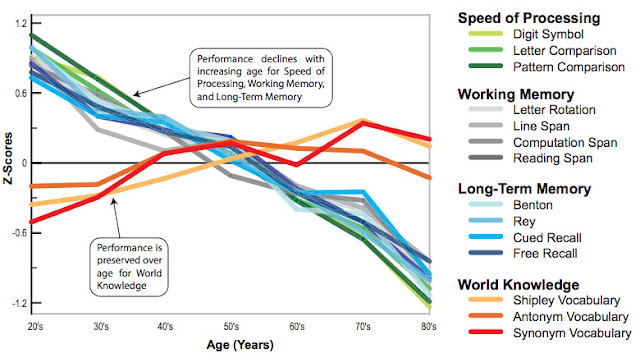
http://lh4.ggpht.com...40/brainage.jpg

^that documents the decline. Basically, fluid IQ is closely tied in with working memory. And we can definitely see that the brains of calorie restricted mice and primates age more slowly than the brains of controls. If anything, I think this provides compelling evidence that fluid IQ might decrease more slowly for humans under calorie restriction - in fact - it might even be an insidious way to achieve super-high IQs (since IQ scores are normalized by age, and since the raw IQ score decreases with age after age 20, you could essentially get a raw IQ score VERY high for your age by age 50).
  • dislike x 1
  • like x 1

#2 exigentsky

  • Guest
  • 262 posts
  • -2

Posted 30 March 2011 - 05:02 AM

I thought IQ tests were no longer normalized by age in adulthood. In any case, if CRON protects the rest of the body, there's no reason to expect the brain to be different. Although, it's still unverified in humans.

#3 InquilineKea

  • Topic Starter
  • Guest
  • 784 posts
  • 89
  • Location:Redmond,WA (aka Simfish)

Posted 22 June 2011 - 06:41 AM

http://www.pnas.org/...51-bb324fed186f


The cellular basis of age-related behavioral decline remains obscure but alterations in synapses are likely candidates. Accordingly, the beneficial effects on neural function of caloric restriction and exercise, which are among the most effective anti-aging treatments known, might also be mediated by synapses. As a starting point in testing these ideas, we studied the skeletal neuromuscular junction (NMJ), a large, accessible peripheral synapse. Comparison of NMJs in young adult and aged mice revealed a variety of age-related structural alterations, including axonal swellings, sprouting, synaptic detachment, partial or complete withdrawal of axons from some postsynaptic sites, and fragmentation of the postsynaptic specialization. Alterations were significant by 18 mo of age and severe by 24 mo. A life-long calorie-restricted diet significantly decreased the incidence of pre- and postsynaptic abnormalities in 24-mo-old mice and attenuated age-related loss of motor neurons and turnover of muscle fibers. One month of exercise (wheel running) in 22-mo-old mice also reduced age-related synaptic changes but had no effect on motor neuron number or muscle fiber turnover. Time-lapse imaging in vivo revealed that exercise partially reversed synaptic alterations that had already occurred. These results demonstrate a critical effect of aging on synaptic structure and provide evidence that interventions capable of extending health span and lifespan can partially reverse these age-related synaptic changes.


#4 InquilineKea

  • Topic Starter
  • Guest
  • 784 posts
  • 89
  • Location:Redmond,WA (aka Simfish)

Posted 22 June 2011 - 06:46 AM

More info here: http://www.longecity...__fromsearch__1

Nothing about calorie restriction, but it documents the decline of fluid IQ in age that we all should be worried about (and also proposes various hypotheses for the mechanism)

Edited by InquilineKea, 22 June 2011 - 06:46 AM.


#5 JLL

  • Guest
  • 2,192 posts
  • 161

Posted 22 June 2011 - 01:17 PM


Caloric Restriction Improves Memory in the Elderly

In their study, Witte et al. compared the effects of calorie restriction (CR) and increased unsaturated fatty acid (UFA) intake on memory in the elderly. They found that eating less was more effective in improving memory scores than eating more unsaturated fatty acids.


#6 InquilineKea

  • Topic Starter
  • Guest
  • 784 posts
  • 89
  • Location:Redmond,WA (aka Simfish)

Posted 11 July 2011 - 07:00 PM

Book to read: http://library.nu/do...ogy Series, 49)

Aka "Major Issues in Cognitive Aging"

But doesn't look very hopeful right now though - there is pretty much NO relationship between any of the variables they measured and cognitive decline with age. That being said, they COMPLETELY neglect variables like blood glucose and insulin, and this may be where their analysis is flawed. Of course you can have high blood glucose levels and be in "good health" up to your 80s. That still isn't going to prevent the glucose from destroying your brain from inside.
  • like x 1

#7 Cephalon

  • Guest
  • 497 posts
  • 48
  • Location:Cologne

Posted 17 August 2011 - 12:14 AM

JLL quoted a very interesting study there.

The authors explain possible routes by which CR improved cognition.
Looks like everything is involved: increased IGF and BDNF, increased channel activity of NMDA receptors,
Glutamate and GABA mediated synaptic plasticity

Finally a cognitive enhancement that works, does not cause harm if applied properly but may help you to stay young and healthy. And it does not cost a cent ... you even save on foods, as long as you did not live on a cheap diet before


Edit: here you'll find the complete study from 2009: http://www.pnas.org/...5.full.pdf html

Edited by Cephalon, 17 August 2011 - 12:16 AM.


#8 TheFountain

  • Guest
  • 5,367 posts
  • 259

Posted 03 September 2011 - 03:07 AM

I accidentally voted the original post down when I meant to vote it up. See what I mean about this stupid rating system? I should be able to change my vote.
  • like x 1


1 user(s) are reading this topic

0 members, 1 guests, 0 anonymous users