stopgam's thread
npcomplete
16 Feb 2015
I agree with you, I just wanted to point out that asking him questions about NP hard problems is pointless since he rejects the Church-Turing thesis. Current theoretical models of quantum computing are also Turing, so we may get a little bit of speedup over NP, but assuming NP != P (most people assume P is not equal to NP), then the class NP-Complete looks like it will only get square root speedup via Grover's algorithm on a QC. Of course the square root of an exponential is still exponential... so no "magic" there either. In other words, NP-Complete on a "regular computer" appears to be NP-Complete on quantum computers too, with maybe a square root of N speedup where N is the problem size.
I don't know about you, but I really enjoy the cartoons!
serp777
16 Feb 2015
I agree with you, I just wanted to point out that asking him questions about NP hard problems is pointless since he rejects the Church-Turing thesis. Current theoretical models of quantum computing are also Turing, so we may get a little bit of speedup over NP, but assuming NP != P (most people assume P is not equal to NP), then the class NP-Complete looks like it will only get square root speedup via Grover's algorithm on a QC. Of course the square root of an exponential is still exponential... so no "magic" there either. In other words, NP-Complete on a "regular computer" appears to be NP-Complete on quantum computers too, with maybe a square root of N speedup where N is the problem size.
I don't know about you, but I really enjoy the cartoons!
One possibility, which i don't know if it has a proof saying otherwise, is if P versus NP is inherently unsolvable. There might not be any proof under our current system of axioms that determines whether p = or p != np. Or the proof might be so large and complicated that it might theoretically be possible but humans will never achieve such knowledge because there wouldn't be enough time in the universe to find it. It could be that the laws of physics and the amount of matter in the universe just prevents us from ever finding out certain stuff. Its worth trying but it could be futile.
Also the square root of an exponetial is much better than just an exponential because it dramatically increases the size of the data sets you could do before it became essentially axiomatic, even if the final result is still exponential. It might be just enough to allow for an artificial intelligence to function based on a quantum computer.
Edited by serp777, 16 February 2015 - 09:21 AM.
Julia36
16 Feb 2015
We must attack death on every front, plan against it for the future, dismember it in the present, and revoke it in the past!
In our hands lie the great tools of science and technology. Behind them, the tested systems of causality and probability by which all known laws in the cosmos exist.
Added to these are the vast facts in growing databases like "Tree of Life on the Web" project. Then come the brilliant modern sciences, statistics, mathematics and computing. There are growing innovative techniques and devices and the accelerating discipline of artificial intelligence which began giving men orders in London as exploding traffic lights outside Parliament in 1868, but has improved and is now integral to civilization with no known nor containable limit.
At some point in the future the specific ,description of tiniest events - even thoughts and memories - will be calculated and exposed for all the world to see. Man is not outside the laws of Nature and it is not different science to reconstruct his brain than any other part of him.
QUANTUM ARCHAEOLOGY.
How Science is trying to resurrect the dead.
Micro Map of the past being created.
- Quantum computers and new maths to calculate detailed histories and memories of everyone dead.
- Face and body reconstructions a million years old already achieved: mind reconstructions coming.
- 106 billion people to be resurrected within 40 years.
MAIN ARTICLE:~~>(working: Nine pages)
QuantumArchaeology
TEDxDeExctinction talks website »
<--- MORE INFORMATION BACK THRU THIS THREAD<------
I'm aware of your arguments, but ur right I reject them because I'm a futurist with some understanding of archaeology. We ARE recovering the past and science IS advancing! The question of what their limits are is moot but far from settled.
The big player hasn't yet taken the stage Artificial intelligence hasn't yet passed the human general intelligence of one human brain. I expect A.I. to be strong about 2022 on present trends, which is is faster than was predicted, mainly because it;s been commercialised, so profits are driving it.
eg for robots to works they have to be smart:
=====================================================
Top 50 Robot companies to watch
![]()
3D Robotics 3D Robotics is a Private company with a focus on robotics. It is located at 1608 4th Street, Berkeley CA in the United States.
ABB Robotics ABB Robotics is a Public company with a focus on Industrial & Manipulator robotics. It is located at Affolternstrasse 44, Zurich in Switzerland.
Aethon Aethon is a Private company with a focus on Medical & Assistive & Mobile robotics. It is located at 100 Business Center Drive, Pittsburgh in the United States.
Boeing Boeing is a Public company with a focus on robotics. It is located at 100 North Riverside Plaza, Chicago IL in the United States.
Bosch Group Bosch Group is a Private company with a focus on Industrial & Mobile robotics. It is located at Postfach 30 02 20, Stuttgart in Germany.
Caterpillar, Inc. Caterpillar, Inc. is a Public company with a focus on Industrial & Mobile robotics. It is located at 501 Southwest Jefferson Avenue, Peoria IL in the United States.

Ekso Bionics Ekso Bionics is a Public company with a focus on Medical & Assistive robotics. It is located at 1414 Harbour Way, Richmond CA in the United States.
FANUC Robotics FANUC Robotics is a Public company with a focus on Industrial robotics. It is located at Oshino-mura, Yamanashi Prefecture in Japan.
Festo Festo is a Private company with a focus on Industrial & Manipulator robotics. It is located at Ruiter Straße 82, Esslingen in Germany.
Foxconn Technology Group Foxconn Technology Group is a Public company with a focus on Industrial robotics. It is located at No.2 Zihyou St., Tucheng District New Taipei in Taiwan.
Future Robot Future Robot is a company with a focus on robotics. It is located at 901, Uspace 1B, 670, Sampyeong-dong Bundang-gu in South Korea.
gomtec gomtec is a Private company with a focus on Industrial robotics. It is located at Am Technologiepark 12 , Seefeld in Germany.
Julia36
16 Feb 2015
Google Google is a Public company with a focus on Humanoid & Industrial & Manipulator & Mobile robotics. It is located at 1600 Amphitheatre Parkway, Mountain View California in the United States.
Hocoma Hocoma is a Private company with a focus on Medical & Assistive robotics. It is located at Industriestrasse 4, Volketswil in Switzerland.
Honda Robotics Honda Robotics is a Public company with a focus on Medical & Assistive & Software & Humanoid robotics. It is located at 1-1, 2-Chome, Minami-Aoyama Minato-ku, Tokyo in Japan.
Honeybee Robotics Honeybee Robotics is a Private company with a focus on Manipulator & Mobile robotics. It is located at 460 W. 34th Stree, New York NY in the United States.
Intuitive Surgical Intuitive Surgical is a Public company with a focus on Medical & Assistive robotics. It is located at 1020 Kifer Road, Sunnyvale CA in the United States.
Kinova Robotics Kinova Robotics is a Private company with a focus on Medical & Assistive & Manipulator robotics. It is located at 355 Peel St., Montreal Quebec in Canada.
KUKA Robotics KUKA Robotics is a Public company with a focus on Industrial robotics. It is located at 51870 Shelby Parkway, Shelby Township MI in the United States.
rest of list:
platypus
16 Feb 2015
Time-travel is needed to transport the massive sensor-array into the past in order to monitor all events for QA. This might create a problem/paradox as the needed sensor-array will block most of the stars and will therefore affect the thoughts and actions of people.
What is the current best estimate for functional time-travel to be available? Certainly not 2021... ![]()
Julia36
16 Feb 2015
[You cant cover the truth from the Future: there's no way to hide. The biggest problem with Quantum Archaeology is turning our ego's round: we're not the only copy; man is not outside the laws of physics.]


Henry VIII's third wife Jane Seymour is actually Anne Boleyn, facial recognition technology reveals
Edited by stopgam, 16 February 2015 - 05:47 PM.
Julia36
16 Feb 2015
Time-travel is needed to transport the massive sensor-array into the past in order to monitor all events for QA. This might create a problem/paradox as the needed sensor-array will block most of the stars and will therefore affect the thoughts and actions of people.
What is the current best estimate for functional time-travel to be available? Certainly not 2021...

[I'm not using time travel in my argument. Archaeology can be done by statistics from a few artefacts in the present we should be able to describe the whole of the past we require for human resurrections, probably for anything that has lived. Everythi8ng that has lived has effected other things...which effect other things. Cross-referencing them back is a maths problem coming computers should do at some stage].

[It seems to me an important argument: Can we raise the dead or cant we?]
Edited by stopgam, 16 February 2015 - 05:57 PM.
Julia36
16 Feb 2015
[Everything is caused. Everything by number order and affect. Remove one fact and the fabric of the universe doesn't hold]

Ancient rocks show life could have flourished on Earth 3.2 billion years ago

"People always had the idea that the really ancient biosphere was just tenuously clinging on to this inhospitable planet, and it wasn't until the emergence of nitrogen fixation that suddenly the biosphere become large and robust and diverse," said co-author Roger Buick, a UW professor of Earth and space sciences. "Our work shows that there was no nitrogen crisis on the early Earth, and therefore it could have supported a fairly large and diverse biosphere."
more
http://phys.org/news...th-billion.html
[These are simple retrodictions billions of years ago. Computers will do trillions and into other universes, or science will have halted.]

Edited by stopgam, 16 February 2015 - 06:11 PM.
npcomplete
16 Feb 2015
I agree with you, I just wanted to point out that asking him questions about NP hard problems is pointless since he rejects the Church-Turing thesis. Current theoretical models of quantum computing are also Turing, so we may get a little bit of speedup over NP, but assuming NP != P (most people assume P is not equal to NP), then the class NP-Complete looks like it will only get square root speedup via Grover's algorithm on a QC. Of course the square root of an exponential is still exponential... so no "magic" there either. In other words, NP-Complete on a "regular computer" appears to be NP-Complete on quantum computers too, with maybe a square root of N speedup where N is the problem size.
I don't know about you, but I really enjoy the cartoons!
One possibility, which i don't know if it has a proof saying otherwise, is if P versus NP is inherently unsolvable. There might not be any proof under our current system of axioms that determines whether p = or p != np. Or the proof might be so large and complicated that it might theoretically be possible but humans will never achieve such knowledge because there wouldn't be enough time in the universe to find it. It could be that the laws of physics and the amount of matter in the universe just prevents us from ever finding out certain stuff. Its worth trying but it could be futile.
Also the square root of an exponetial is much better than just an exponential because it dramatically increases the size of the data sets you could do before it became essentially axiomatic, even if the final result is still exponential. It might be just enough to allow for an artificial intelligence to function based on a quantum computer.
square root of exponential and square root speedup of NP via Grover's algorithm on a QC:
Computational Complexity ~ sqrt(exp(N)) => exp(N/2)
-
On a Quantum Turing Machine each of those exp(N/2) steps [presumably exp, with P!=NP] is a "killer step". Even in the non-quantum world a simple NP-Complete problem can require a hard subproblem to be solved at each of the steps. Years ago we had a hard problem where each step required the evaluation of an objective function that was itself a hard problem in nonlinear nonconvex programming. At a talk I said "this isn't NP-Complete, this is NP-Ridiculous", pointing to the fact that some problems have hard discrete components (NP-Complete) mixed with hard continuous components (nonlinear nonconvex). That is just one real world problem where NP-Completeness was part of the problem.
Suppose we have a big computing device. If classic we want the processors to at least be able to communicate with each other. If QC, we want the qubits to be able to interact, and other subsystems to communicate. We then have the classic "network reliability" problem, which is known to be #P-Complete (read "number P Complete", written with a "#" sign). Some of the proposed networks of quantum computers proposed for computational fluid dynamics (sometimes called type 2 QC) make this reliability problem even more obvious in the QC world.
One of the defining characteristics of the NP-Complete class is that it is in class NP (obvious), and that a proposed solution (called a solution certificate) can be verified in a polynomial number of steps, even if it is NP-Complete. For example, TSP, or Traveling Salesman Problem: It is hard to find a TSP solution, but very easy (polynomial time on a Turing machine) to check that a proposed NP-Complete solution does satisfy the "yes/no" test defining the overall problem.
For TSP, a pedestrian version of the "yes/no decision problem" would be the question "Is there a tour of a given graph with a total path length less than an upper bound B?". It is hard to find a good solution in a general assymetric directional graph. However, if I give you a "certificate" that is a guess of a solution, then it is trivial to answer that "yes/no" question - you just add up the lengths between each node in the proposed solution. (note that the underlying Hamiltonian Circuit problem is NP-Complete, and does not have edge lengths as part of the problem)
Now back to reliability. Notice the "#" in the reliability complexity "#P-Complete". The implication, unproven, is that network reliability is NOT a member of NP, since enumeration of "pathsets" needed to calculate reliability in checking a solution certificate is not polynomial time.
Of course AI can already run on a QC in theory (QC's are really at the small experimental stage). However, training a neural network is NP-Complete, along with many other problems in machine learning, so no magic computing there.
Here are a couple of papers that you might enjoy.
The first paper is from Bennett et al on "Strengths and Weaknesses of Quantum Computing". Basically, the take away is that Quantum Computers are not Magic Computers:
http://arxiv.org/pdf...-ph/9701001.pdf
The second paper is from Seth Lloyd and Daniel Abrams, "Nonlinear quantum mechanics implies polynomial-time solution for NP-Complete and #P problems".
http://arxiv.org/pdf...h/9801041v1.pdf
So maybe things are easy in both NP-Complete and #P-Complete, but to get to the "easy" we need our computational models to use nonlinear field theories. "I am not holding my breath on that one", it could be a long wait.
Julia36
16 Feb 2015
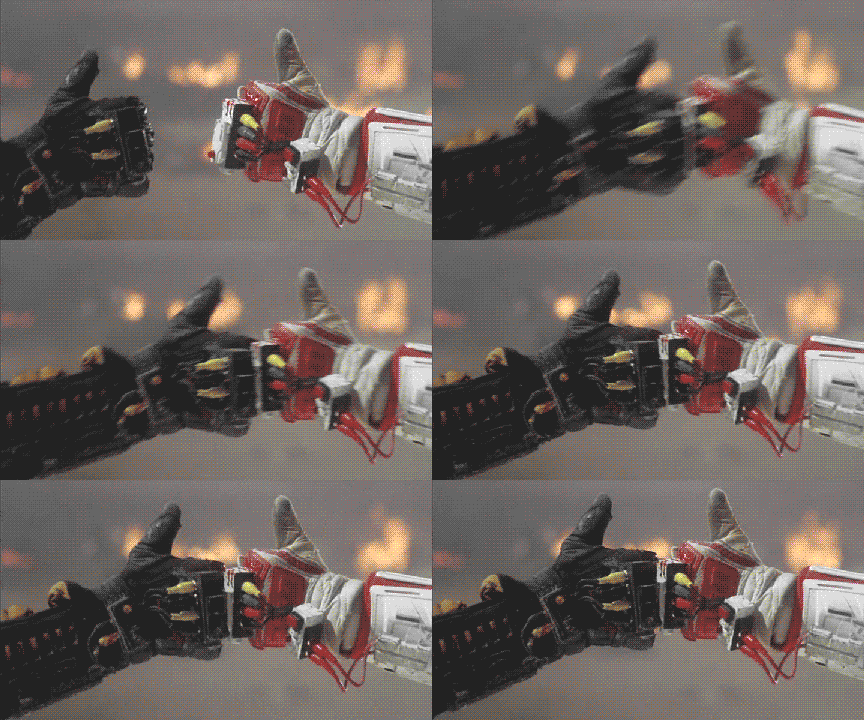
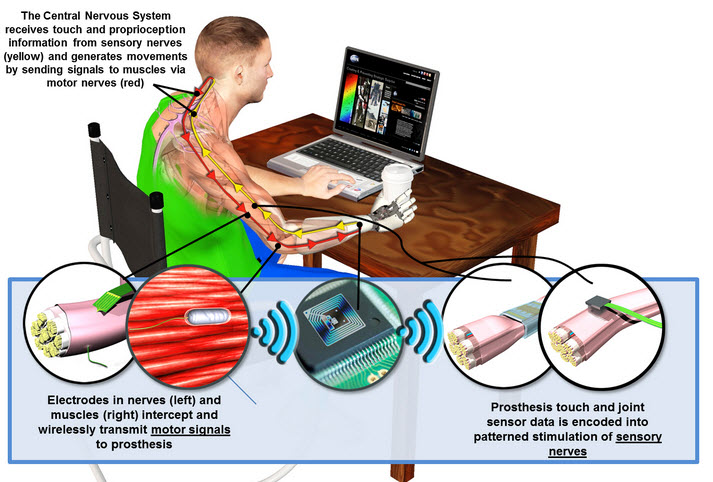
DARPA pushes robots to achieve sensation

http://www.kurzweila...-a-natural-hand
"In another major step toward dissolving the boundaries between machine and human, the Defense Advanced Research Projects Agency (DARPA) has awarded prime contracts for Phase 1 of its Hand Proprioception and Touch Interfaces (HAPTIX) program to a multi-institution research team. HAPTIX (a play on “haptics“) seeks to create a prosthetic hand system that moves and provides sensation like a natural hand,," more>|>>
Julia36
16 Feb 2015

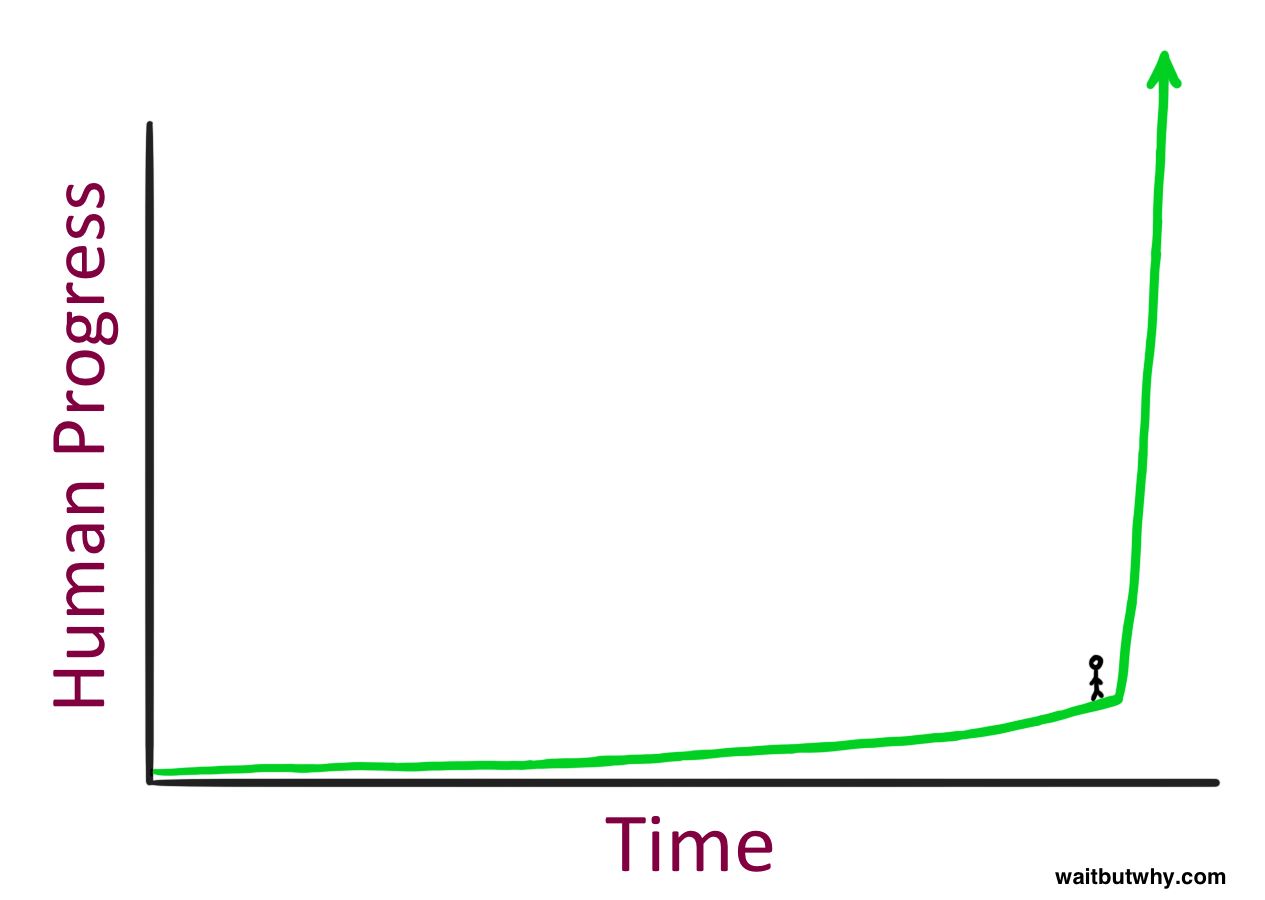
"We are on the edge of change comparable to the rise of human life on Earth."
--Vernor Vinge
http://www.huffingto...ence&ir=Science

Julia36
16 Feb 2015
Ancient texts uncovered among the human remains of an Egyptian village suggest workers from the New Kingdom had their own version of a state-supported health care.
This scheme, which involved paid sick leave and on-site doctors, made sure workers making the king’s tomb 3,600 years ago were productive and well looked after.
The dig of the ancient Egyptian worker’s village at Deir el-Medina is being led by Stanford archaeologist Anne Austin.
The village was built for workmen who made the royal tombs during the New Kingdom (1550 to 1070 BC)."
more>>>

“Although [the Amazon and Sahara] seem so different, a lot of the questions are actually very similar,” says David Mattingly, an archaeologist at the University of Leicester in the United Kingdom. He studies a culture known as the Garamantes, which began building a network of cities, forts, and farmland around oases in the Sahara of southern Libya around 1000 B.C.E. The civilization reached its peak in the early centuries of the Common Era, only to decline after 700 C.E., possibly because they had tapped out the region’s ground water, Mattingly explains." more>>>
http://news.sciencem...unlikely-places

Edited by stopgam, 16 February 2015 - 08:16 PM.
Julia36
16 Feb 2015
Julia36
16 Feb 2015

"New research shows that a burst of evolutionary innovation in the genes responsible for electrical communication among nerve cells in our brains occurred over 600 million years ago in a common ancestor of humans and the sea anemone." more>>>
http://phys.org/news...tor-humans.html
serp777
17 Feb 2015
I agree with you, I just wanted to point out that asking him questions about NP hard problems is pointless since he rejects the Church-Turing thesis. Current theoretical models of quantum computing are also Turing, so we may get a little bit of speedup over NP, but assuming NP != P (most people assume P is not equal to NP), then the class NP-Complete looks like it will only get square root speedup via Grover's algorithm on a QC. Of course the square root of an exponential is still exponential... so no "magic" there either. In other words, NP-Complete on a "regular computer" appears to be NP-Complete on quantum computers too, with maybe a square root of N speedup where N is the problem size.
I don't know about you, but I really enjoy the cartoons!
One possibility, which i don't know if it has a proof saying otherwise, is if P versus NP is inherently unsolvable. There might not be any proof under our current system of axioms that determines whether p = or p != np. Or the proof might be so large and complicated that it might theoretically be possible but humans will never achieve such knowledge because there wouldn't be enough time in the universe to find it. It could be that the laws of physics and the amount of matter in the universe just prevents us from ever finding out certain stuff. Its worth trying but it could be futile.
Also the square root of an exponetial is much better than just an exponential because it dramatically increases the size of the data sets you could do before it became essentially axiomatic, even if the final result is still exponential. It might be just enough to allow for an artificial intelligence to function based on a quantum computer.
square root of exponential and square root speedup of NP via Grover's algorithm on a QC:
Computational Complexity ~ sqrt(exp(N)) => exp(N/2)
-
On a Quantum Turing Machine each of those exp(N/2) steps [presumably exp, with P!=NP] is a "killer step". Even in the non-quantum world a simple NP-Complete problem can require a hard subproblem to be solved at each of the steps. Years ago we had a hard problem where each step required the evaluation of an objective function that was itself a hard problem in nonlinear nonconvex programming. At a talk I said "this isn't NP-Complete, this is NP-Ridiculous", pointing to the fact that some problems have hard discrete components (NP-Complete) mixed with hard continuous components (nonlinear nonconvex). That is just one real world problem where NP-Completeness was part of the problem.
Suppose we have a big computing device. If classic we want the processors to at least be able to communicate with each other. If QC, we want the qubits to be able to interact, and other subsystems to communicate. We then have the classic "network reliability" problem, which is known to be #P-Complete (read "number P Complete", written with a "#" sign). Some of the proposed networks of quantum computers proposed for computational fluid dynamics (sometimes called type 2 QC) make this reliability problem even more obvious in the QC world.
One of the defining characteristics of the NP-Complete class is that it is in class NP (obvious), and that a proposed solution (called a solution certificate) can be verified in a polynomial number of steps, even if it is NP-Complete. For example, TSP, or Traveling Salesman Problem: It is hard to find a TSP solution, but very easy (polynomial time on a Turing machine) to check that a proposed NP-Complete solution does satisfy the "yes/no" test defining the overall problem.
For TSP, a pedestrian version of the "yes/no decision problem" would be the question "Is there a tour of a given graph with a total path length less than an upper bound B?". It is hard to find a good solution in a general assymetric directional graph. However, if I give you a "certificate" that is a guess of a solution, then it is trivial to answer that "yes/no" question - you just add up the lengths between each node in the proposed solution. (note that the underlying Hamiltonian Circuit problem is NP-Complete, and does not have edge lengths as part of the problem)
Now back to reliability. Notice the "#" in the reliability complexity "#P-Complete". The implication, unproven, is that network reliability is NOT a member of NP, since enumeration of "pathsets" needed to calculate reliability in checking a solution certificate is not polynomial time.
Of course AI can already run on a QC in theory (QC's are really at the small experimental stage). However, training a neural network is NP-Complete, along with many other problems in machine learning, so no magic computing there.
Here are a couple of papers that you might enjoy.
The first paper is from Bennett et al on "Strengths and Weaknesses of Quantum Computing". Basically, the take away is that Quantum Computers are not Magic Computers:
http://arxiv.org/pdf...-ph/9701001.pdf
The second paper is from Seth Lloyd and Daniel Abrams, "Nonlinear quantum mechanics implies polynomial-time solution for NP-Complete and #P problems".
http://arxiv.org/pdf...h/9801041v1.pdf
So maybe things are easy in both NP-Complete and #P-Complete, but to get to the "easy" we need our computational models to use nonlinear field theories. "I am not holding my breath on that one", it could be a long wait.
"However, training a neural network is NP-Complete, along with many other problems in machine learning, so no magic computing there."
Right, but NP complete assumes a perfectly trained AI. Clearly our brains have not completed learning, nor will they ever, so you don't have to train a neural network so that it would reflect NP complete. In other words we don't need to be entirely trained.
The problem with doing all calculations in terms of big O requirements is that the big O requirements look at upper bounds of processing results. Like when it looks at tetris, I think big O shows it to be an NP hard problem--easy to verify, hard to find a solution. But the human brain manages to find solutions which increase the probability of wining better than random chance, and better than an iterative computer algorithm. I've also thought that the flaw, or rather the limitations, with big O is that it doesn't include the speed up resulting from learning algorithms that improve over time. How would you account for this in an NP complete or NP hard problem?
brains are capable of finding solutions to problems that would normally take computers more than the theoretical limits of time that the universe will exist for. Certain mathematical proofs indicate this. For instance, the proof that there are an infinite amount of prime numbers would take an infinite amount of time to solve according to big O, because you would have to iterate through an infinite set, looking at each number and calculating whether each number was prime or not. Of course Euclid was able to use a novel mathemaical proof that defied iterative proofs. Big O essentially doesn't account for creativity and solutions that are better than random chance but involve elements of hypothesized guessing.
"For TSP, a pedestrian version of the "yes/no decision problem" would be the question "Is there a tour of a given graph with a total path length less than an upper bound B?". It is hard to find a good solution in a general assymetric directional graph. However, if I give you a "certificate" that is a guess of a solution, then it is trivial to answer that "yes/no" question - you just add up the lengths between each node in the proposed solution."
See for the travelling salesman problem, consider an airline operator that has looked at routing airline customers through various paths for the most cost effective combination of terminals. The person uses his/her experience to pick routes that he/she knows has known to be better even if they defy what you would traditionally expect. Now the person doesn't calculate the best route possible, but its going to be better than a standard computer algorithm by using her years of intuition and memory to make decisions. By using memory and observing various patterns, this airline operator can beat what the computer would normally do in terms of the TSP. For example, "I know the most efficient route from getting to Paris from new York, and I know that the best path from New York to Berlin follows a similar path for the first part, so therefore I can predict that the best path to italy probably also takes that common path from New York to Paris, and then the cheapest path from there to italy. A computer algorithm would have to calculate the path entirely from scratch without making this intuitive leap. Maybe it isn't the most efficient path, but its more likely to be.
Julia36
17 Feb 2015
Ok many problems here.Resurrection of the dead, particularly people 200-2000 years in the past, isn't just solved by miniaturization and math. And its math, not maths. And because of sums? What sums? How are you going to record the configuration of every atom in the brain for people who's brains have long since disintegrated? You're talking about star trek transporter technology that can go into the past.
It would be incredibly hard to resurrect one person who died recently with a perfectly preserved brain. We can't even bring people out of cryogenic sleep yet.
What evidence do you have the biology is anywhere close to restarting failed biological systems?
[I've looked at Resurrection from the point of a future scientist, based on trends, One trend is miniturisation. Miniaturisation implies many things (including advanced maths/math) like improving skills in measurement, observation and technology.
One important trend is science is advancing and some say speeding up ie the time taken to make important discoveries is shortening. How do you measure that? One way is the size of calculation we can do and time it takes. Power of supercomputers and increasing power of microscopy demonstrate this, and these are typical of science and technology.
I dont premise QA on time travel, but on statistics. We're not pursuing the exact particles from a changed set of events, but to scientifically describe a given environment from how those events changed into our present.
From small amounts of specific data in the present, added to vast and growing data bases we have,
"From the macroscopic constraints you can specify microscopic detail."
- I think this is also demonstrably true in fractal theory, since while each physics event is unique, it's existence is defined by knowable laws, and a prototype of it is easier described eg an atom a molecule of arsole. The periodic table is based on this assumption.
Retrodiction is easier than prediction because you have umpteen reference points to check your work at eg artefacts and fossil records:
you might think 1813-14 was a cold winter in UK but you can check your retrodiction by looking at tree rings.
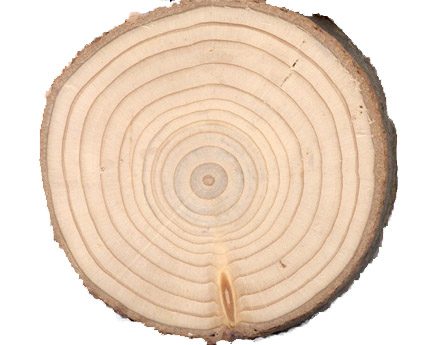
Data that is confirmed is much better than data just calculated.
Another assumption in QA is that nothing exists alone but everything is joined to other things. And they are joined by the laws of physics.
We know many of the relevant laws of physics, not all but enough to calculate the others from.
We haven't resurrected anyone who died for long with a perfectly preserved brain, but that is not what QA is trying to do: it argues we could calculate what the brain was at the moment o0f death - and for any moment during the dead's life - then rebuild it (minus the illnesses).
I assert we can already do this now, but it wouldn't be very good: by that I mean we can aim at prototypes and progressively modify them until the resurrectee fits every test possible for authenticity.

Not enough mathematics or data from event histories like artefacts result is a poor replica:)
Biology has done astounding things. Evolutionary biology is advancing enough to recreate an 800 ml year old proton pump....extinct for near a billion years....by probability and data bases, and test it works inside a yeast cell. (Thornton),
so its not true to state resurrections haven't started.
Quantum Archaeology is proven as a concept by that experiment alone.
De-extinctions also demonstrate a prototype is capable of being resurrected, and from there to a given individual is a matter of configuring (mainly by calculation) the data.]

[So it's calculation rather than particle chasing or time travel that QA is after. Calculation is mathematics as machinery and is hurtling forward in power.
But the huge advance is Artificial intelligence: when that gets aware enough to self-modify calculations it is hard to set any limits of what calculations are too big.]
platypus
17 Feb 2015
There are an infinite different particle-histories of the universe that lead to exact this observable state of affairs/objects. If you need to differentiate between those infinite alternative histories for QA you need to find the particles that manifest that difference. If you cannot detect those particles due to lack of detectors, you are screwed. That's why "information cannot be destroyed" won't automatically help you, but you need to be prepared. Time-machines that transport massive detectors into the past are a good start for serious QA.
serp777
17 Feb 2015
Ok many problems here.Resurrection of the dead, particularly people 200-2000 years in the past, isn't just solved by miniaturization and math. And its math, not maths. And because of sums? What sums? How are you going to record the configuration of every atom in the brain for people who's brains have long since disintegrated? You're talking about star trek transporter technology that can go into the past.
It would be incredibly hard to resurrect one person who died recently with a perfectly preserved brain. We can't even bring people out of cryogenic sleep yet.
What evidence do you have the biology is anywhere close to restarting failed biological systems?
[I've looked at Resurrection from the point of a future scientist, based on trends, One trend is miniturisation. Miniaturisation implies many things (including advanced maths/math) like improving skills in measurement, observation and technology.
One important trend is science is advancing and some say speeding up ie the time taken to make important discoveries is shortening. How do you measure that? One way is the size of calculation we can do and time it takes. Power of supercomputers and increasing power of microscopy demonstrate this, and these are typical of science and technology.
I dont premise QA on time travel, but on statistics. We're not pursuing the exact particles from a changed set of events, but to scientifically describe a given environment from how those events changed into our present.
From small amounts of specific data in the present, added to vast and growing data bases we have,
"From the macroscopic constraints you can specify microscopic detail."
- I think this is also demonstrably true in fractal theory, since while each physics event is unique, it's existence is defined by knowable laws, and a prototype of it is easier described eg an atom a molecule of arsole. The periodic table is based on this assumption.
Retrodiction is easier than prediction because you have umpteen reference points to check your work at eg artefacts and fossil records:
you might think 1813-14 was a cold winter in UK but you can check your retrodiction by looking at tree rings.
Data that is confirmed is much better than data just calculated.
Another assumption in QA is that nothing exists alone but everything is joined to other things. And they are joined by the laws of physics.
We know many of the relevant laws of physics, not all but enough to calculate the others from.
We haven't resurrected anyone who died for long with a perfectly preserved brain, but that is not what QA is trying to do: it argues we could calculate what the brain was at the moment o0f death - and for any moment during the dead's life - then rebuild it (minus the illnesses).
I assert we can already do this now, but it wouldn't be very good: by that I mean we can aim at prototypes and progressively modify them until the resurrectee fits every test possible for authenticity.
Not enough mathematics or data from event histories like artefacts result is a poor replica:)
Biology has done astounding things. Evolutionary biology is advancing enough to recreate an 800 ml year old proton pump....extinct for near a billion years....by probability and data bases, and test it works inside a yeast cell. (Thornton),
so its not true to state resurrections haven't started.
Quantum Archaeology is proven as a concept by that experiment alone.
De-extinctions also demonstrate a prototype is capable of being resurrected, and from there to a given individual is a matter of configuring (mainly by calculation) the data.]
[So it's calculation rather than particle chasing or time travel that QA is after. Calculation is mathematics as machinery and is hurtling forward in power.
But the huge advance is Artificial intelligence: when that gets aware enough to self-modify calculations it is hard to set any limits of what calculations are too big.]
"One important trend is science is advancing and some say speeding up ie the time taken to make important discoveries is shortening. How do you measure that? One way is the size of calculation we can do and time it takes. Power of supercomputers and increasing power of microscopy demonstrate this, and these are typical of science and technology."
One flaw of this logic is that you know the rate of change of the rate of change of technology. Another flaw is assuming you know the rate of change of the rate of change of the rate of change.Technology could unexpectedly flat line due to limitations in physics, or the rate of change might stop increasing as much. The rate of change of acceleration might be negative. The final flaw is that you know the amount of investment it will take to attain certain advanced technologies that are currently beyond our comprehension.
"
I dont premise QA on time travel, but on statistics. We're not pursuing the exact particles from a changed set of events, but to scientifically describe a given environment from how those events changed into our present.
From small amounts of specific data in the present, added to vast and growing data bases we have,"
As I told OP, saying statistics or maths doesn't get you out of the problem of being able to reconstruct, with precision, brain configurations that could lead to a ressurection. Even configurations. Statistics applies to average of particles, not specific quantizations which are necessary for understanding details about the past. Please explain or show the evidence of new statistics which allow you to reconstruct any dataset from the past. Entropy makes that nearly theoretically impossible, and realistically beyond sci fi.
"
Biology has done astounding things. Evolutionary biology is advancing enough to recreate an 800 ml year old proton pump....extinct for near a billion years....by probability and data bases, and test it works inside a yeast cell. (Thornton),
so its not true to state resurrections haven't started."
False analogy. Because biology has made advances, therefore every other field will make equivalent advances. The difference is that DNA is a big data storage device, with a history of evolutionary processes. There isn't a 3 billion year old cumulative data storage device for things like the configuration of different people's brains or historical settings. Unless you can provide me with specifics instead of hopeful analogies, I will continue to assume that you need time travel to be able see states of matter that have long since been reorganized due to entropy.
If you had a gigantic generic data storage device like DNA I might be willing to believe your story.
"Quantum Archaeology is proven as a concept by that experiment alone."
Except that quantum archaeology doesn't have a 3 billion year old, vast data storage device. You don't have 3 billion years of statistical data. Therefore quantum Archaeology is basically infinitely far away from biology.
"De-extinctions also demonstrate a prototype is capable of being resurrected, and from there to a given individual is a matter of configuring"
It shows that a clone is able to be generated from genetic information. This is not equivalent to resurrecting a previously alive member of a species. Cloning technology exists, but not resurrection. I'd also like to point out even the difficulty of de extinction--bringing back a dinosaur or a wooly mammoth for that matter has proven to be extremely challenging. And no one wants to spend the vast amounts of money. im still waiting for who's going to pay for all this quantum archaeology stuff.
"But the huge advance is Artificial intelligence: when that gets aware enough to self-modify calculations it is hard to set any limits of what calculations are too big."
Another flawed assertion. This assumes you know the rate of learning of an artificial intelligence. Not all artificial intelligences would be created equal. It might only be as intelligent as your standard human--thus humans are not yet intelligent enough to be able to modify themselves to infinity, so neither should we assume we'll create a perfectly intelligent self modifying AI. And a self modifying AI would require substantial advances in everything in computer science and mathematics. Not to mention we need significantly more powerful computers. Everyone tends to assume AI=instantly perfectly intelligent entity, but like any other being is limited to the speed at which it is able to determine new information. You also assume infinite creativity--that it will be able to come up with perfect solutions to every problem, or that there are perfect solutions in the first place. Also assumes that you wont be limited by the laws of physics and that there is no intelligence ceiling.
A good analogy is like data in star trek--we might create an artificial intelligence like that, which is superior in many ways to humans, but won't instantly become a super being.
Julia36
17 Feb 2015
Human Brain evolved from Jellyfish

They may look like a completely alien species in our eyes, but new research suggests that our brains share a surprising link with sea anemones and jellyfish.
Scientists have discovered a key evolutionary spurt that allowed animals to develop complex brains occurred in a common ancestor we share with the brightly coloured sea creatures.
Biologists have found genes responsible for enabling electrical communication between nerve cells first occurred 600 million years ago." more +
video
Julia36
17 Feb 2015
[says you!
the best stats we have is quantum statistics and they are probability-based
I dont have a problem with science fiction as long as it doesn't breach the laws of physics, it is probable/possible. You are not required to prove something is impossible of course, but as we are already doing archaeology and getting forensic facials of people dead over a million years, it's likely with A.I. we'll advance]
"
Biology has done astounding things. Evolutionary biology is advancing enough to recreate an 800 ml year old proton pump....extinct for near a billion years....by probability and data bases, and test it works inside a yeast cell. (Thornton),
so its not true to state resurrections haven't started."
False analogy. Because biology has made advances, therefore every other field will make equivalent advances.
[I didn't say that, just that resurrection has been proved by Tho9rnton's work, and this validates QA since the proton pump was extinct for 800 million years and he recreated it by statistics (BTW note his connection to George Church @ Harvard)

Here a living biological mechanism that pumped proteins in organism extinct for nearly a billion years was resurrected by Jo Thornton by calculating backward from present day systems, and verified by inserting it into yeast cells where it worked, proving his theory
Here a living biological mechanism that pumped proteins in organism extinct for nearly a billion years was resurrected by Jo Thornton by calculating backward from present day systems, and verified by inserting it into yeast cells where it worked, proving his theory]
####The difference is that DNA is a big data storage device, with a history of evolutionary processes. There isn't a 3 billion year old cumulative data storage device for things like the configuration of different people's brains or historical settings. Unless you can provide me with specifics instead of hopeful analogies, I will continue to assume that you need time travel to be able see states of matter that have long since been reorganized due to entropy.###
Yes there is...that's the exciting thing... the environment.
Constructing the Quantum Archaeology Grid will prove that. Big Job.
### If you had a gigantic generic data storage device like DNA I might be willing to believe your story.###
[The whole world is a story...a story is a sequence not necessarily linear...of events.
The universe stores itself.
People pontoon have a problems with arguements that the entire universe will be simulated, but themselves??? Tooo complex. Nuts. A man and his mind are as determined as summer and winter.
He cant obey the laws of physics but his precious mind has free will and doesn't! it's preposterous.
"Quantum Archaeology is proven as a concept by that experiment alone."
]
###
Except that quantum archaeology doesn't have a 3 billion year old, vast data storage device. You don't have 3 billion years of statistical data. Therefore quantum Archaeology is basically infinitely far away from biology.###
[But you do...the world is a continuum, it hasn't just sprung into being. nowhere does a human being see that. Each new event is dependent on the past ones that effected it.
]
"De-extinctions also demonstrate a prototype is capable of being resurrected, and from there to a given individual is a matter of configuring"
Julia36
17 Feb 2015
Early hominids ate just about everything

"Reconstructions of human evolution are prone to simple, overly-tidy scenarios. Our ancestors, for example, stood on two legs to look over tall grass, or began to speak because, well, they finally had something to say. Like much of our understanding of early hominid behavior, the imagined diet of our ancestors has also been over-simplified....
Recently, fellow anthropologist C. Owen Lovejoy and I took a close look at this crucial question in human behavioral evolution: the origins of hominid diet. We focused on the earliest phase of hominid evolution from roughly 6 to 1.6 million years ago, both before and after the first use of modified stone tools. This time frame includes, in order of appearance, the hominids Ardipithecus and Australopithecus, and the earliest members of our own genus, the comparatively brainy Homo. None of these were modern humans, which appeared much later, but rather our distant forerunners.
We examined the fossil, chemical and archaeological evidence, and also closely considered the foraging behavior of living animals. Why is this crucial? Observing animals in nature for even an hour will provide a ready answer: almost all of what an organism does on a daily basis is simply related to staying alive; that includes activities such as feeding, avoiding predators and setting itself up to reproduce. That's the evolutionary way.
What did our ancestors actually eat? In some cases, researchers can enlist modern technology to examine the question. Researchers study the chemical makeup of fossil dental enamel to figure out relative amounts of foods the hominid ate derived from woody plants (or the animals that ate them) versus open country plants. Other scientists look in ancient tooth tartar for bits of silica from plants that can be identified to type – for example, fruit from a particular plant family. Others examine the small butchering marks made on animal bones by stone tools. Researchers have found, for example, that hominids even 2.6 million years ago were eating the meat and bone marrow of antelopes; whether they were hunted or scavenged is hotly debated." more>>
http://phys.org/news...minids-ate.html

Edited by stopgam, 17 February 2015 - 09:05 PM.
Julia36
17 Feb 2015
Forensic Facial Reconstruction of a 2800 Year Old Mummy

http://www.zbrushcen...-Year-Old-Mummy
Science and technology is done by companies and labs @ institutions, but in the near future- within a generation of 20 years - it will done on personal electronic devices-
You will create 'dead' people and civilisations, parts of the cosmos and almost anything imaginable.
A.I. will start delivering this from about 2022.
When we are immortal I observe it a human urge to resurrect the others, and that may be extended to all dead things.
serp777
17 Feb 2015
Statistics applies to average of particles, not specific quantizations which are necessary for understanding details about the past. Please explain or show the evidence of new statistics which allow you to reconstruct any dataset from the past. Entropy makes that nearly theoretically impossible, and realistically beyond sci fi.
[says you!
the best stats we have is quantum statistics and they are probability-based
I dont have a problem with science fiction as long as it doesn't breach the laws of physics, it is probable/possible. You are not required to prove something is impossible of course, but as we are already doing archaeology and getting forensic facials of people dead over a million years, it's likely with A.I. we'll advance]
"
Biology has done astounding things. Evolutionary biology is advancing enough to recreate an 800 ml year old proton pump....extinct for near a billion years....by probability and data bases, and test it works inside a yeast cell. (Thornton),
so its not true to state resurrections haven't started."
False analogy. Because biology has made advances, therefore every other field will make equivalent advances.
[I didn't say that, just that resurrection has been proved by Tho9rnton's work, and this validates QA since the proton pump was extinct for 800 million years and he recreated it by statistics (BTW note his connection to George Church @ Harvard)
Here a living biological mechanism that pumped proteins in organism extinct for nearly a billion years was resurrected by Jo Thornton by calculating backward from present day systems, and verified by inserting it into yeast cells where it worked, proving his theory
Here a living biological mechanism that pumped proteins in organism extinct for nearly a billion years was resurrected by Jo Thornton by calculating backward from present day systems, and verified by inserting it into yeast cells where it worked, proving his theory]
####The difference is that DNA is a big data storage device, with a history of evolutionary processes. There isn't a 3 billion year old cumulative data storage device for things like the configuration of different people's brains or historical settings. Unless you can provide me with specifics instead of hopeful analogies, I will continue to assume that you need time travel to be able see states of matter that have long since been reorganized due to entropy.###
Yes there is...that's the exciting thing... the environment.
Constructing the Quantum Archaeology Grid will prove that. Big Job.
### If you had a gigantic generic data storage device like DNA I might be willing to believe your story.###
[The whole world is a story...a story is a sequence not necessarily linear...of events.
The universe stores itself.
People pontoon have a problems with arguements that the entire universe will be simulated, but themselves??? Tooo complex. Nuts. A man and his mind are as determined as summer and winter.
He cant obey the laws of physics but his precious mind has free will and doesn't! it's preposterous.
"Quantum Archaeology is proven as a concept by that experiment alone."
]
###
Except that quantum archaeology doesn't have a 3 billion year old, vast data storage device. You don't have 3 billion years of statistical data. Therefore quantum Archaeology is basically infinitely far away from biology.###
[But you do...the world is a continuum, it hasn't just sprung into being. nowhere does a human being see that. Each new event is dependent on the past ones that effected it.
]
"De-extinctions also demonstrate a prototype is capable of being resurrected, and from there to a given individual is a matter of configuring"
All of this is theory from you. In fact, its theory without supporting evidence. Where is your mathematical evidence that you can reconstruct a person's entire brain from statistical data?
"the best stats we have is quantum statistics and they are probability-based"
Yeah, and they give you probability figures. How will you use probability distributions to reconstruct the brain of a 2000 year old long dead person. Where are you acquiring the information for every particle in the brain including momentum, charge, etc? I'd like to see some hard calculations instead of assertions. We dont even have the massive zetabyte drive necessary for storing all that information about the brain either.
"I didn't say that, just that resurrection has been proved by Tho9rnton's work, and this validates QA since the proton pump was extinct for 800 million years and he recreated it by statistics"
You're talking about the ressurection of something entirely different, and then using the same word with a different meaning to show that human ressurection is good to go. You do realize that ressurecting an entire human brain is about 15 order of magnitude harder than finding a lost proton pump right? AND they had all of DNA to work from. This leads to my next point:
"But you do...the world is a continuum, it hasn't just sprung into being. nowhere does a human being see that. Each new event is dependent on the past ones that effected it."
Is this some dimension im not aware of? The continuum where all historical data of everything is preserved in a magic quantum vacuum data store? I fail to see how you're going to be reconstructing huge quantities of data, by using statistics, from molecules which have been reconfigured many billions of times by entropy.
Please show me the math. IM fascinated to know if the math actually does exist. The revolution of such mathematics would lead us to determining the origins of the universe, and a theory of everything, by being able to recover all configurations of sub atomic particles; this much, much, much more substantial than quantum archaeology. if you can show this you just won every nobel prize in everything.
Edited by serp777, 17 February 2015 - 09:49 PM.
Julia36
18 Feb 2015
QUANTUM ARCHAEOLOGY.
How Science is trying to resurrect the dead.
Micro Map of the past being created.
- Quantum computers and new maths to calculate detailed histories and memories of everyone dead.
- Face and body reconstructions a million years old already achieved: mind reconstructions coming.
- 106 billion people to be resurrected within 40 years.
MAIN ARTICLE:~~>(working: Nine pages)
QuantumArchaeology
TEDxDeExctinction talks website »
<--- MORE INFORMATION BACK THRU THIS THREAD<------
[we are speeding in observing and mapping the smaller. Pre4sently in separate data bases, coming a.i.'s should be able to synthesise these into a grid of the environment, of the past as well as the present, figuring out the gaps by statistics and the laws of physics. When we can go small and detailed enough resurrection will follow]

"Amazing biophotography: white blood cells kills a parasitic worm
The timelapse footage was captured by Steven Rosen and his colleagues at UC San Francisco over a period of 80 minutes. It shows white blood cells from a mouse attacking a parasite known as Caenorhabditis elegans. The black lump in the top right was debris used as a control sample" more>>
Edited by stopgam, 18 February 2015 - 12:08 AM.