

Old age has not just the physical misery but also lots of psychological pain, such as loneliness. Here is an article on the problem here:
OAP loneliness 'is a health issue and should be treated with same urgency as obesity'
By Paul Sims
PUBLISHED: 01:16, 9 July 2012 | UPDATED: 07:56, 9 July 2012
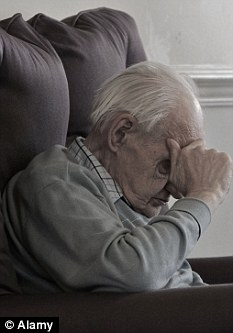
One in ten pensioners say they feel completely cut off from society, family and friends (picture posed by model)
Loneliness in old age should be recognised as a major health issue and be treated with the same urgency as obesity, campaigners will urge today.
Up to a million pensioners are suffering in silence on a daily basis in the UK, according to alarming figures.
Even more feel out of touch with the pace of modern life and one in ten say they feel completely cut off from society, family and friends.
The startling statistics – compiled by Age UK – come amid growing calls for the Government to do more to help the millions of pensioners who now live alone.
The number of people aged 60 or over hit 14 million for the first time last year and is expected to rise to 20 million by 2031.
Of those, five million say they now consider the television to be their only source of company.
More...At an international conference starting in Oxford today ministers will be urged to do more to tackle the problem of loneliness among the elderly.
- Postcode lottery that sees thousands of elderly denied vital care services to be abolished
- The Coalition's new care policy paves the way for the full nationalisation of retirement
Leading experts say they want tackling loneliness to be made an equivalent public health priority as obesity and smoking addiction.
To help, a new online aid will be launched this week and has been designed to help local health organisations and councils identify those at risk and prioritise the hardest to reach.
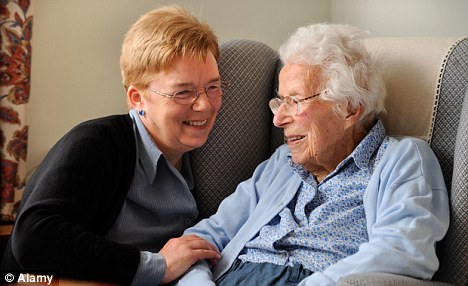
A study published last month found that 'feeling lonely' almost doubled the risk of an old person dying (picture posed by model)
Created by the Campaign to End Loneliness and funded by the Department of Health the ‘toolkit’ highlights current health research, offers briefing notes, factsheets, case studies, checklists, and scales to measure loneliness.
Last night, Paul Bairstow MP, minister for care services, said society needed to do more.
‘Too many people in our society, particularly older people, are cut-off and isolated,’ he said.
‘We need to do more as a society to recognise those at risk of loneliness and isolation and help them to stay connected.
‘Loneliness can have a significant impact on people’s health. Yet, unlike risks such as alcohol and obesity, it is still out of sight.
‘Relationships can help keep us well, and we can all play a part in tackling loneliness.’
There is now growing evidence that loneliness in old age is as bad for health as smoking and can increase the risk of developing Alzheimers by 50 per cent .
A study published last month by the University of California found that ‘feeling lonely’ almost doubled the risk of an older person dying. It also found loneliness was associated with functional decline.
Other research has found lonelinee can lead to poor mental, physical and emotional well-being and increased rates of cardiovascular disease, hypertension, cognitive decline and dementia.
Figures produced at the end of last year by Age UK show that as many as 500,000 elderly people spend Christmas Day alone whilst 17 per cent said they had less than weekly contact with family, friends and neighbours.
A dedicated national helpline for the elderly will be launched in the autumn.
TV presenter Esther Rantzen, 71, who created Childline, announced plans for The Silver Helpline last month.
Trained advisers will deal with a range of problems including loneliness and physical abuse in care homes.
‘There is nothing to me like the human voice,’ she said. ‘The Samaritans has proved that, ChildLine has proved that. Talking to someone over the phone can liberate you into revealing exactly how you feel ... and discovering you’re not the only person in world who feels that.’
Last night, Michelle Mitchell, Charity Director General of Age UK, said: ‘Living in isolation and loneliness is a stark reality for too many older people and can have a significantly adverse effect on their physical and mental health.
‘Studies have proved it can be equivalent to well established risk factors such as obesity and smoking.
‘Disability, illness, problems with finances and lack of access to transport often mean older people feel cut off from their family, friends and local community.
‘With the on-going crisis in provision of social care, older people are missing out on essential care that could be the difference between staying active and staying isolated.’
A spokeswoman for the Campaign to End Loneliness, who have organised this week’s conference with Age UK Oxfordshire, said: ‘Preventing loneliness could reduce health and social care costs, by preventing these health problems from occurring.’
Read more: http://www.dailymail...l#ixzz20FBGG1vP

Here is one very harrowing piece from the comments on said article:
Ian, gloucester 15.10. Whilst I agree with the first part of your post I would say that until you have known true loneliness, you will never understand. When all your relatives are dead, your friends dead, live amongst people who when one is able to set foot outside the door, pass you by as if you do not exist. When the only person you see from week to week is the internet grocery delivery driver. When you try to speak to strangers, just for some social contact, they are too busy or think that you're nuts because you dare to speak to a stranger. When you go for weeks, months without having a conversation with anyone; when you desperately would love to have a visitor, or go visit someone, there is no-one. When you've done 20 year's of voluntary work helping others, and when you need someone, there is no-one. When you cry because you are surrounded by people with families who have constant visitors, and you miss your family. Then and only then will you know what true loneliness is.
- waiting for god, lonely planet earth uk, 09/7/2012 16:44
Read more: http://www.dailymail...l#ixzz20FBiDsa7