This is from Kurzweilai.net
Stay cool and live longer?
Scientists have known for nearly a century that cold-blooded animals, such as worms, flies and fish all live longer in cold environments, but have not known exactly why
February 20, 2013
[+]
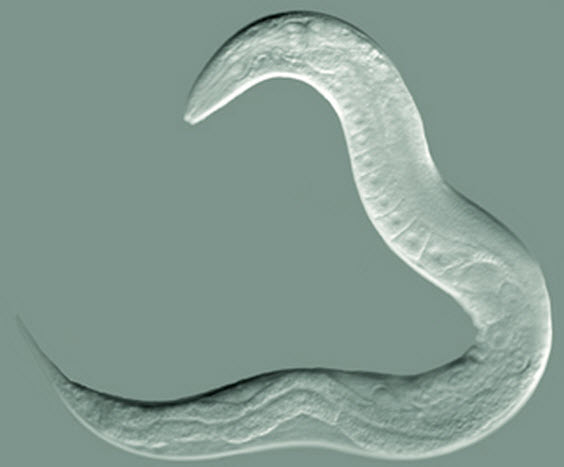
Roundworms’ life-extension secret: being cool (credit: The Goldstein Lab/UNC Chapel Hill )
Researchers at the University of Michigan Life Sciences Institute have identified a genetic program that promotes longevity of roundworms (nematodes) in cold environments — and this genetic program also exists in warm-blooded animals, including humans.
“This raises the intriguing possibility that exposure to cold air — or pharmacological stimulation of the cold-sensitive genetic program — may promote longevity in mammals,” said Shawn Xu, LSI faculty member and the Bernard W. Agranoff Collegiate Professor in the Life Sciences at the U-M Medical School.
Scientists had long assumed that animals live longer in cold environments because of a passive thermodynamic process, reasoning that low temperatures reduce the rate of chemical reactions and thereby slow the rate of aging.
“But now, at least in roundworms, the extended lifespan observed at low temperature cannot be simply explained by a reduced rate of chemical reactions,” Xu said. “It’s, in fact, an active process that is regulated by genes.”
Xu found that cold air activates a receptor known as the TRPA1 channel, found in nerve and fat cells in nematodes, and TRPA1 then passes calcium into cells. The resulting chain of signaling ultimately reaches DAF-16/FOXO, a gene associated with longevity. Mutant worms that lacked TRPA1 had shorter life spans at lower temperatures.
Possible in humans
Because the mechanisms identified by Xu and his collaborators also exist in a range of other organisms, including humans, the research suggests that a similar effect might be possible.
The study also links calcium signaling to longevity for the first time and makes a novel connection between fat tissue and temperature response.
Researchers have known that lowering the core body temperature of warm-blooded animals, such as mice, by 0.9 degrees Fahrenheit can extend lifespan by 20 percent, but it hasn’t been practical for humans to attempt to lower the core body temperature, Xu said.
“But if some aspects of the aging process are initiated in skin and fat cells in humans as they are in nematodes, should we go out to embrace some cold air in the winter?” Xu said.
Wasabi: secret sauce for life extension?
Xu added that in addition to cool temperatures, the spicy condiment wasabi activates TRPA1 as well, and that feeding wasabi to nematodes increases their life spans.
“Maybe we should be going to sushi restaurants more often,” he said.
Xu is a faculty member in the U-M Life Sciences Institute, where his laboratory is located and all his research is conducted. He is also an associate professor in the Department of Molecular and Integrative Physiology at the U-M Medical School.
Other authors on the paper were Rui Xiao and Yongming Dong of the Life Sciences Institute; Bi Zhang and Jianke Gong of the Life Sciences Institute and the College of Life Science and Technology at the Huazhong University of Science and Technology; Tao Xu of the College of Life Science and Technology at the Huazhong University of Science and Technology and the Institute of Biophysics, Chinese Academy of Sciences; and Jianfeng Liu of the College of Life Science and Technology at the Huazhong University of Science and Technology.
This work was supported by the Program of Introducing Talents of Discipline to Universities from the Ministry of Education of China, the National Natural Science Foundation of China, and the National Institute of General Medical Sciences and National Institute of Aging, both of the National Institutes of Health.
References:
Shawn Xu,
http://www.ncbi.nlm....pubmed/23415228
Cell. 2013 Feb 14;152(4):806-17. doi: 10.1016/j.cell.2013.01.020.
A Genetic Program Promotes C. elegans Longevity at Cold Temperatures via a Thermosensitive TRP Channel.
Xiao R, Zhang B, Dong Y, Gong J, Xu T, Liu J, Xu XZ.
Source
Life Sciences Institute, University of Michigan, Ann Arbor, MI 48109, USA.
Abstract
Both poikilotherms and homeotherms live longer at lower body temperatures, highlighting a general role of temperature reduction in lifespan extension. However, the underlying mechanisms remain unclear. One prominent model is that cold temperatures reduce the rate of chemical reactions, thereby slowing the rate of aging. This view suggests that cold-dependent lifespan extension is simply a passive thermodynamic process. Here, we challenge this view in C. elegans by showing that genetic programs actively promote longevity at cold temperatures. We find that TRPA-1, a cold-sensitive TRP channel, detects temperature drop in the environment to extend lifespan. This effect requires cold-induced, TRPA-1-mediated calcium influx and a calcium-sensitive PKC that signals to the transcription factor DAF-16/FOXO. Human TRPA1 can functionally substitute for worm TRPA-1 in promoting longevity. Our results reveal a previously unrecognized function for TRP channels, link calcium signaling to longevity, and, importantly, demonstrate that genetic programs contribute to lifespan extension at cold temperatures