#121 OFFLINE
Posted 10 February 2012 - 07:01 AM
#122 OFFLINE Re: Exercise & Aging
Posted 30 April 2012 - 07:28 PM
#123 OFFLINE Re: Exercise & Aging
Posted 03 May 2012 - 07:31 PM
#124 OFFLINE Re: Exercise & Aging
Posted 04 May 2012 - 12:50 AM
Mind, on 03 May 2012 - 07:31 PM, said:
And note how little it takes:
Quote
Since this is the optimum, running longer will be less good for you, and eventually you will get to a point where running is harming your health even more than doing nothing. The next time you see a car with a "26.2" or "13.1" sticker on it, indicating that the driver runs marathons or half marathons, you might wonder if instead they should have a sticker that says "I'm killing myself with sport"... Maybe they are.
#125 OFFLINE Re: Exercise & Aging
Posted 06 May 2012 - 08:25 PM
niner, on 04 May 2012 - 12:50 AM, said:
Mind, on 03 May 2012 - 07:31 PM, said:
And note how little it takes:
Quote
Since this is the optimum, running longer will be less good for you, and eventually you will get to a point where running is harming your health even more than doing nothing. The next time you see a car with a "26.2" or "13.1" sticker on it, indicating that the driver runs marathons or half marathons, you might wonder if instead they should have a sticker that says "I'm killing myself with sport"... Maybe they are.
I agree with you but OTH I think it's a question of how you want to live your life.. "Tyrell" puts it pretty well in this magnificent film
Edited by klantskalle, 06 May 2012 - 08:26 PM.
#126 OFFLINE Re: Exercise & Aging
Posted 05 August 2012 - 12:51 PM
niner, on 04 May 2012 - 12:50 AM, said:
Quote
Since this is the optimum, running longer will be less good for you, and eventually you will get to a point where running is harming your health even more than doing nothing. The next time you see a car with a "26.2" or "13.1" sticker on it, indicating that the driver runs marathons or half marathons, you might wonder if instead they should have a sticker that says "I'm killing myself with sport"... Maybe they are.
I don't think that's completely correct. The Copenhagen City study found that in perspective especially to CVD, high amounts of exercise decrease the risk a lot more than moderate amounts, and in general higher amount is better. Why they say jogging in moderation is better, I don't know, there's dozens of things that can be used to explain the phenominon and I haven't seen the full study yet.
Quote
Men with high physical activity survived 6.8 years longer, and men with moderate physical activity 4.9 years longer than sedentary men. For women the figures were 6.4 and 5.5 years, respectively. http://www.ncbi.nlm....pubmed/16575269
It has also been noted that elite athletes have longer lifespans than general population, especially if they participate in endurance-style training:
Quote
In conclusion, I don't think you have to worry about exercising too much
#127 OFFLINE Re: Exercise & Aging
Posted 06 August 2012 - 07:54 PM
#128 OFFLINE Re: Exercise & Aging
Posted 20 August 2012 - 11:09 AM
#129 OFFLINE Re: Exercise & Aging
Posted 20 August 2012 - 04:57 PM
johnross47, on 06 August 2012 - 07:54 PM, said:
I'm just as guilty as you of going a little farther and sometimes I'll just feel good and run a 1/2 marathon. Later I feel rather hungry and almost always over eat to compensate. I consider it optimal if I limit myself to around 20 km per week of running.
I asked Dr. Luigi Fontana why elite athletes are not represented in centenarian cohorts. His response was that prolonged aerobic exercise over time damages the nerve tissues to the heart and causes arrhythmia and that most older athletes don't die from atherosclerosis, but rather from heart arrhythmia problems. So, exercise can really cause trouble. However, for the average person an daily walk or run a few times a week or similar exercise is probably good. More is not always better.
#130 OFFLINE Re: Exercise & Aging
Posted 20 August 2012 - 07:39 PM
#131 OFFLINE Re: Exercise & Aging
Posted 21 August 2012 - 01:07 AM
johnross47, on 20 August 2012 - 07:39 PM, said:
A few 'totally fit' athletes bite the dust every year. Skipped beats could be sodium, magnesium, or other deficiencies so I'd get it checked out.
It's fairly easy to do a self test with a little Celtic sea salt after a run with your water though. If it's sodium the effect should be pretty quick. Magnesium or other nutrients may take more time to normalize.
#132 OFFLINE Re: Exercise & Aging
Posted 21 August 2012 - 07:27 PM
According to cron-o-meter most of my minerals are ok, unless I have absorbtion issues or something, but my diet is low on the salt so maybe I'll try that.
#133 OFFLINE Re: Exercise & Aging
Posted 30 August 2012 - 07:19 AM
#134 OFFLINE Re: Exercise & Aging
Posted 23 October 2012 - 11:57 AM
Regular exercise, much like calorie restriction, has a beneficial effect on near all measures of aging in humans - though unlike calorie restriction it doesn't increase maximum life span in laboratory animals. Here is a reminder that decline in brain function is slowed by exercise:
The new research included about 700 people living in the United Kingdom who all had brain scans when they reached the age of 73. Three years earlier, at age 70, the study participants were questioned about the leisure and physical activities they engaged in. People in the study who reported being the most physically active tended to have larger brain volumes of gray and normal white matter, and physical activity was linked to less brain atrophy. Regular exercise also appeared to protect against the formation of white matter lesions, which are linked to thinking and memory decline.[In another study, researchers] recruited 120 older inactive adults with no evidence of dementia. ... Half began a modest exercise routine that included walking at a moderate pace for 30 to 45 minutes, three times a week. The other half did stretching and toning exercises. A year later, MRI brain scans showed that a key region of the brain involved with memory, known as the hippocampus, was slightly larger in the walking group, while it has shrunk slightly in the non-aerobic stretching group.
"The old view is that as we get older our brains become less malleable and less able to change. The new view is that it remains plastic even very late in life. We were able to show positive change after just one year of moderate-intensity physical activity."
Link: http://www.webmd.com/healthy-aging/news/20121022/exercise-protects-aging-brains-better
<br> <br>View the full article
#135 OFFLINE Re: Exercise & Aging
Posted 30 October 2012 - 01:45 PM
Following on from a recent post on exercise and the aging brain, here is yet another study to show that improvements in cognitive function can be brought about by regular exercise and its consequent effects on body composition, metabolism, and other line items. Use it or lose it, as they say:
A regular exercise routine can make you fitter than ever - mentally fit. In a new study, previously sedentary adults were put through four months of high-intensity interval training. At the end, their cognitive functions - the ability to think, recall and make quick decisions - had improved significantly.Blood flow to the brain increases during exercise. The more fit you are, the more that increases. The pilot [study] looked at adults, average age 49, who were overweight and inactive. [Researchers] measured their cognitive function with neuropsychological testing, as well as their body composition, blood flow to the brain, cardiac output and their maximum ability to tolerate exercise.
The subjects then began a twice-a-week routine with an exercise bike and circuit weight training. After four months - not surprising - their weight, body mass index, fat mass and waist circumference were all significantly lower. Meanwhile, their capacity to exercise (measured by VO2 max) was up 15 per cent.
Most exciting, [cognitive function] had also increased, based on follow-up testing. These improvements were proportional to the changes in exercise capacity and body weight. Essentially, the more people could exercise, and the more weight they lost, the sharper they became.
Link: http://www.eurekalert.org/pub_releases/2012-10/hasf-eis102212.php
<br> <br>View the full article
#136 OFFLINE Re: Exercise & Aging
Posted 07 November 2012 - 12:08 PM
In recent years a number of studies have tried to put numbers to the gains in life expectancy that might accompany exercise. Here is another:
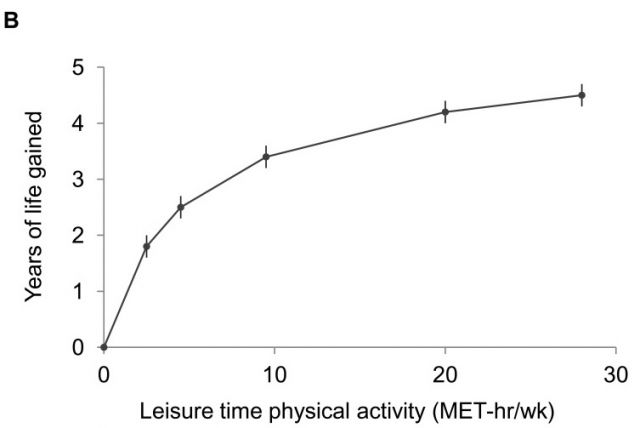
In pooled data from six prospective cohort studies, the researchers examined associations of leisure-time physical activity of a moderate to vigorous intensity with mortality. They analyzed data from more than 650,000 subjects and followed subjects for an average of ten years - analyzing over 82,000 deaths.Participation in a low level of leisure time physical activity of moderate to vigorous intensity, comparable to up to 75 min of brisk walking per week, was associated with a 19 percent reduced risk of mortality compared to no such activity. Assuming a causal relationship, which is not specifically demonstrated in this research, this level of activity would confer a 1.8 year gain in life expectancy after age 40, compared with no activity. For those who did the equivalent to 150 min of brisk walking per week - the basic amount of physical activity currently recommended by the federal government - the gain in life expectancy was 3.4 years.
Participants faring best were those who were both normal weight and active: among normal weight persons who were active at the level recommended by the federal government, researchers observed a gain in life expectancy of 7.2 years, compared to those with a BMI of 35 or more who did no leisure time physical activity.
You might compare these results to those obtained from a study of highly trained athletes and work examining jogging and life expectancy.
Link: http://www.eurekalert.org/pub_releases/2012-11/bawh-paa110512.php
<br> <br>View the full article
#137 OFFLINE Re: Exercise & Aging
Posted 07 November 2012 - 07:06 PM
Quote
No surprise here. If you are over weight and sit around all day, you can expect to live 7.2 years less than someone who is normal weight and gets a few minutes of exercise per day.
Edited by Mind, 07 November 2012 - 07:06 PM.
#138 OFFLINE Re: Exercise & Aging
Posted 21 November 2012 - 10:01 PM
#139 OFFLINE Re: Exercise & Aging
Posted 22 November 2012 - 08:54 AM
http://well.blogs.ny...nd-to-exercise/
I think Dr. Timmons can be seen in a BBC doc on this topic, it's on youtube.
#140 OFFLINE Re: Exercise & Aging
Posted 22 November 2012 - 09:40 PM
okok, on 22 November 2012 - 08:54 AM, said:
Well, this study (the one we're talking about) still puts the benefit at around 2 y for minimal exercise:
Quote
This really isn't that far out of most other studies:
Quote
And just 'cause this study is the newest, doesn't mean its somewhat high numbers are the most reliable.
Someone is going to say, reasonably enough (without looking at the paper), "Oh, come on: an hour of brisk walking a day? What about high-intensity workouts?" Remembering, first, that what the definition of a MET suggests, and what the HIIT and other research mostly shows, is that one gets similar metabolic benefits from shorter duration, higher-intensity exercise as from longer duration, lower-intensity exercise. So eg. 22.5+ MET-h/wk is also what's achieved by ~3 h of jogging/wk, or half an hour's worth 6 days a week. Recall, also, that the data on measured cardiorespiratory fitness (as opposed to self-reported physical activity) from Blair's Cooper Institute of Aerobics studies and others pretty clearly show that there is a rapid tailing-off of benefits on CVD and mortality not long after one moves from being completely sedentary to being minimally fit -- not, as one might think, a near-linear continuation of greater and greater benefit with increasing cardiorespiratory fitness (or, as some might imagine, a nonlinear further increase of benefit at high levels of activity).
The new study's results are entirely consistent with that body of research, with most of the benefit obtained at 10 Met-h/wk, and little marginal gain in going from 22.5 MET-h/wk to 30:
Quote
And the Copenhagen City Heart Study has apparently found an inverted u-shaped dose-response to jogging on mortality:
Quote
More on the Copenhagen City Heart Study in a post in the CR Society Archives which are, unfortunately, down at the moment; I'll link it when they're up again.
Reference
Leisure time physical activity of moderate to vigorous intensity and mortality: a large pooled cohort analysis.
Moore SC, Patel AV, Matthews CE, Berrington de Gonzalez A, Park Y, Katki HA, Linet MS, Weiderpass E, Visvanathan K, Helzlsouer KJ, Thun M, Gapstur SM, Hartge P, Lee IM.
PLoS Med. 2012 Nov;9(11):e1001335. doi: 10.1371/journal.pmed.1001335. Epub 2012 Nov 6. PMID: 23139642
Edited by Michael, 22 November 2012 - 09:45 PM.
#141 OFFLINE Re: Exercise & Aging
Posted 23 November 2012 - 04:40 PM
Edited by okok, 23 November 2012 - 04:48 PM.
#142 OFFLINE Re: Exercise & Aging
Posted 27 November 2012 - 11:08 PM
Reason is a sage and poet:
Quote
#143 OFFLINE Re: Exercise & Aging
Posted 14 December 2012 - 06:42 PM
and low intensity sports-some apparent small advantage in power sports.
Overall, I think the important message is to be active, no matter what it might be!
http://health.usnews...vival-advantage
#144 OFFLINE Re: Exercise & Aging
Posted 26 February 2013 - 12:32 PM
A number of studies have shown that it is possible to be both old and very healthy in comparison to your peers, and surveying older athletes is a good way to find some of those old, very healthy people. The big question is one of causation: are they healthy because they are athletes, or did they become healthy athletes because they are more physically robust, thanks to genetic or other differences? This is a part of the uncertainty over whether more exercise is always better and the degree to which genetics versus lifestyle versus chance contributes to the course of aging.
People who exercise on a regular basis up to the age of 80 have the same aerobic capacity as someone half their age, says a new study. "These athletes are not who we think of when we consider 80-year-olds because they are in fantastic shape. They are simply incredible, happy people who enjoy life and are living it to the fullest. They are still actively engaged in competitive events."Researchers examined nine endurance athletes from northern Sweden and compared them to a group of healthy men from Indiana in the same age group who only performed the activities of daily living with no history of structured exercise. The endurance athletes were cross-country skiers, including a former Olympic champion and several national/regional champions with a history of aerobic exercise and participation in endurance events throughout their lives. The athletes exercised four to six times a week, averaging 3,700 more steps per day than the non-exercisers.
Members of the two study groups rode exercise bikes as researchers measured oxygen uptake. When the participants reached total exhaustion, they had reached maximum oxygen uptake (also known as VO2 max). Skeletal muscle biopsies were then taken to measure the capacity of their mitochondria, the aerobic base of their muscle and other cells. The study also found the endurance athletes established new upper limits for aerobic power in men 80-91 years old, including a maximum oxygen uptake that was nearly twice that of untrained men their age.
"To our knowledge, the VO2 max of the lifelong endurance athletes was the highest recorded in humans in this age group, and comparable to nonendurance-trained men 40 years younger. We also analyzed the aerobic capacity of their muscles by examining biopsies taken from thigh muscles, and found it was about double that of typical men. In fact, the oldest gentleman was 91 years old, but his aerobic capacity resembles that of a man 50 years younger. It was absolutely astounding."
Link: http://cms.bsu.edu/news/articles/2013/2/80-could-be-the-new-40
<br> <br>View the full article
#145 OFFLINE Re: Exercise & Aging
Posted 08 April 2013 - 09:55 PM
The weight of scientific evidence tells use that regular moderate exercise is very beneficial; aside from calorie restriction, it is the best thing that basically healthy people can do for themselves. No presently available medical technology surpasses the benefits of exercise and calorie restriction for long term health for the vast majority of the population - which is a strange thing to be saying in the midst of modern medicine and biotechnology. Strange but nonetheless true. This is a state of affairs we'd all like to see change for the better, via the introduction of new biotechnologies of rejuvenation, therapies that can be envisaged in some detail today, and which (if research and development is well funded) lie only a few decades ahead of us.
Near enough to matter, but still out of reach. So at this point exercise and calorie restriction are all that most of us have to work with to increase the odds of you still being alive to benefit from future rejuvenation therapies. It has to be said that the odds are not going to be moved to anywhere near the degree they would if a very large amount of funding arrived at the SENS Research Foundation, thus speeding up progress towards clinical reversal of age-related degeneration, but most of us are not in a position to make that happen.
The benefits of exercise are very broad, much like those offered by calorie restriction. It impacts mechanisms and the speed of change throughout the body and the aging process. On this topic, I recently noticed a couple of papers that note two small aspects of the interaction of exercise and aging, one in mice, and one in we humans. In mouse studies, it's quite possible to show that exercise causes numerous health benefits: mice are short-lived and thus researchers can follow them all the way through their lives:
Enhanced Diastolic Filling Performance with Lifelong Physical Activity in Aging Mice
Fourteen C57Bl/6J mice (seven male and seven female) were individually housed at eight weeks of age in cages with a running wheel, magnetic sensor and digital odometer. Duration, distance and running velocity were recorded daily. Fourteen additional mice C57Bl/6J mice (seven male and seven female) were placed in individual cages without running wheels at eight weeks of age. [Ultrasound techniques] were used to image the left ventricle every four weeks throughout the lifespan.Lifelong physical activity resulted in greater diastolic filling parameters by the second quarter of the lifespan highlighting the clinical importance of regular aerobic activity in young adulthood as a mechanism for improved left ventricular performance with aging.
In the case of humans a research group must instead work with shorter snapshots of time, drawing data from existing populations with their quirks and histories. Given that, it is much harder to prove the degree to which exercise causes good health and slower aging versus only being associated with these line items.
The study was conducted on a subgroup population of the IKARIA study consisting of 185 middle-aged (40-65 years) and 142 elderly subjects (66-91 years). Endothelial function was evaluated by ultrasound measurement of flow-mediated dilatation (FMD).In the overall study population FMD was inversely associated with age and middle-aged subjects had higher FMD compared with the elderly. Multiple linear regression analysis revealed that among middle-aged subjects the physically active had higher FMD compared with the physically inactive. Physically active subjects in the middle-aged group showed higher FMD compared with the physically active elderly. However, there was no difference in FMD values between middle-aged inactive subjects and the elderly physically active.
The present study revealed that increased [physical activity] was associated with improved endothelial function in middle-aged subjects and that [physical activity] in elderly subjects can ameliorate the devastating effects of ageing on arterial wall properties.
The full PDF version of the Ikaria study paper quoted above is available, so you can judge for yourself just how justified the authors' conclusion might be. Causation is hard to demonstrate - but the general presumption is that the causation shown in animal studies is also operating in human ones when it comes to things like exercise and cardiovascular health in aging. Proving and then putting numbers to that presumption are the challenges.
<br> <br>View the full article
Also tagged with one or more of these keywords: exercise, longevity
0 user(s) are reading this topic
0 members, 0 guests, 0 anonymous users